Sales Budget Planning for 2027: What to Fund, and In What Order
Written by: Mike Carroll

Quick Answer: Most sales budgets are assembled as a shopping list, with headcount, tools and training each justified on their own merits. The order matters more than the list does, because each of those investments assumes something the one before it was supposed to deliver. Getting the sequence wrong is how a fully funded plan produces a flat year, and it is also why the same line items reappear in the following budget.
Key Takeaways
- A budget is a sequence, not a list. Fund a tool before the habits exist, and you have paid for better reporting on the same behavior.
- Every line item carries an assumption. Writing that assumption down next to the number is the cheapest diligence available.
- Growth has an operational ceiling. A sales plan that outruns what the rest of the business can deliver stalls in a way no sales fix will touch.
- Build the checkpoints before January. Revenue arrives too late to steer by, so the budget needs earlier signals written into it.
What Should You Fund First in a 2027 Sales Budget?
Fund the thing the next item depends on, and keep going in that order.
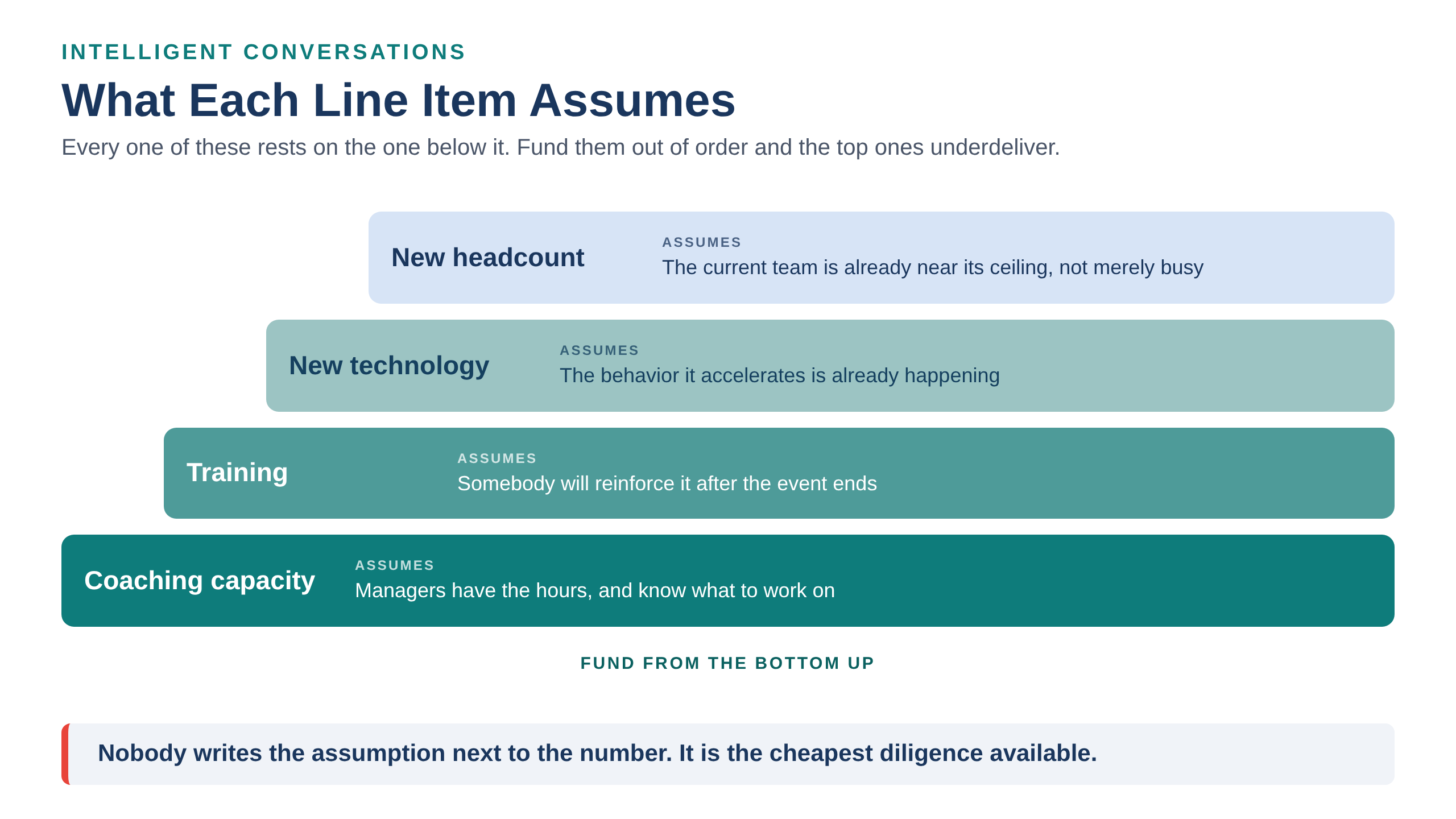
Three line items dominate most sales budgets, and each one quietly assumes the others are already handled. That assumption is almost never written down, which is why it is almost never checked.
|
Line item |
What it quietly assumes |
What happens if the assumption is wrong |
|---|---|---|
|
New headcount |
The current team is already performing near its ceiling |
The new hire inherits the same conditions and produces the same result, at full cost |
|
New technology |
The behavior the tool accelerates already exists |
You get a faster version of what was happening anyway, plus a renewal |
|
Training |
Somebody will reinforce it after the event |
Awareness for a few weeks, then the old habits, then the same line item next year |
|
Coaching capacity |
Managers have time and know what to work on |
The structure exists on paper and loses to the week |
Read down the assumption column and the sequence builds itself. Coaching capacity has to come before training, because training without reinforcement is a recurring expense rather than an investment. Behavior has to exist before technology accelerates it. And headcount only makes sense once the current team is genuinely near its limit rather than merely busy.
That last one is where the most money goes astray. A salesperson with real potential who has never been coached properly costs a fraction of a new hire and usually carries more upside. Sales Coaching ROI: Why the Middle of Your Team Returns the Most covers where that untapped capacity normally sits, and it is rarely where the attention is.
Before the requisition opens, the honest question is whether the current team cannot be moved, or whether nobody has seriously tried.
Can Your Operation Actually Absorb the Growth You Are Planning?
This is the question that gets skipped entirely, and it is the one that stops a good year dead.
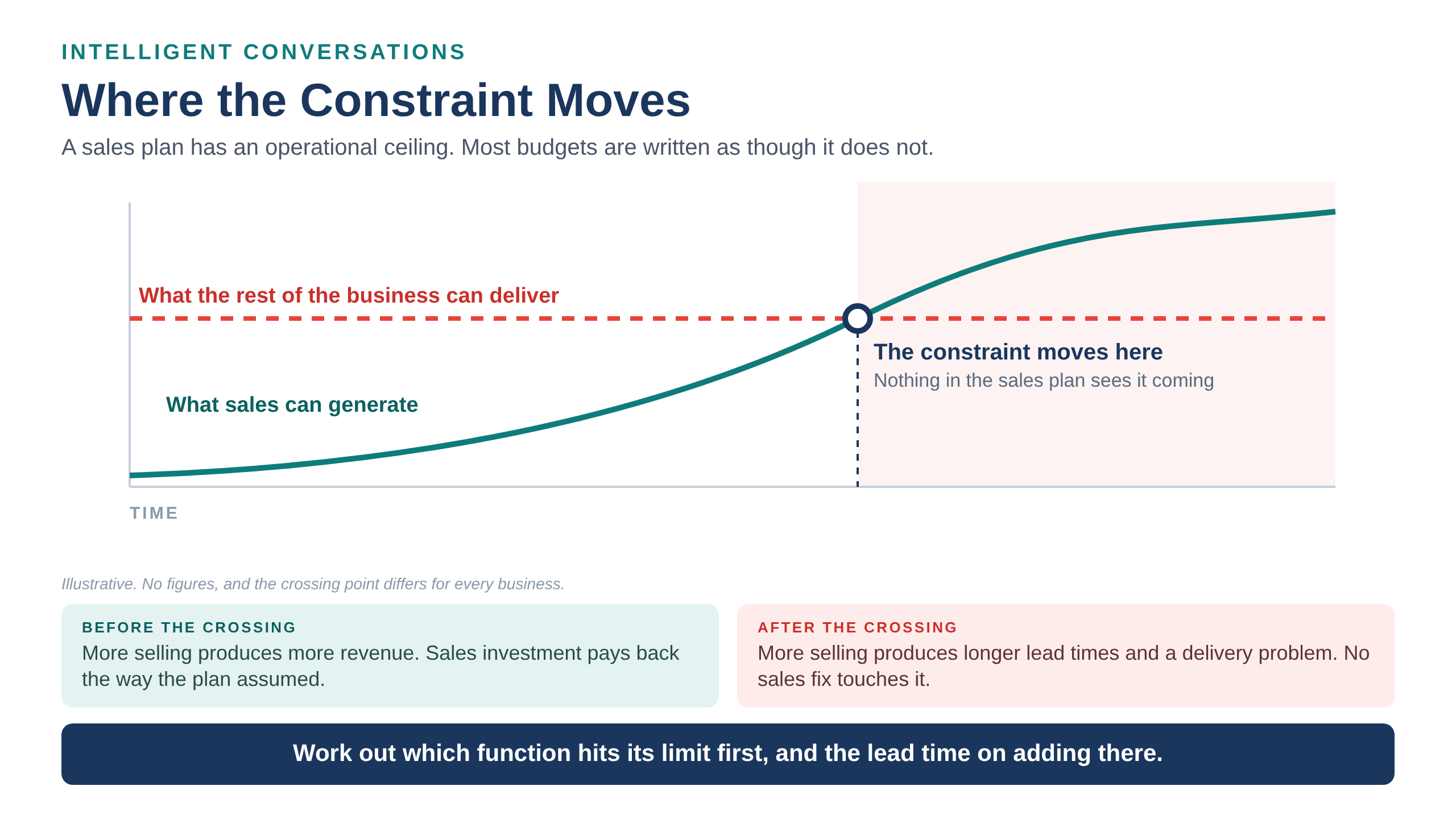
Sales budgets are built as though the rest of the business is infinitely elastic. It is not. Engineering, support, fulfilment, onboarding and service all have a throughput limit, and a sales team that beats its number finds that limit before anyone in the planning meeting does.
One client ended up pausing an active sales program for several months for exactly this reason. The team had become genuinely effective at generating new opportunities, and operations could not keep pace with what was being sold. Nobody on the sales side had done anything wrong. The constraint simply moved, and nobody had planned for where it would move to.
Worth putting on the agenda before the number is locked:
- What specifically would be different if the company were meaningfully larger next year? Not a feeling. Which function hits its limit first, and at roughly what volume.
- Who owns the handoff after the sale closes? Growth usually breaks at the seams between functions rather than inside them.
- What is the lead time on the capacity you would need? Hiring an engineer or a service lead takes longer than hiring a salesperson, so that decision has to be made earlier, not later.
- Would you rather sell less and deliver well, for one year? An unpopular question, and occasionally the right answer.
A sales target that the business cannot fulfil does more damage than a conservative one. The deals still close, the delivery slips, and the reputation cost lands on the same salespeople who were praised in January.
How Do You Build Checkpoints Into the Budget?
Decide in November what you will look at in March, because revenue will not tell you in time.
The structural problem with a sales budget is that the number it is judged by arrives after the money is spent and after the year is largely decided. Lagging Indicators in Sales: Why Your Revenue Number Is Lying to You covers why that number confirms a problem months after the behavior that caused it.
The fix is to name the earlier signals now, while the plan is still being written, and attach them to specific dates:
|
When |
What to look at |
What it tells you |
|---|---|---|
|
Day 30 |
Whether the new rhythm survived contact with a normal week |
Whether anything actually changed, or only the slide deck |
|
Day 90 |
First meetings generated, how early weak deals get dropped |
Whether behavior moved, which is the only thing that can move revenue later |
|
Day 180 |
Pipeline shape, stage-to-stage conversion, forecast accuracy |
Whether the behavior is converting into something you can plan on |
|
Month 12 |
Revenue and margin |
Confirmation, long after the decisions that produced it |
Net-New Meetings: How to Track the Indicator That Predicts Next Quarter covers how to define the day-90 number so it means the same thing every week, which is what makes it usable as a checkpoint rather than another metric.
Checkpoints written into the budget change what a mid-year review can do. A problem visible in March can still be fixed inside the year. The same problem discovered in November becomes next year's budget request.
What Should You Decide Before January?
Four decisions, none of which require more money to make.
- Establish a baseline before the first dollar moves. What the team can currently do, and what is in the way, is the input every other decision depends on. Guessing at it is what funds the wrong line item.
- Separate the diagnosis from the purchase. The fastest way to buy the wrong thing is to decide what you want and then look for evidence. Before You Invest in Your Sales Team, Answer These 5 Questions covers the diagnostic questions worth answering first.
- Decide what gets measured weekly. If revenue is the only number the team sees, revenue is the only thing that will change. Not All Revenue Is Equal: How to Find Where Your Margin Actually Lives covers why the revenue ranking and the margin ranking are rarely the same list.
- Name the capacity ceiling and who owns it. Including the date by which the supporting hires would need to start.
The 12-Week Playbook lays out the sequence from baseline to a single play to a measurable result, which is the shape this whole post is arguing a budget should follow.
Get the 12-Week Playbook
A budget built on last year's revenue tends to repeat last year's decisions with next year's money. This playbook covers how to set a baseline before the plan is locked, find the one or two things that would actually move the number, and build the checkpoints that tell you by March whether it is working.

Frequently Asked Questions



What Your Sales Manager Sees vs. What the Data Says
Quick Answer: A sales manager watching a salesperson can see what happened, but not why it happened, and that gap is ...
Ready to Build a High-Performing Sales Team?
Let's create your custom Sales Transformation Program.