Sales Coaching ROI: Why the Middle of Your Team Returns the Most
Written by: Mike Carroll

Quick Answer: Most coaching time goes to the two groups that benefit from it least. Top performers largely self-correct, and the people at the bottom often have a problem coaching was never going to solve. The group in the middle has the fundamentals, takes feedback, and has plateaued mainly for lack of attention, which makes it the one tier where a modest improvement spreads across enough people to move the number.
Key Takeaways
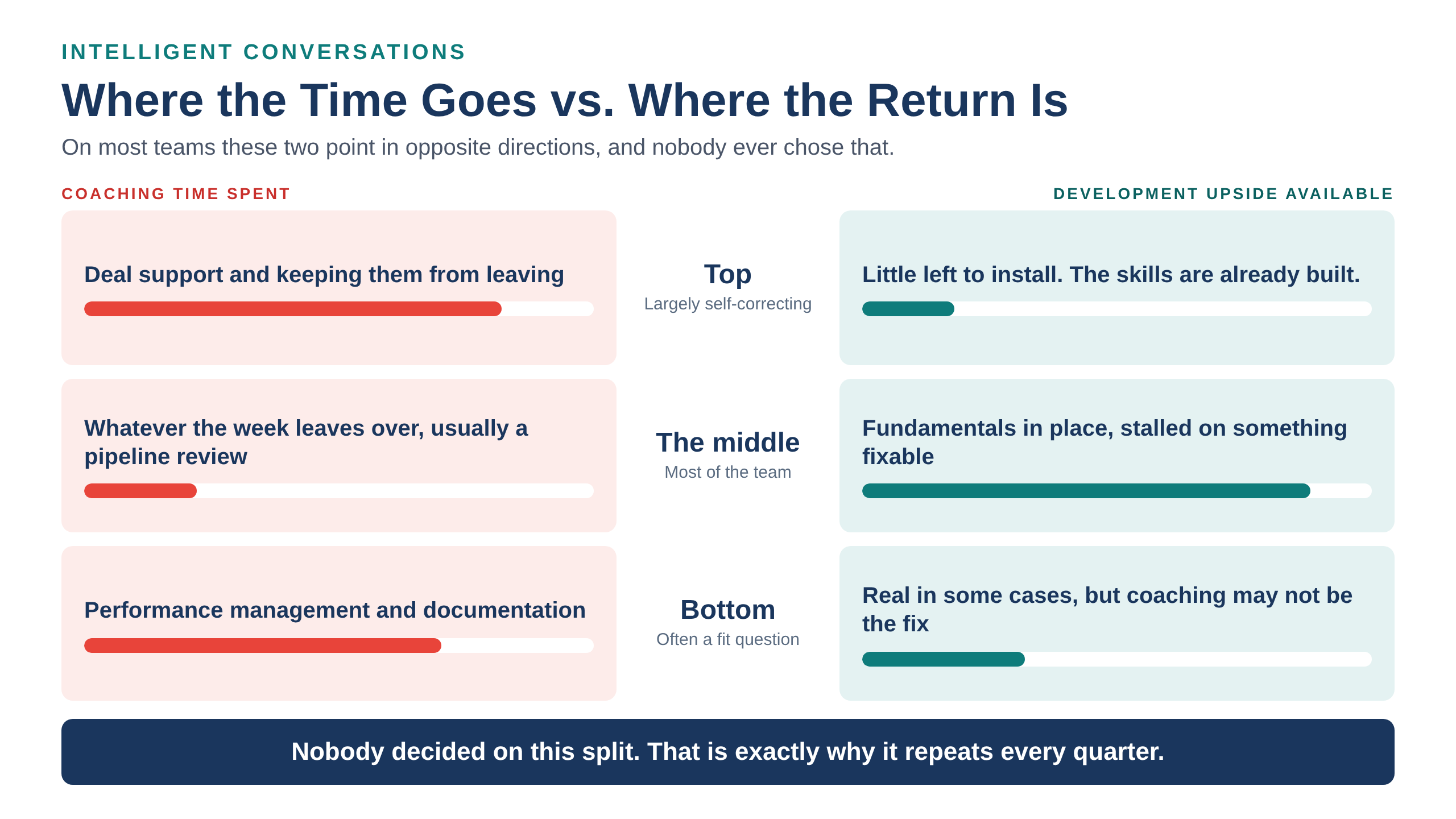
- Coaching time follows urgency, not return. The top gets retention attention, the bottom gets documentation, and the middle gets whatever is left after the week's fires.
- Top performers are the most expensive place to spend coaching hours. They were going to diagnose and fix most of it themselves.
- The middle is where the arithmetic works, because a small lift multiplied across most of the team beats a large lift on one person.
- This is an allocation decision, not a coaching-skill problem. It can be changed in a week and costs nothing.
Where Does Sales Coaching Time Actually Go?
It goes to whoever is loudest that week, and that is almost never the middle of the team.
Ask a sales manager to account for their coaching hours over the last month and the pattern is consistent across most teams. The top performer got time because they are closing the big deal and nobody wants to lose them. The struggling salesperson got time because the situation is urgent and probably needs documenting. Everybody else got a pipeline review.
|
Tier |
What pulls the manager's attention |
What that time actually is |
What it returns |
|---|---|---|---|
|
Top performers |
Big deals in flight, flight risk, visibility with leadership |
Retention and deal support |
Little development, because the skills are already there |
|
The middle |
Nothing urgent, nothing on fire |
Usually a pipeline review |
The most available upside, rarely claimed |
|
Bottom performers |
Missed numbers, escalations, a decision coming |
Performance management |
Sometimes a turnaround, often a conclusion already reached |
None of that is irrational. Each of those calls on a manager's time is real, and in any given week the urgent ones win. The problem is that the same thing happens the following week, and the quarter after that, so the tier with the most room to improve is the one that consistently gets the least help.
Why Do Top Performers Return the Least on Coaching Time?
Because they already do most of what coaching is designed to install.
A strong salesperson notices when their own pipeline is thinning, adjusts when a market shifts, and asks for help on the specific thing they are stuck on rather than waiting for a scheduled conversation. Time spent with them is genuinely valuable, but most of it is deal support and relationship maintenance rather than skill development.
That is worth naming honestly, because it changes what the time is for:
- Deal support helps one deal close. It does not change what the salesperson does next quarter.
- Retention attention keeps somebody from leaving. Important, and not the same thing as making them better.
- Development changes behavior that repeats. This is the only one that compounds, and it is the rarest of the three.
None of this argues for ignoring the strongest people on the team. It argues for counting the hours honestly. A manager who believes they spend half their coaching time on development, and who actually spends most of it protecting revenue already in motion, is working from a picture of their own week that is not accurate.
What Your Sales Manager Sees vs. What the Data Says covers why that gap between what a manager thinks they see and what is actually happening is so hard to close from observation alone.
What Makes the Middle the Highest-Return Group?
Arithmetic, mostly.
The case for the middle is not sentimental and it does not require believing those salespeople are secretly excellent. It only requires multiplication.
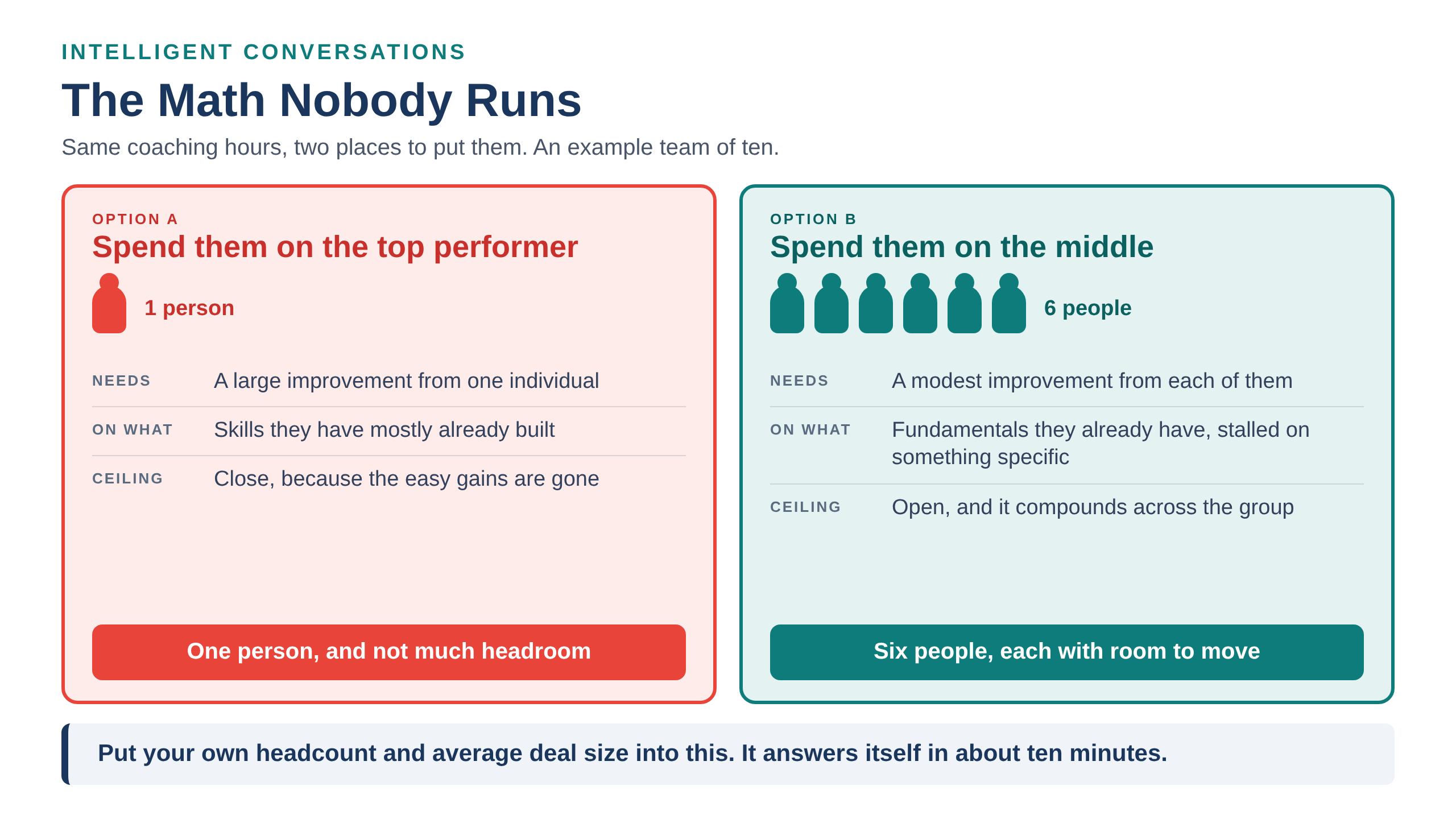
Take a team of ten. One top performer, six in the middle, three struggling. A manager has a fixed number of coaching hours and has to decide where they go.
|
Where the hours go |
What has to happen to move the number |
How likely that is |
|---|---|---|
|
The top performer |
One person improves substantially, on skills they have mostly already built |
Low, and the ceiling is near |
|
The three at the bottom |
Three people improve substantially, when some of them may be in the wrong seat |
Mixed, and slow |
|
The six in the middle |
Six people improve modestly, on fundamentals they already have |
Much higher, and it compounds |
Run that with your own team's numbers rather than taking the shape of it on faith. Put your actual headcount in each tier next to your actual average deal size, and the comparison answers itself in about ten minutes.
What makes the middle respond is not talent. It is that they show up, take feedback without defensiveness, and have usually plateaued on something specific and fixable, like how early they qualify or whether they ask for the next step directly. Those are coachable in weeks, not quarters.
How Do You Redirect Coaching Time Without Losing Anyone?
Name the split out loud, then protect it in the calendar.
This is one of the few changes in a sales organization that costs nothing and can start on Monday:
- Separate retention conversations from development ones. Both belong on the calendar. Labelling them differently stops the first from quietly eating the budget for the second.
- Decide the split in advance and write it down. A manager who has not decided where the hours go will spend them on whatever is loudest, every time.
- Pick two or three themes for the middle group, not ten. A focused list is what makes the time repeatable instead of improvised week to week.
- Protect the hours before the quarter starts. Coaching time that exists only when nothing is on fire does not exist.
- Check what the data says before choosing the themes. Guessing at what the middle needs tends to produce coaching on whatever the manager personally found hard when they were selling.
That last point is where most redirections fail. Moving the time is easy. Knowing what to do with it once it has moved is the harder half, and it is the part a baseline answers.
Top Sales Performer vs. Best Salesperson: The Gap covers a related trap, which is using revenue rank to decide who deserves the investment in the first place.
The 12-Week Playbook lays out the sequence, from establishing a baseline to picking the one or two themes worth working first.
Get the 12-Week Playbook
Deciding where coaching time goes is easier than deciding what to do once it gets there. This playbook covers both, from setting a baseline on the team to picking the one or two themes worth working first, so the hours land on something specific instead of another pipeline review.

Frequently Asked Questions



Top Sales Performer vs. Best Salesperson: The Gap
Quick Answer: The salesperson producing the most revenue on your team isn't automatically your best one, because ...
Ready to Build a High-Performing Sales Team?
Let's create your custom Sales Transformation Program.