The 12-Week Sales Manager Playbook
Written by: Mike Carroll

Every costly sales investment, whether it's a new hire, a new CRM, or another training program, tends to disappoint for the same reason: it was made before anyone established a baseline. Revenue is a lagging indicator, and it hides everything a sales leader actually needs to know. The 12-week playbook described here starts with a deep analysis of the team, surfaces the one or two levers that genuinely matter, and builds a tailored coaching plan from what the data says, not from what the consultant assumes or what worked somewhere else.
Key Takeaways
- Revenue tells you what already happened. Net-new meetings tell you what happens next quarter.
- The highest revenue producer on a team is often not the best salesperson. Territory, tenure, and inherited accounts inflate the number.
- Objective data and observational data are not competing. Objective data tells a manager what patterns to watch for; observation confirms them.
- Training without a coaching system evaporates within six weeks. The system is what makes the content stick.
- Before buying a new tool, a new hire, or another training program, the right first step is establishing a baseline. That means knowing what the data actually says about the team.
Why does revenue keep lying to Sales Leaders?
Revenue is the number every CEO stares at, and that is precisely the problem: it only reflects what already happened.
A team can have a strong Q3 because of pipeline built in Q1 and Q2. The revenue number in September says nothing about what Q4 looks like. Conversely, a team that starts shifting its behavior in August (more net-new meetings, cleaner pipeline, better-qualified opportunities) may not show revenue improvement for another two or three months. Managing by revenue alone is driving by the rearview mirror.
Companies that chase the revenue number make reactive investments, driven by whatever symptom just surfaced rather than any real diagnosis of the cause:
- They hire when the number drops.
- They buy a tool when a competitor announces theirs.
- They book a training when the quarter misses.
A data-driven 12-week playbook exists to close that gap, trading a lagging number that explains the past for leading indicators that reveal what is actually happening now. It starts with the questions most CEOs can't yet answer about their own team.
What does a sales performance baseline actually include, and who should run it?
A genuine sales performance baseline goes beyond CRM reports and manager impressions. It measures the activities, beliefs, and skills that drive future results, not the revenue numbers that reflect past ones.
A baseline starts with a structured analysis: interviews, questionnaires, and a deep dive into the team that takes roughly a month to complete properly. The goal is not to confirm what leadership already suspects. It is to surface what observation alone cannot see.
There are two kinds of data that come out of this work, and they do different jobs:
|
Objective Data (the Analysis) |
Observational Data (the Manager) |
|
|
What it captures |
Beliefs, skills, and behaviors under structured conditions |
What actually happens in the field, day to day |
|
Strength |
Surfaces patterns a manager can't see just by watching |
Confirms and adds real-world context to those patterns |
|
Risk when used alone |
Not concrete until a manager watches for it in the field |
Prone to snap judgments and inflated impressions |
Once a manager knows what to look for (a salesperson who has high need for approval, for instance, or who struggles to commit to a follow-up step), the manager starts noticing it everywhere. The two data sources become complementary rather than competing.
What makes this different from a standard assessment is the specificity of what it reveals. Not every gap is the same kind of gap:
|
Skill Gap |
Belief Gap |
|
|
What's actually missing |
The salesperson doesn't know how |
The salesperson doesn't believe it will work |
|
Coaching response |
Teach the mechanics |
Address the mindset first |
|
Example from the data |
Trouble quantifying a business case for the client |
Discounts proactively because asking full price feels like confrontation |
Coaching a skill gap is different from coaching a belief gap, and the analysis tells the difference.
The baseline also identifies the team's actual leading indicator: net-new meetings, specifically how many first meetings with genuine prospects got to a defined next step last week. That single metric, tracked consistently, tells a sales leader more about next quarter than any CRM dashboard built around revenue. It also isn't the same as coaching to activity for its own sake, a pattern that keeps managers busy without changing outcomes.
Why do new hires, new tools, and new training programs keep disappointing the same sales team?
They keep disappointing because they were selected before anyone identified what the team actually needs.
The pattern is consistent: a quarter misses, and leadership looks at the revenue number and decides the answer is more activity, so they book a training. They look at the pipeline and decide the answer is a better CRM. Or headcount gets the blame, and one more A-player becomes the fix. The investment gets made, and six months later the number still isn't where it should be.
Training is a one-time event, but coaching is the system that carries it into daily practice. Without a reinforcement infrastructure, training produces about six weeks of changed behavior before salespeople revert to whatever they were doing before.
Training itself isn't the issue. Companies buy the input without building the system that determines whether it compounds or evaporates. The same logic applies to hiring: adding a new salesperson without knowing whether the underperformance is a coaching problem, a territory problem, or a management problem means the new hire joins a broken environment. The environment usually wins.
It applies to tools too. A $100K platform investment deserves a business case before the purchase order:
- What specifically will this produce, in time saved, opportunities advanced, or better data?
- How long does it take to realize that value?
- What are the risks if it doesn't perform?
Those questions rarely get asked. Instead, leadership sees a demo, hears about a competitor using the product, and signs.
How do you know which one or two levers actually move revenue before you spend?
The analysis narrows the field. Instead of coaching everything, the data shows where the highest-leverage problems actually live.
The baseline earns its cost by identifying what to fix first. A report alone doesn't do that.
|
The Revenue Number |
The How (Skills, Beliefs, Behaviors) |
|
|
Reflects |
Territory, tenure, brand recognition, inherited accounts |
What the salesperson actually does |
|
Orientation |
Past. What already happened. |
Future. What will happen next. |
|
Blind spot |
Hides skill gaps a strong territory covers up |
Surfaces the gaps that would show up in any market |
A useful thought experiment: take the President's Club award winner from the best territory, pull them out, and place them in a completely new market, no brand recognition, no existing accounts, just a list of companies and a phone. Would that person still look like the top performer everyone assumes they are? Sometimes yes. Often the answer is more complicated.
Why territory-driven performance can be misleading:
- The how (activities, beliefs, and skills that shape what a salesperson does next) is future-oriented.
- The what (revenue already booked) is past-oriented.
- A salesperson near the bottom of the list who hustles and does the right things to close what little revenue they can often deserves more confidence than a salesperson who sits on a strong territory and simply collects orders.
How the Recommend phase turns that into action:
- The analysis narrows down to four or five broad themes for the team.
- One conversation with the manager gets specific.
- Ideal state: one theme at a time.
- Practically: two to three themes per year is achievable.
- Prior themes get spot-checked even after the focus shifts, so the work compounds rather than resets.
What are the three most common paths to a fix?
When a sales team stalls, the cause almost always falls into one of three buckets. The analysis is what tells you which one. Once you know, you stop guessing and start working the highest-leverage problem first.
-
1. Coaching. Your managers are busy, but they are reacting to deals instead of developing people. Their one-on-ones are pipeline reviews and status updates, not real coaching with an agenda and a growth objective for each person. Fix what your managers coach, and the whole team moves.
-
2. Process. Your salespeople each sell their own way. Deals ride on a single contact and a thin business case, so they stall or get lost late. A consistent process that people actually follow is the fix, and it holds up better than another tool.
-
3. Talent. You have good salespeople in the wrong kind of sale. The people you hired do not match what your sale actually demands: its complexity, its pace, the size of the deals, or the money conversations it takes. This one is the slowest to fix, because it starts with how you hire.
You run one path at a time. Pick the biggest constraint, work it for a quarter, measure it, then move to the next. Teams that try to fix all three at once usually fix none of them. The playbook below walks you through whichever path the data points to, week by week.

What does the first 12 weeks of a data-driven sales engagement look like in practice?
The 12 weeks follow a clear operating motion: Analyze, Recommend, Execute. Each phase builds on the previous one, and the whole thing starts before a single salesperson gets coached.
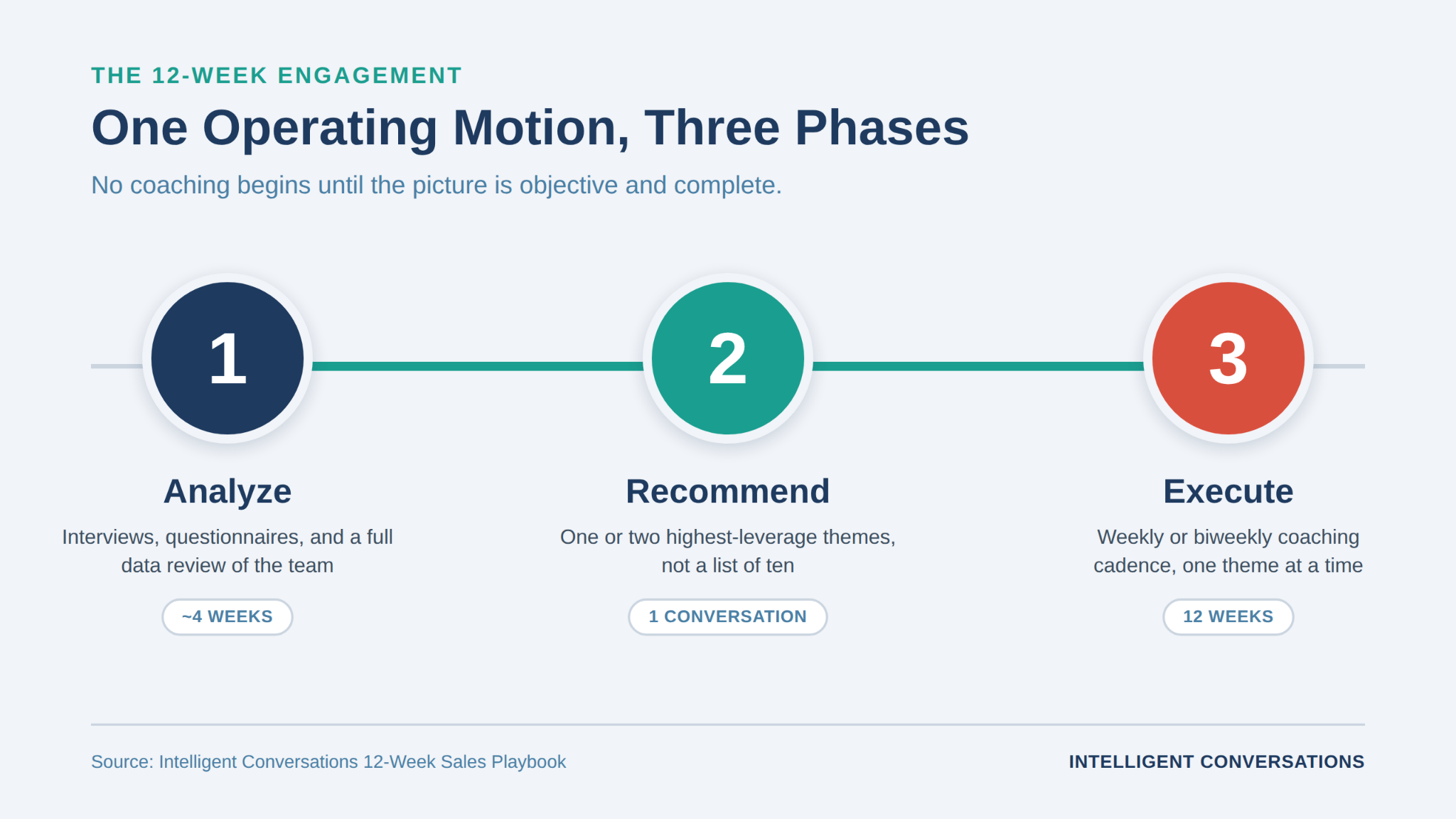
|
Phase |
What Happens |
Output |
|
Analyze (~4 weeks) |
Interviews, questionnaires, a thorough review of the team's data |
Objective picture of strengths, skill gaps, belief barriers, and leading indicator performance |
|
Recommend (1 conversation) |
The one or two highest-leverage levers get identified, not a list of ten |
A coaching agenda built around skill gaps vs. belief gaps |
|
Execute (12 weeks) |
Weekly or biweekly cadence on the chosen path, one focus at a time |
Themes that show up reliably in the field, then get spot-checked while the next theme takes focus |
One practical leading-indicator tool that requires no dashboard at all: color-code the calendar. Net-new meetings get a specific color. Call it money green. A manager scans the calendar at the start of each week and reads pipeline health in thirty seconds. If there is no money green, next quarter already has a problem.
The reverse is also true and often overlooked. When a pipeline is full, salespeople stop holding onto bad-fit opportunities. They become self-selective because they can afford to be. Pipeline volume does not just fix desperation; it improves qualification behavior across the team.
A healthy pipeline shape matters as much as volume:
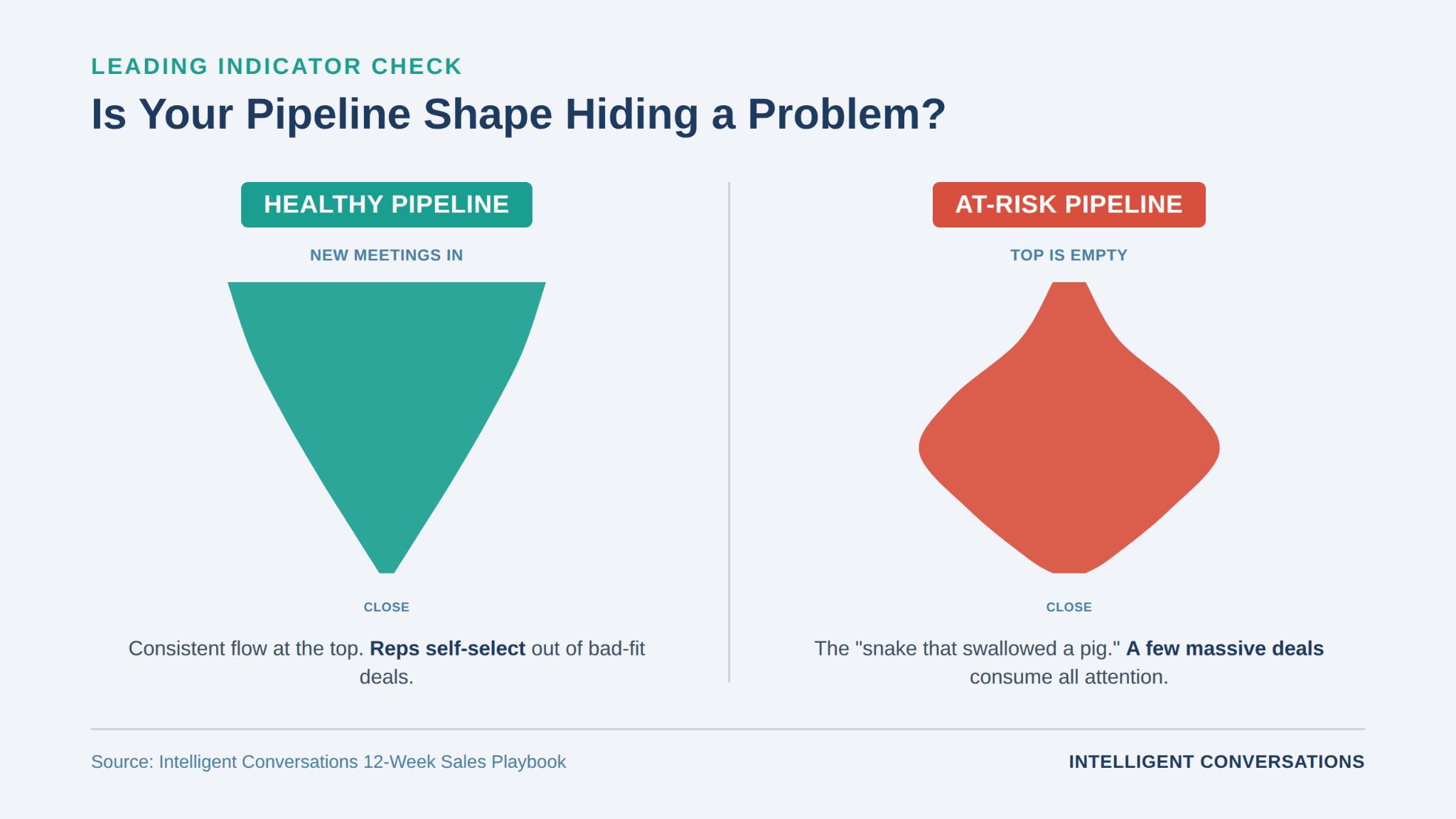
A common failure pattern: a salesperson has two or three massive deals moving through the funnel, consuming all of their attention through the close and into the installation or onboarding. The top of their funnel goes completely dark, and the pipeline looks full on paper: bulging in the middle, empty above. It's the same deal bunker mindset that shows up whenever salespeople go heads-down on what's already in front of them instead of maintaining steady prospecting. A quarter later, there is nothing left to close.
That shape doesn't show up in a revenue report, but it shows up immediately in the leading indicator data, which is exactly why the baseline starts there.
What does proof of progress look like before revenue changes?
Leading indicators give teams something to manage before the revenue number moves, and the data is usually better news than leaders expect.
|
Client 1 |
Client 2 |
|
|
Starting point |
Roughly $98M in revenue; one New York showroom underperforming its realistic target |
Team became highly efficient at generating net-new activity |
|
What happened |
COO formally budgeted the stretch target, contingent on team accountability. Team hit it early, in the middle of market disruption. |
Operations couldn't keep pace with sales output. CEO paused the engagement for several months to staff up engineering and fulfillment. |
|
The lesson |
Groundwork laid early shows up in revenue later, not immediately |
Sales readiness has to be matched by operational readiness before scaling further |
That second story points to a question worth asking before any growth investment: what would be different if this company were operating at a meaningfully higher revenue level? Are the operations, the management structure, and the delivery capacity actually ready to absorb that growth?
The baseline answers that question for the sales side. It does not replace the ops-side analysis, but it surfaces the sales-specific constraints that would otherwise choke growth before it arrives.
That decision, the genuine commitment to change rather than the checkbox version of it, is the variable that separates teams that shift from teams that complete a program and revert. The data tells the leader what to do. The leader's commitment determines whether anyone actually does it, and where that commitment lands first is almost always the sales manager, not the rep.
Frequently Asked Questions
Why doesn't sales training stick, and what should you do instead?
Training delivers content once. Without a coaching system to reinforce it, salespeople retain the new behavior for roughly six weeks before reverting to what they did before. The fix is building the manager's coaching cadence before the training event happens. Better content alone doesn't solve it. A manager who knows what specific skills and beliefs to reinforce, based on objective data about each salesperson, turns a training event into a process that compounds over time rather than fading out.
How do you build a 12-week sales coaching plan from data rather than assumptions?
The plan starts with an analysis phase: structured interviews, questionnaires, and a deep review that takes roughly a month. The output is a specific picture of the team's skill gaps, belief barriers, and leading indicator performance. From that picture, a coaching agenda is built around the one or two highest-leverage levers the data identifies. The 12-week cadence then executes against that agenda: one theme at a time, reinforced weekly or biweekly, with prior themes spot-checked so the gains hold.
How do you know if your coaching is actually working, before revenue changes?
Progress shows up in leading indicators before it shows up in revenue. Look for better-qualified meetings, shorter time to disqualify dead-end opportunities, cleaner pipeline stages, and salespeople who stop holding onto bad-fit accounts. These changes typically become visible within three to six months. Revenue follows, but the behavioral signals come first.
What is a sales performance baseline, and why does it come before coaching?
A sales performance baseline is a structured analysis of a team's skills, beliefs, activities, and leading-indicator behaviors. It answers the question that comes before every other question: what is actually causing underperformance? Without a baseline, coaching is a guess. With one, the coaching agenda targets the specific gaps that have the highest leverage on results.
Why might your top revenue producer not be your best salesperson?
Revenue numbers reflect territory quality, account inheritance, and tenure as much as they reflect skill. A salesperson who produces strong numbers in a strong market may have significant skill gaps that the territory covers. The relevant test is whether that performance would hold in a new market with no brand recognition and no existing accounts. Measuring the how (the skills, beliefs, and behaviors that drive conversion) produces a different and more accurate picture of where coaching will actually pay off.
How do you track sales leading indicators without a complex dashboard?
One practical starting point requires no technology: color-code the calendar. Give net-new meetings a specific color and scan the team's calendars each week. The presence or absence of that color tells a manager more about next quarter's revenue than most CRM reports. The number of net-new meetings that reach a defined next step is the single metric that most reliably predicts what the pipeline will look like 90 days from now.
What does a healthy sales pipeline look like versus a risky one?
A healthy pipeline has consistent flow entering at the top, across multiple stages. A risky pipeline has the snake-that-swallowed-a-pig shape: massive deals moving through the middle of the funnel while the top is empty. This happens when salespeople get fully consumed by closing large deals or managing post-sale activity, neglecting new prospecting entirely. The pipeline looks full on paper but has no future revenue behind the current deals. The leading indicator data surfaces this shape long before it becomes a revenue problem.
What should a sales leader ask before investing in a new sales tool or platform?
Three questions matter most. First, what specifically will this investment produce in terms of time saved, opportunities advanced, or better data, and by how much? Second, how long does it realistically take to see that value? Third, what are the risks if those results do not materialize? A meaningful tool investment deserves a business case that answers all three before any purchase decision is made. Skipping that step is the same mistake as skipping a baseline before hiring: spending before knowing what the data says.





Before You Invest in Your Sales Team, Answer These 5 Questions
How do you know whether your next sales investment will actually produce a return?
Ready to Build a High-Performing Sales Team?
Let's create your custom Sales Transformation Program.