
Net-New Meetings: How to Track Sales' Best Indicator
Written by: Mike Carroll

Quick Answer: A net-new meeting is a first appointment with a prospect who isn't already in your pipeline, and it only counts if it ends with an agreed next step. Count them every week against a fixed baseline. That count shows you next quarter's pipeline problem two to three months before it reaches the revenue report, and a color-coded calendar is the entire tracking system.
Key Takeaways
- Only first meetings that earn a next step count. Everything else is activity.
- The source doesn't matter. Referral, marketing, cold call: a meeting is a meeting.
- There's no universal weekly number. Five a week means nothing without your own baseline and your own season.
- A color-coded calendar is the whole system. No CRM build, no dashboard, no training curve.
- Volume problems and closing problems look identical in the revenue number. They need opposite fixes.
What Counts as a Net-New Meeting?
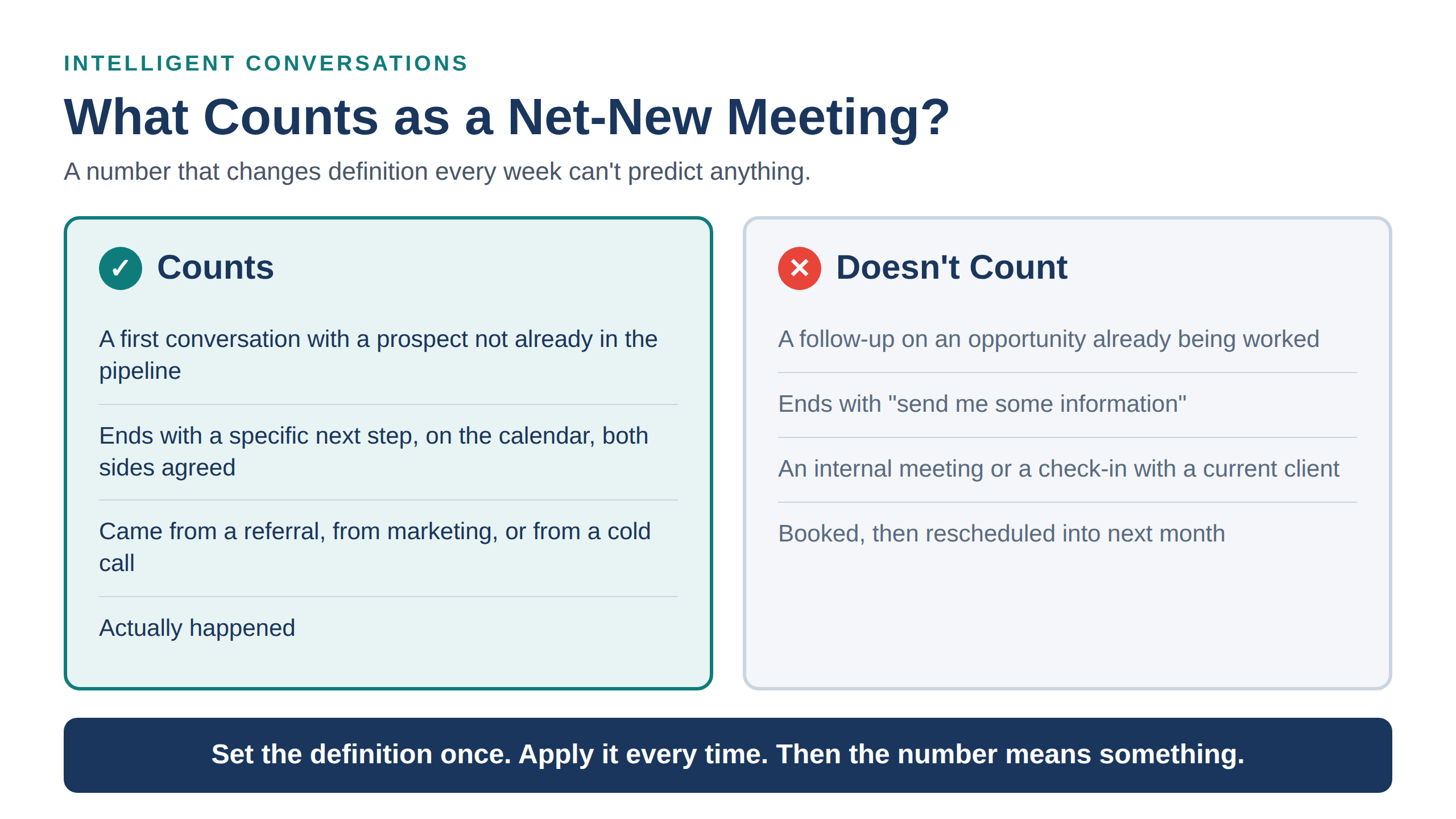
A first appointment with a prospect who isn't already in your pipeline, ending with a specific next step both sides agreed to.
That definition does more work than it looks like. Most teams already count meetings. Very few count the same thing twice in a row, and a number that shifts definition every week can't predict anything.
|
Counts |
Doesn't count |
|---|---|
|
A first conversation with a prospect not already in the pipeline |
A follow-up on an opportunity already being worked |
|
Ends with a specific next step, on the calendar, both sides agreed |
Ends with "send me some information" |
|
Came from a referral, from marketing, or from a cold call |
An internal meeting or a check-in with a current client |
|
Actually happened |
Booked, then rescheduled into next month |
Where the meeting came from is the part leaders get wrong most often. It doesn’t matter where the appointments come from, if it's referrals, if it's marketing, if it's cold calling, whatever it is.
A meeting sourced by marketing counts the same as one a salesperson dug up alone. What matters for the forecast is that a real first conversation happened and moved forward. What the source does change is accountability, and that's a separate number to watch.
You can sometimes back out however many leads marketing is going to give you, but your sales team still has to drive some of their own.
Two teams can post the same net-new meeting count while one of them is generating nothing on its own. Track the split alongside the total.
Your Revenue Number Is Lying to You (What Lagging Indicators Hide) covers why revenue can't answer any of this, and why the leading indicators sit upstream.
How Many Net-New Meetings Should a Salesperson Have Each Week?
There's no universal number, and any consultant who hands you one is guessing at your business.
The target comes from your own baseline, not from a benchmark. Here's how to set one:
- Count one normal week. Not a good week, not a slow week. How many net-new meetings reached a defined next step?
- Write the number down. That's the baseline. It isn't a judgment and it isn't a target yet.
- Note the season. A baseline set during your slowest month will mislead you in your busiest one.
- Compare against it every week after. Direction matters more than the absolute number.
Three weeks of data beats any industry average. A team running four net-new meetings a week in a market where six is realistic has a gap worth coaching. A team running four in a market where four is strong doesn't.
Track the Full Funnel First, Then Stop
Most teams either track nothing or track everything. Both fail.
For a stretch, track the whole chain. Call attempts, then conversations, then the conversations that produce an appointment, then the appointments that end with a next step. That full view shows where the drop-off actually sits. Once it's clear, stop measuring the rest. The one number worth keeping is the last one, and watching it takes no micromanaging at all.
How Do You Track Net-New Meetings Without a Dashboard or New Software?
A color-coded calendar is enough, and it reads at a glance.
The whole system is four steps:
- Pick one color for net-new meetings. A dark, rich green. Money green.
- Apply the definition from the table above. Every time, no exceptions.
- Color every confirmed meeting that fits it, the day it gets booked.
- Open the calendar every Monday. Read the week in five seconds.
No CRM configuration. No dashboard build. No new tool for anyone to resent.
What the Calendar Tells You
|
What you see |
What it means |
What to do this week |
|---|---|---|
|
Green spread across every week |
Top of funnel is healthy |
Leave it alone |
|
Green clustered in one week, empty after |
Prospecting happens in bursts |
Set a weekly minimum, not a monthly one |
|
Almost no green |
Pipeline gap forming now |
Coach prospecting activity before anything else |
|
Green that gets reclassified later |
The definition is loose |
Lock the definition and re-baseline |
|
Green on the calendar, nothing in the pipeline |
Meetings aren't earning next steps |
This is a closing problem, not a volume one |
The discipline part isn't small. When a meeting counts as net-new on Monday and gets downgraded on Thursday, the number stops meaning anything. Set the definition once, apply it every time, and the color tells the truth.
How Do You Tell Whether Low Revenue Is a Volume Problem or a Closing Problem?
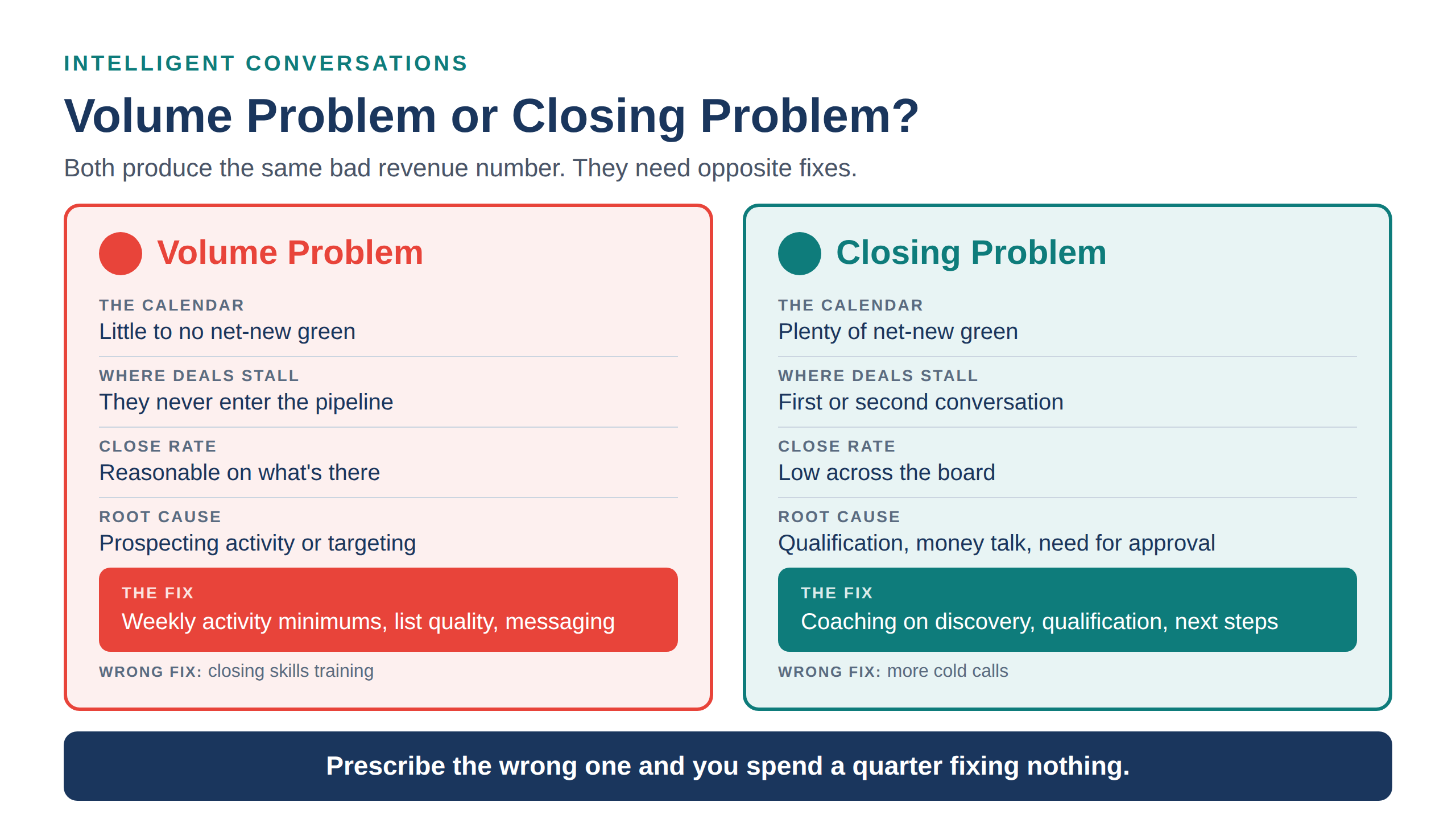
Look at where deals stall. If they never enter, it's volume. If they enter and stop moving, it's closing or qualification.
This distinction decides the coaching plan. Both problems produce the same disappointing revenue number and they need opposite responses. Closing skills training for a salesperson who can't generate first meetings is wasted money. Prospecting coaching for someone who books plenty of meetings and can't advance them is wasted time.
|
Volume problem |
Closing problem |
|
|---|---|---|
|
What the calendar shows |
Little to no green |
Plenty of green |
|
Where deals stall |
They never enter |
First or second conversation |
|
Close rate |
Reasonable on what's there |
Low across the board |
|
Root cause |
Prospecting activity or targeting |
Qualification, money conversations, need for approval |
|
The fix |
Weekly activity minimums, list quality, messaging |
Coaching on discovery, qualification, and next steps |
|
Wrong fix |
Closing skills training |
More cold calls |
The ratio is what separates them: of the net-new meetings that happened, what share advanced past the first conversation? A team booking twelve and advancing two has a very different problem than a team booking two and advancing both.
How Do You Keep the Number From Slipping Once the Quarter Moves On?
Go back and inspect it after you've moved on to something else.
Most teams fix the top of the funnel, feel good about it, and let it decay the moment attention shifts to the next priority. The habit that prevents it is simple. Every so often in the new quarter, go back to last quarter's focus and inspect it. Ask how the top of the funnel is holding. Momentum is easier to keep than to rebuild.
A net-new meeting count that got healthy in Q1 and never got checked again in Q2 is not a fixed problem. It's a problem waiting to reappear on a slower timeline. Put the spot-check on the calendar the same way the meetings go on it.
The 12-Week Playbook builds this into the cadence, with the baseline set in Week 2 and rechecked at Weeks 4, 6, and 11.
Frequently Asked Questions
What counts as a net-new meeting?
A first appointment with a prospect who isn't already in your pipeline, ending with a specific next step both sides agreed to. A follow-up on an existing opportunity doesn't count. A meeting that ends with "send me some information" doesn't count either. The source doesn't matter: referral, marketing, and cold call all count the same.
How many net-new meetings should a salesperson have per week?
There's no universal number. It depends on your sales cycle, your deal size, and your season. Count one normal week, write the number down as a baseline, and measure direction against it from there. A benchmark pulled from another company's business will point you at the wrong problem.
How do you track net-new meetings without a complex dashboard?
Color-code the calendar. Assign one color, a dark rich green, to every net-new meeting. A manager can scan any salesperson's calendar and read pipeline health in seconds without pulling a report. The definition has to stay consistent or the color stops meaning anything.
Should meetings sourced by marketing count toward the number?
Yes. A first conversation that earns a next step predicts revenue the same way regardless of where it came from. Track the self-sourced split as a separate number, because a team that generates nothing on its own has a different exposure than one that does, even when the totals match.
How do you know if your team has a volume problem or a closing problem?
Look at where deals stop moving. No first appointments means a prospecting volume problem. Plenty of meetings that stall at the first or second conversation means a qualification or closing problem. Both look the same in the revenue number and need different coaching.
How soon does a net-new meeting count start predicting revenue?
The count reflects pipeline that will close roughly one sales cycle out, so a team with a 90-day cycle sees the revenue consequence of this quarter's meetings next quarter. That lag is the reason to watch the count weekly instead of waiting for the revenue report.
Get the 12-Week Playbook
Most sales investments start with a decision and work backward to the data. This playbook runs the other direction. It shows how to set a baseline, pick the leading indicators that matter for your team, and find out whether the real gap is coaching, process, or talent before spending on any of them.






Are You Flying Blind?
I was in a conversation with a CEO last week asking questions about their sales organization, the critical sales ratios ...
Ready to Build a High-Performing Sales Team?
Let's create your custom Sales Transformation Program.