
Why Sales Coaching Time Keeps Shrinking (And What to Fix First)
Written by: Mike Carroll

Why does sales coaching keep slipping even when managers want to do it?
Most sales managers are stretched across more reps than they can coach well, and the coaching hours that survive tend to go toward pipeline mechanics, not the skill with the widest gap between top and average performers: handling objections and rejection. The real issues are capacity and targeting, and as covered in "Why Sales Coaching Fails", both need fixing before coaching quality improves.
Key Takeaways
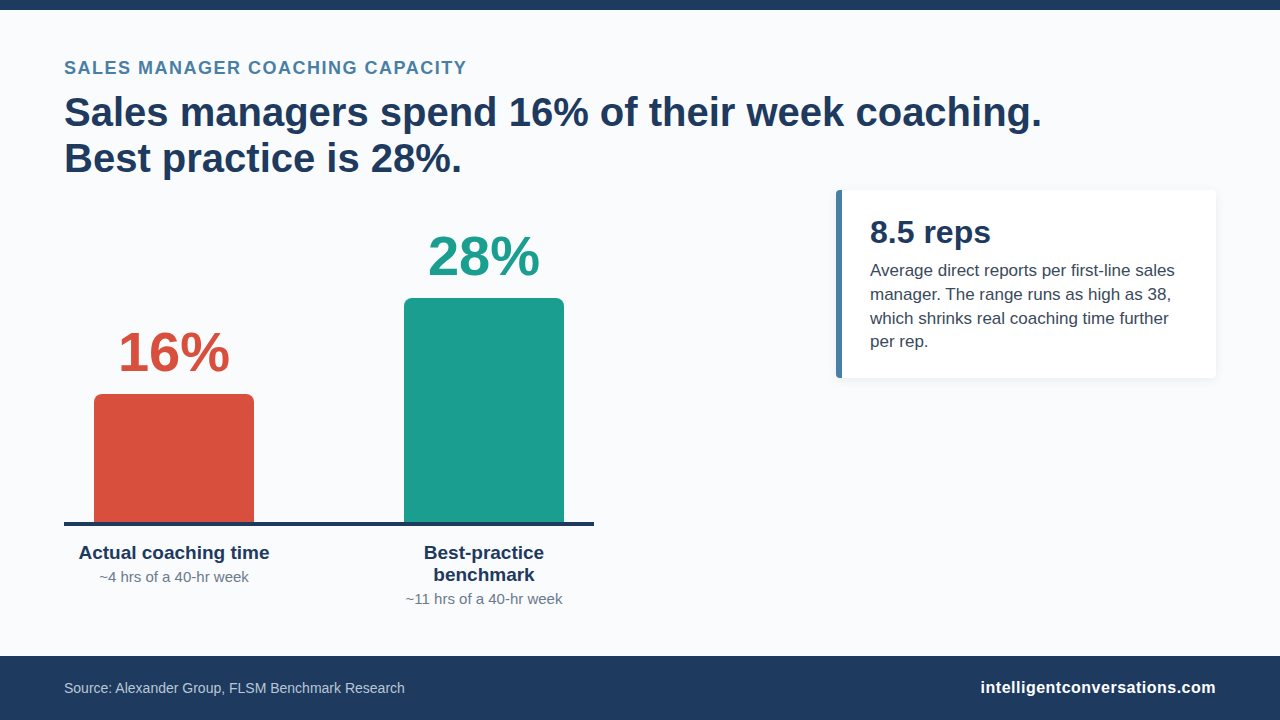
- First-line sales managers carry an average of 8.5 direct reports, and the range runs as high as 38, according to Alexander Group's benchmark research
- Those same managers spend about 16% of their time coaching. Best practice is close to double that, at 28%
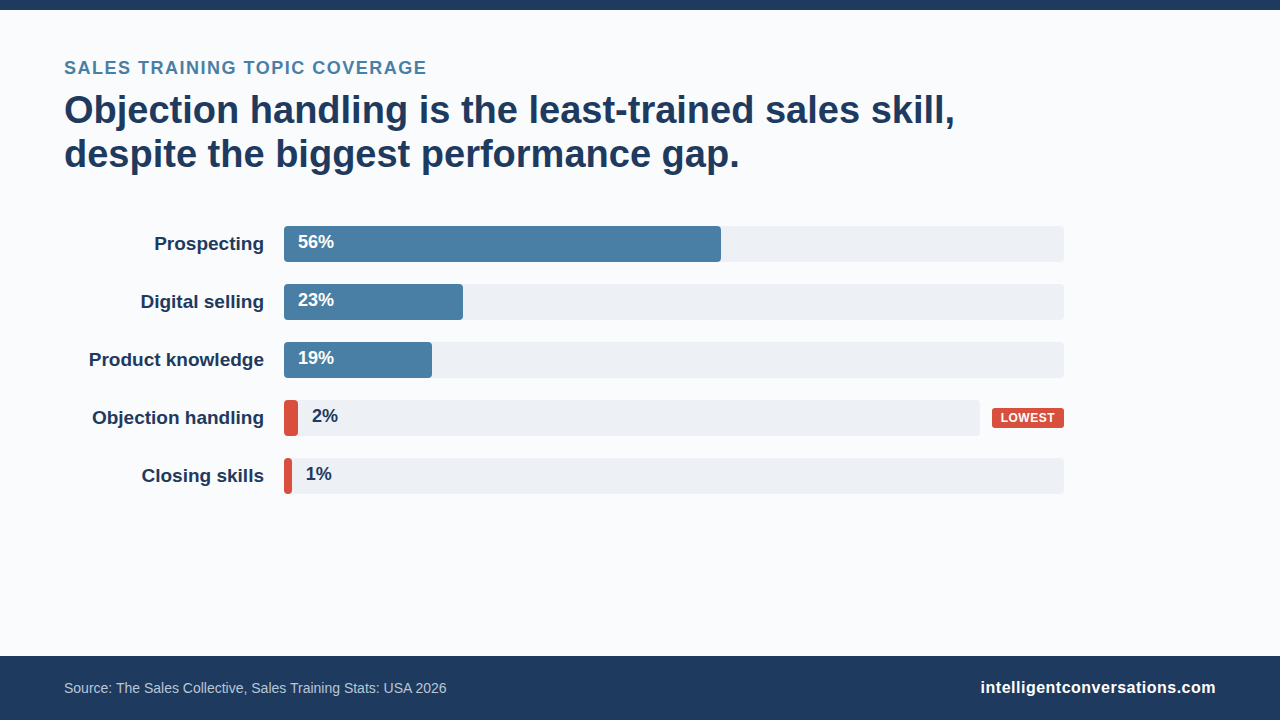
- Objection handling and closing skills are among the least-trained topics in sales organizations, per The Sales Collective's 2026 sales training data
- IC's OMG data identifies Handles Rejection as one of six Sales DNA competencies, and it's one of the hardest for managers to coach without assessment data
- A manager with too many reps and no priority list ends up coaching everyone a little and nobody well
How many reps can one sales manager actually coach well?
Fewer than most sales organizations are asking them to carry. Alexander Group's benchmark data puts the average first-line sales manager at 8.5 direct reports, though the range runs from as few as two to as many as 38 depending on the sales model. Even at the average, real coaching, the kind that changes behavior, takes sustained one-on-one time per salesperson, and that time gets thinner every time headcount grows without adding a manager.
The same research found first-line managers spend about 16% of their time coaching. That's roughly four hours in a 40-hour week. Alexander Group puts best practice closer to 28%, nearly double. The gap isn't because managers don't value coaching. It's pipeline reviews, forecast calls, internal meetings, and admin work crowding it out.
Where does the coaching time that's left actually go?
Most of it goes toward what's easiest to see: pipeline, activity, and deal status. Those conversations feel productive because they produce something to report on. As "The Questions Your Sales Managers Should Be Asking" points out, managers routinely overestimate how much of their 1:1 time is real coaching versus deal review, because the two conversations feel identical from the manager's side of the table.
What gets squeezed out is the slower work: naming the specific belief or habit that's actually holding a salesperson back, then building a plan around it. That takes more than a status check. It takes a manager who has the time and the data to know what to look for.
Why does objection handling keep losing out?
Objection handling and closing skills rank at the bottom of what sales organizations actually train for. The Sales Collective's 2026 sales training research found objection handling covered in roughly 2% of training programs and closing skills in about 1%, well behind prospecting, digital selling, and product knowledge. Training budgets go toward what's easiest to schedule and easiest to prove happened. Objection handling is harder to train in a classroom because the resistance is emotional. A salesperson can know the right line and still avoid saying it, because saying it risks the rejection.
Inside IC's OMG data, this shows up as Handles Rejection, one of six Sales DNA competencies. A rep who takes rejection personally doesn't need another script. They need the emotional pattern named and worked through, which most sales training was never built to do. The same pattern shows up with Stays in the Moment: a salesperson can know exactly what they should have said, and still miss it live, because the gap isn't knowledge either.
What happens on a team when this pattern runs for a year?
The team develops a quiet ceiling that nobody can point to. Reps who could handle more volume start avoiding it after a string of losses, and activity dips. The manager sees the dip and pushes for more calls, which raises the pressure and makes the avoidance worse. Nobody is failing on paper. Quota gets hit, mostly. But the team never gets past a certain level, and every explanation for it sounds reasonable in isolation: the market, the territory, the lead quality. This is the same pattern covered in "B-Level Managers Produce B-Level Teams": one-on-ones happen on schedule, but the themes never change.
The actual driver is simpler. Nobody ever coached the thing that was actually in the way, because nobody had the time to find it or the data to see it.
→ These patterns show up in nearly every OMG evaluation Intelligent Conversations runs. Sales DNA competencies like Handles Rejection are invisible to normal observation. A manager can watch a hundred calls and still miss it, because it doesn't look like a skills problem. It looks like a motivation problem. Assessment data tells a manager exactly where to point limited coaching time instead of guessing.
This is also why a training event alone never closes the gap. As covered in "Why Sales Training Wears Off in 3 Weeks", a salesperson can sit through objection-handling training and still avoid using it, because the block was never a knowledge problem to begin with.
What should change first?
The fix is a shorter list, chosen from real data. A manager carrying eight or more reps can't coach eight development plans well. They can coach one theme per rep, picked from assessment data instead of whatever came up in last week's deal review. That's the difference between a manager who's busy and a manager who's actually developing people.

Frequently Asked Questions
How many direct reports should a sales manager have? Alexander Group's benchmark data puts the average first-line sales manager at 8.5 direct reports, though the right number depends on deal complexity, rep tenure, and how much of the sale is field versus inside. The more useful question is whether the manager has enough time left, after pipeline and forecast duties, to run real development coaching with each rep. When that time gets thin, coaching quality drops before anyone notices headcount is the cause.
Why is objection handling so hard to coach? Because it's usually not a skills gap. A rep can know the right response to an objection and still avoid saying it, because rejection itself is what they're avoiding. That's an emotional pattern, not a knowledge gap, and it needs to be identified before it can be coached.
Can a manager fix this without adding headcount? Yes, to a point. Picking one development theme per rep instead of trying to cover everything makes limited time go further. But there's a ceiling to how many reps one manager can develop well, and past that point, the fix is either more managers or fewer reps per manager.
How is this different from a standard sales training program? Standard training teaches the same material to everyone on a schedule. It doesn't account for the fact that different reps are stuck on different things. IC's approach starts with OMG assessment data to identify what's actually limiting each rep, then builds coaching around that instead of a generic curriculum.





Why Sales Coaching Fails: A Data-Driven Guide to Coaching What Actually Matters
Executive Summary Why do sales managers keep coaching without seeing results? Most sales coaching fails. Not because ...
Ready to Build a High-Performing Sales Team?
Let's create your custom Sales Transformation Program.