Why Sales Coaching Fails: A Data-Driven Guide to Coaching What Actually Matters
Written by: Mike Carroll

Executive Summary
Why do sales managers keep coaching without seeing results?
Most sales coaching fails. Not because managers don’t care, but because they’re coaching the wrong things. They focus on activity metrics, deal reviews, and pipeline numbers. Those are visible. But the real obstacles to sales performance are invisible: deep-seated beliefs, mindset patterns, and behavioral traits that determine whether a salesperson can actually execute what they’ve been taught.
These invisible traits are called Sales DNA competencies. There are six of them, and they affect everything from how a rep handles objections to whether they’ll ask about budget to how fast they bounce back from a lost deal. Managers cannot see Sales DNA through normal observation. Until a manager understands what’s actually limiting each rep, coaching stays surface-level, and results stay inconsistent.
Key Takeaways: Why Sales Coaching Fails and How to Fix It
- Sales coaching fails when managers coach visible symptoms (activity, pipeline) instead of invisible root causes (beliefs, mindset, DNA)
- The 6 Sales DNA competencies determine whether a rep can execute any tactic they’ve been taught
- Managers cannot see Sales DNA through observation alone. It requires assessment data.
- Coaching and hiring are connected problems. If you hired someone with weak Sales DNA and low coachability, no framework will save you.
Why Does Sales Coaching Feel Harder Now? The Coaching Paradox
Most sales managers are not coaching enough. The data from Objective Management Group doesn’t support the idea that managers are coaching consistently. Neither does the recent Membrain report on sales management effectiveness. The standard from OMG’s perspective is that managers should spend 50% of their time coaching. Very few come close.
Managers are stretched thin. They get pressure from the top and complaints from below. They’re squeezed in the middle. Coaching gets crowded out by firefighting, deal support, forecasting, and internal meetings.
But here’s the paradox. Even the managers who do coach more consistently still aren’t seeing results. They run weekly 1:1s, review the pipeline, and have debrief calls. Nothing changes.
Because they tend to coach reactively rather than proactively. They tell people what to do rather than asking questions. They coach for production rather than development.
The sign of an effective coach is when the quality of the problem gets better over time.
When salespeople are getting further into conversations, exploring areas they haven’t reached before, running into new challenges because they’re doing things differently, that’s coaching working. But most managers measure coaching by pipeline numbers. When those numbers don’t move, they assume coaching isn’t working. What they’re really seeing is that the coaching is aimed at the wrong target.
Before you change your coaching cadence, your framework, or your team, you need to know what’s actually driving the behaviors you’re trying to change.
Why Do Reps Agree with Coaching and Then Do the Exact Same Thing?
When a CEO says, “Our managers are coaching, but nothing is changing,” the same patterns show up almost every time. Managers are coaching reactively. Most of what passes for coaching is spot coaching, in-the-moment firefighting. That’s not development, that’s getting through the day.
What actually drives managers crazy is that reps agree with the feedback. They nod along, then walk into a meeting and do the exact same thing.
Two reasons:
- First, it’s easier in the coaching moment to just agree and move on.
- Second, in the actual sales moment, the rep’s underlying discomfort with money, fear of rejection, or need to be liked overrides the intellectual understanding they agreed to in the 1:1.
Reps can agree with coaching feedback all day long. The question is whether they can execute it in the sales moment when their beliefs and fears are competing for control.
Technical vs. Conceptual: The Distinction That Changes Everything
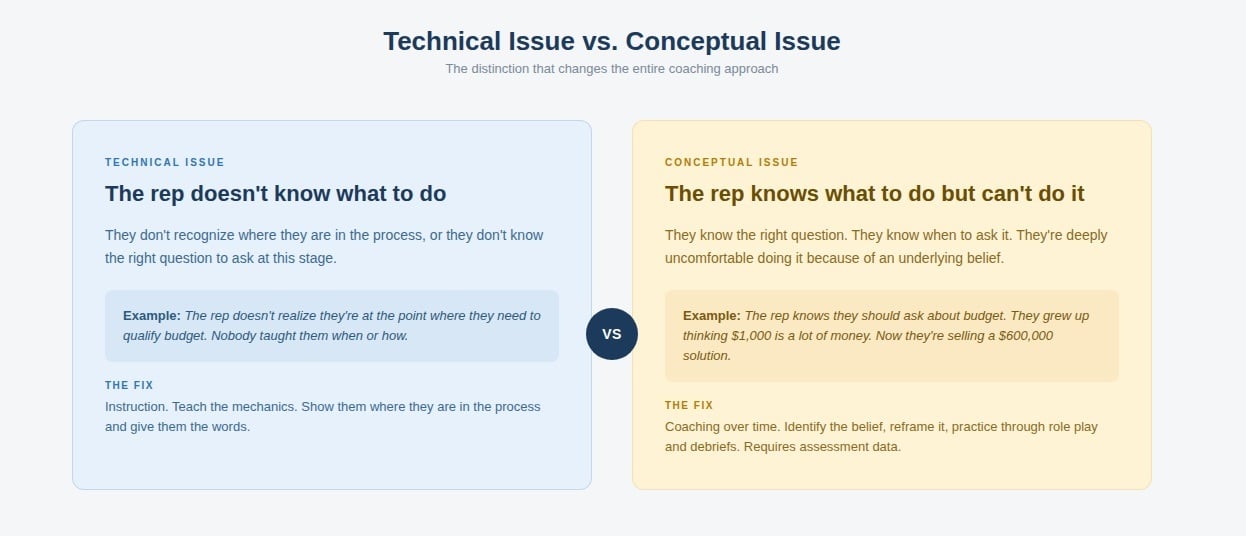 When a rep struggles on a call, the critical question is: Is this a technical issue or a conceptual issue?
A technical issue means the rep doesn’t know the mechanics. They don’t recognize where they are in the process, or they don’t know the right question to ask. That’s fixable with instruction.
A conceptual issue is different. The rep knows what to do. They even know how. They’re just deeply uncomfortable doing it. Maybe they grew up poor. Maybe $1,000 is a lot of money to them, and they’re selling a $600,000 solution. Their personal views on money are clouding their ability to have value conversations.
Managers almost always treat conceptual issues as technical ones. They say, “I told them what to ask. I told them how. I don’t know why they’re not doing it.” They coach the symptom, not the cause.
There’s another layer. Managers bring their own biases to coaching. When a sales manager has a non-supportive buy cycle, meaning they personally tolerate longer sales cycles and competitive pricing requests, that standard cascades down. The manager’s own DNA shapes what they consider acceptable. And that becomes the team’s ceiling.
What Is Sales DNA? The 6 Competencies Your Managers Can’t See
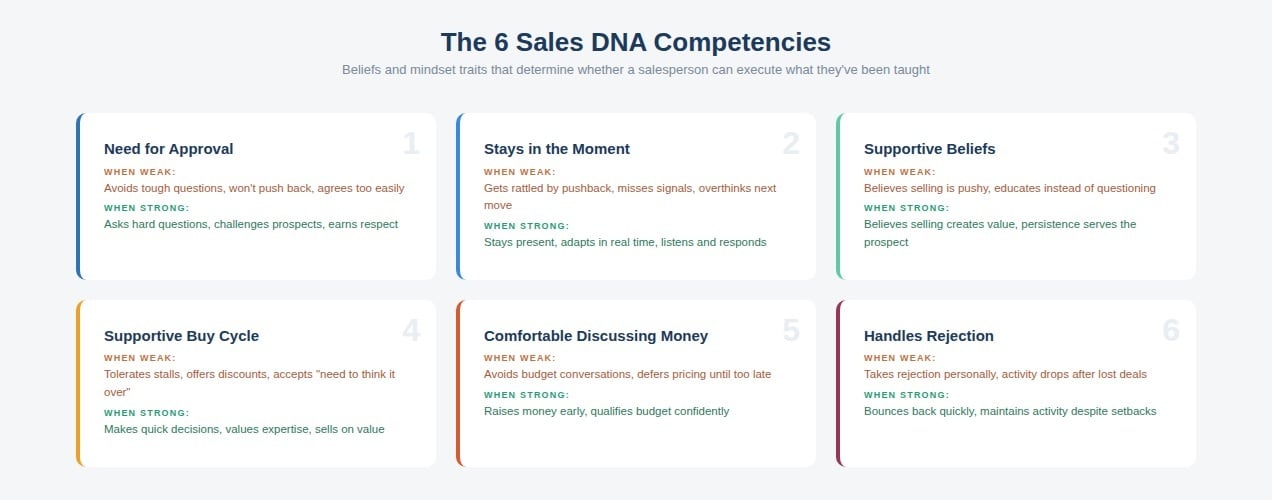
Sales DNA competencies are the beliefs and mindset traits that support or hinder a salesperson’s ability to execute a sales tactic.
They’re part of the 21 core competencies measured by OMG evaluations, alongside 5 Will to Sell competencies and 10 Tactical Sales competencies. They are observable in debriefs if you know what to look for, and assessment data gives managers a cheat code to spot patterns faster.
Competency #1: Need for Approval
Of the DNA competencies, need for approval carries one of the heaviest weightings. It impacts the entire sales process, and it's devastating at the close.
What It Looks Like in Coaching
The rep seems perfectly coachable in 1:1s. They listen, agree, and commit to asking tougher questions. Then they get in front of a prospect and soften everything. They pull their punches. What's happening underneath: it's so important for them to be liked that they won't risk the relationship by asking tough questions. They tell themselves they're "relationship sellers." The real driver is the need to belong.
Some salespeople hesitate to ask for the order because they've finally gotten comfortable with the prospect. Closing means starting over with someone new. So they self-sabotage, keeping the deal alive because closing it means losing the relationship.
Why Managers Miss It
- The rep appears coachable. The compliance masks the underlying need.
- Behavior changes by audience. In coaching, the manager is the authority. In sales, the prospect is. The rep's behavior shifts depending on who they're trying to please.
- Without DNA data, the manager sees a compliant rep and assumes coaching is landing.
Competency #2: Stays in the Moment
What It Looks Like in Coaching
Think of this as the V8 weakness. The rep drives away from a meeting and thinks, “When they said that, I should have said this.” They knew what to do. In the moment, they couldn’t access it. They were thinking ahead, analyzing, worrying about their next move instead of listening.
Recorded calls reveal this clearly. Play back a call and ask, “What did you hear?” The rep says, “Now that I’m listening again, I can hear they gave me a buying signal.” What prevented them from following up? “I literally didn’t hear it.”
Why Managers Miss It
- Logical debriefs mask the problem. The rep explains what happened coherently after the fact. They don't report that they panicked or checked out.
- The manager coaches the deal. Nobody coaches the reaction.
Competency #3: Supportive Beliefs
What It Looks Like in Coaching
OMG measures over 60 different beliefs. The most common non-supportive belief: the need to educate the prospect. Reps think their job is to explain features and demo. The education should happen through questions, not presentations. Help the prospect realize they’re tolerating inefficiencies that cost them time or money. That’s the real education.
Other non-supportive beliefs: selling is adversarial, persistence is pushy, prospects deserve to be left alone if they say they need to think about it. These operate beneath conscious awareness. The rep doesn’t think they have a belief problem. They think they’re being respectful.
These beliefs can be reprogrammed. The salesperson writes out the non-supportive belief and reframes it. “It’s impolite to talk about money” becomes “I can’t help my client unless I ask what it’s costing them to do nothing.” It works, but only if you know the belief exists.
Why Managers Miss It
- Looks like a skills gap. The manager coaches the technique. The rep tries it. It feels wrong. They stop.
- The underlying belief was never addressed because nobody knew it was there.
Competency #4: Supportive Buy Cycle
This is the most misunderstood DNA competency. OMG’s research shows that the way you buy things personally directly impacts how you allow people to buy from you.
What It Looks Like in Coaching
A comparison shopper who drives all over the city for the best deal on a microwave will, in a selling scenario, default to “no problem, take as much time as you need” when a prospect asks to look at other options. That buying behavior is congruent with their personal habits. The problem: they just exposed the deal to the market for weeks they didn’t need to.
A better approach is to ease the pressure and ask a deeper question: ‘No problem. As you think it over, what specifically are you looking for?’ That opens the door to a real conversation about whether comparing options will actually help. When reps recognize how their personal buying habits influence the way they sell, productivity often improves by 30% to 40%.
Why Managers Miss It
- Manager says: "Stop accepting stalls." Rep agrees. Next deal, same thing.
- It's not disobedience. The way they make buying decisions in their own life often carries over into how they sell.
- You can't coach this away without making it visible first through assessment data.
Competency #5: Comfortable Discussing Money
What It Looks Like in Coaching
Reps avoid the money conversation because it’s uncomfortable. They defer it until the proposal stage, when it’s too late to do anything but defend a number. Some reps have entire conversations and then drop a $10,000 price tag at the end. The prospect falls out of their chair. That salesperson is never getting back into that account.
A good rule during discovery: find at least 2x the pain. Selling a $300,000 solution? Find $500,000 to $600,000 in problems first. Anchor the price to their problems, not to a number in a vacuum. Phrases that help: “We’re almost never the low price. Why do you think people buy from us?” Whatever the prospect says supports the value proposition.
Why Managers Miss It
|
What the Manager Hears |
What Actually Happened |
|
"Did you qualify the budget?" "Yes." |
The rep asked a surface question like "Do you have a budget?" and accepted a vague answer. |
|
"They said they have a budget." |
No specific number was discussed. No willingness to invest at the required level was tested. |
|
Deal stays in the pipeline with a green light. |
The proposal will generate sticker shock. The real money conversation never happened. |
Competency #6: Handles Rejection
What It Looks Like in Coaching
There are two kinds of rejection.
|
Type |
What It Looks Like |
Impact |
|
Direct rejection |
"Don't ever call me again." Clear and final. |
Stings briefly. Rep can move on. Easier to process. |
|
Ghosting |
Prospect stops responding. No explanation. No closure. |
Lingers. Erodes confidence over time. Much harder to recover from. |
Some salespeople can’t function at full capacity for an entire quarter after losing a big deal. Activity drops. Administrative tasks fill the time. The manager coaches the activity. But the emotional recovery hasn’t happened. Pushing harder increases the fear of the next rejection.
A reframing technique that works: count nos instead of yeses. “Get 20 nos before 9 a.m.” It flips rejection from something to avoid into something to collect.
Why Managers Miss It
- Looks like a motivation problem. Managers respond by pushing for more calls and tighter accountability.
- Added pressure makes it worse. The rep becomes more hesitant, not more productive.
- Until the emotional impact is addressed, activity coaching only treats the symptom.
→ These six competencies are measured inside every OMG sales evaluation Intelligent Conversations runs. The process starts with data that shows exactly where each rep’s Sales DNA is supporting them or holding them back. That’s where targeted coaching begins.
What Does Data-Driven Sales Coaching Actually Look Like?
Here’s a question worth asking any sales leader: Have you ever coached somebody, told them what to do, led them through a role play, had them understand it completely, and then watched nothing change?
The answer is always yes. And it’s always tied back to underlying Sales DNA issues the manager didn’t know were there.
Assessment data gives managers a clearer view of what’s actually going on, making it easier to spot patterns and coach with purpose. It’s a sales-specific evaluation that shows where each person is getting stuck and helps managers focus on what to coach first.
How the Coaching Conversation Changes With Data
|
Without Data |
With DNA Data |
|
|
What the manager sees |
Rep struggles with budget conversations |
Rep struggles with budget conversations |
|
What the manager says |
"You need to ask about the budget earlier." |
"Your comfort discussing money score suggests this goes deeper than a skills gap." |
|
What happens next |
Rep agrees. Next call, same result. |
Manager and rep explore the belief behind the behavior: personal relationship with money, upbringing, discomfort with large numbers. |
|
The outcome |
Symptom gets repeated coaching. Nothing changes. |
Root cause becomes visible. Coaching targets the actual issue. |
Where the Real Coaching Happens
The data is the roadmap. The debrief is where coaching happens. Don't beat reps over the head with assessment results. The magic is in the conversation:
"Tell me where that call ended. What did they say? You didn't ask that? What do you think would have happened if you had?"
The rep connects the dots on their own. That self-discovery is more powerful than any score on a report.
The Coaching Triangle: Why Most Managers Never Get Past the Middle Layer
IC’s Coaching Triangle has three layers. The base: building genuine relationships with your people. The middle: on-the-job coaching (KPIs, pipeline, activity). The top: destination coaching (where does this person want to be in three years?).
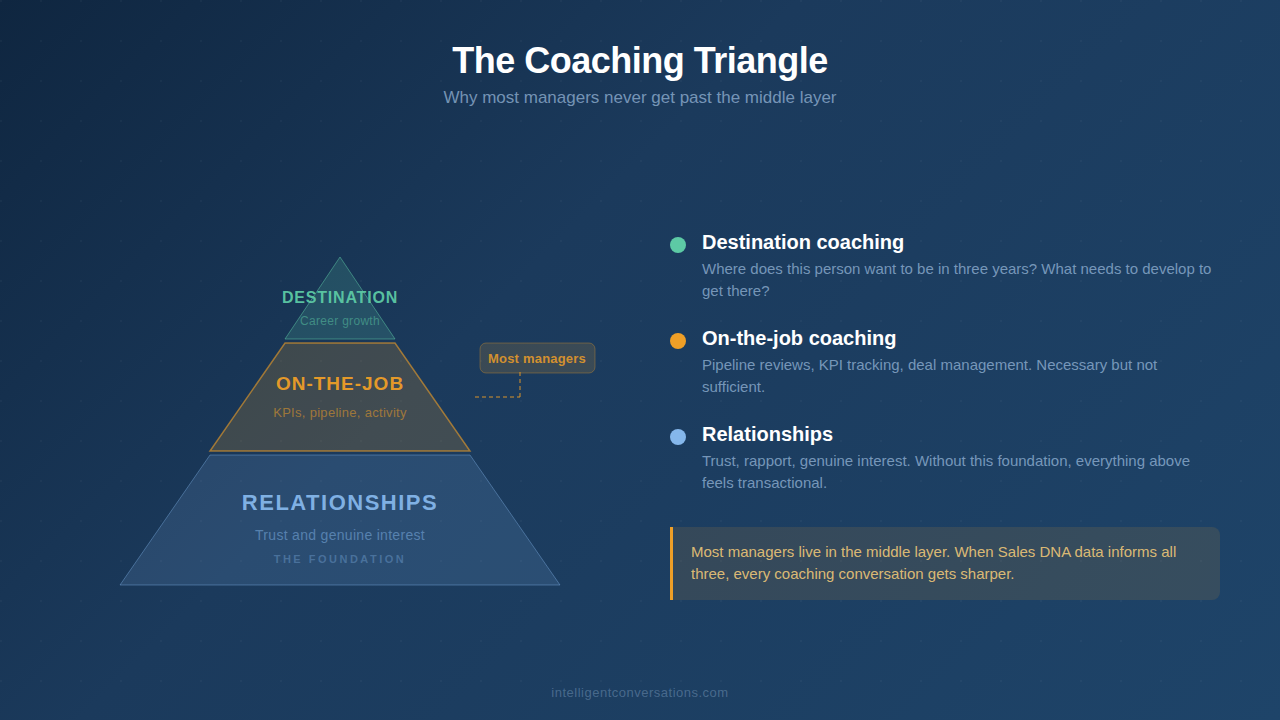
Most managers live in the middle layer. When they do this without the foundation of trust underneath, salespeople comply but don’t feel developed. When Sales DNA data informs all three layers, every coaching conversation gets sharper.
→ IC’s coaching methodology combines the Coaching Triangle with OMG evaluation data to give managers a targeted, individualized coaching plan for every rep on their team.
How Do You Know If It’s a Coaching Problem or a Hiring Problem?
One key indicator in the OMG evaluation, when used as a pre-hire assessment, is coachability, measured on a scale of 0 to 100. Below 75 is considered not coachable. That doesn’t mean automatic disqualification, but hiring managers should be asking for evidence during the interview: examples of feedback the candidate didn’t agree with but took anyway, what they’re actively working on, and how they prefer to receive input.
The connection: if you hired someone with weak Sales DNA, low coachability, and no commitment to change, that’s not a coaching failure. That’s a hiring failure that shows up during coaching. Intelligent Conversations treats hiring and coaching as two stages of the same system. The best time to screen for Sales DNA is before the hire, not after the first failed coaching cycle.
You hired them. Now, coach what matters. But if your hiring process didn’t screen for coachability, your coaching challenge just got harder.

The Questions You Should Be Able to Answer About Your Sales Team (But Probably Can’t)
A revealing test: take the first five salespeople off the elevator and ask each of them to define the sales process. The answer is always five or six different versions. There’s never consistency.
If you lead a sales team, you should be able to answer these:
- Which of your reps are actually coachable, and which are coaching-proof?
- What specific beliefs are limiting your underperformers?
- Are your managers coaching to the right things, or just coaching what they can see?
- Can your team sell on value, or are they defaulting to price?
If you can’t answer with specifics and data, you’re guessing. When leaders start seeing patterns through data, they connect the dots fast. Coaching gains momentum. Better conversations lead to a stronger pipeline, more accurate forecasts, and deals leaving the pipeline that shouldn’t have been there in the first place.
→ These are the kinds of questions IC helps leaders answer with evaluation data that reveals what’s happening beneath the surface.

How to Start Coaching What Actually Matters
If there’s one thing that would change how sales managers coach, it's to narrow your focus.
Pick one high-impact development theme for each person. Top-of-funnel activity. Advancing opportunities. Building technical credibility. Stick with it for a full quarter. You still hold them accountable to everything else. But your coaching lens has a specific focus.
A-level coaches pick one thing and stay with it. B-level coaches try to fix everything and end up fixing nothing.
Stop coaching what you can see. Start coaching what you can’t. The activity numbers and pipeline are lagging indicators of something deeper. The beliefs. The mindset. The Sales DNA. That’s where coaching either succeeds or fails. And you can’t access it without data.
Who Should Be Rethinking Their Coaching Approach
- CEOs and sales leaders who feel like coaching should be working but isn’t
- VPs of Sales who suspect their managers are going through the motions
- Sales Managers who sense something is off but can’t identify the root cause
If your coaching cadence is consistent but your results are not, the issue is what you’re coaching, not how often. The starting point is always diagnosis.
Book a 15-Minute Coaching Effectiveness Review

A short conversation about what’s happening beneath the surface of your team’s coaching conversations.

Great coaching starts with the right people.
Frequently Asked Questions About Sales Coaching Effectiveness
Why does sales coaching fail even when managers are consistent?
Consistency matters, but targeting matters more. If a manager consistently coaches activity and pipeline without addressing underlying beliefs, they’re reliably coaching the wrong things. Effective coaching requires assessment data, not just observation.
What is Sales DNA?
Sales DNA refers to six competencies representing the beliefs and mindset traits that affect whether a salesperson can execute tactics: Need for Approval, Stays in the Moment, Supportive Beliefs, Supportive Buy Cycle, Comfortable Discussing Money, and Handles Rejection. They are part of the 21 core competencies measured by OMG sales evaluations.
How do you know if it’s a coaching problem or a hiring problem?
If a rep has strong Sales DNA and adequate skills, coaching is likely the issue. If a rep has weak DNA and low coachability, no framework will produce lasting change. A sales hiring diagnostic reveals whether the problem started before coaching began.
Can you coach Sales DNA, or is it fixed?
Sales DNA can be coached, but it takes longer than tactical skills. Change requires self-awareness (seeing the data), targeted practice, and sustained accountability. Belief reprogramming exercises, where the rep reframes non-supportive beliefs as supportive ones, are effective. The first step is always measurement.
What are the 21 core sales competencies?
OMG evaluations measure 21 competencies across three categories: 5 Will to Sell (desire, commitment, outlook, motivation, responsibility), 6 Sales DNA (the six listed above), and 10 Tactical Sales competencies covering the full selling process from prospecting through account management.
How do you measure sales coaching effectiveness?
Revenue growth is the ultimate indicator but it’s lagging. Leading indicators: reps asking better questions, reaching higher-level decision makers, shortening sales cycles, and disqualifying bad-fit prospects faster. When the quality of the problem gets better over time, coaching is working.





Coaching for Development vs. Coaching for Production
In today's hyper-competitive business landscape, the difference between mediocre and exceptional sales performance ...
Ready to Build a High-Performing Sales Team?
Let's create your custom Sales Transformation Program.