The Questions Your Sales Managers Should Be Asking (But Are Not)
Written by: Mike Carroll

Executive Summary
What are the questions that reveal whether your sales organization is actually healthy?
Leadership's ability to answer specific questions about team capabilities, coaching effectiveness, and pipeline quality provides a clear view of a sales organization's health. Most leaders cannot answer those questions with confidence because they lack the framework and data needed to do so. Once leaders gain that visibility, they can identify the issues holding performance back and make meaningful improvements.
Key Takeaways
- Most CEOs and sales leaders cannot answer specific questions about their team's capabilities with data.
- Revenue is a lagging indicator. Leading indicators live in coaching quality, conversation quality, and pipeline accuracy.
- Managers who cannot name the one development focus for each rep this quarter are coaching reactively.
- The inability to answer these questions is not a failure, but the starting point.
The Elevator Test: How Consistent Is Your Sales Process?
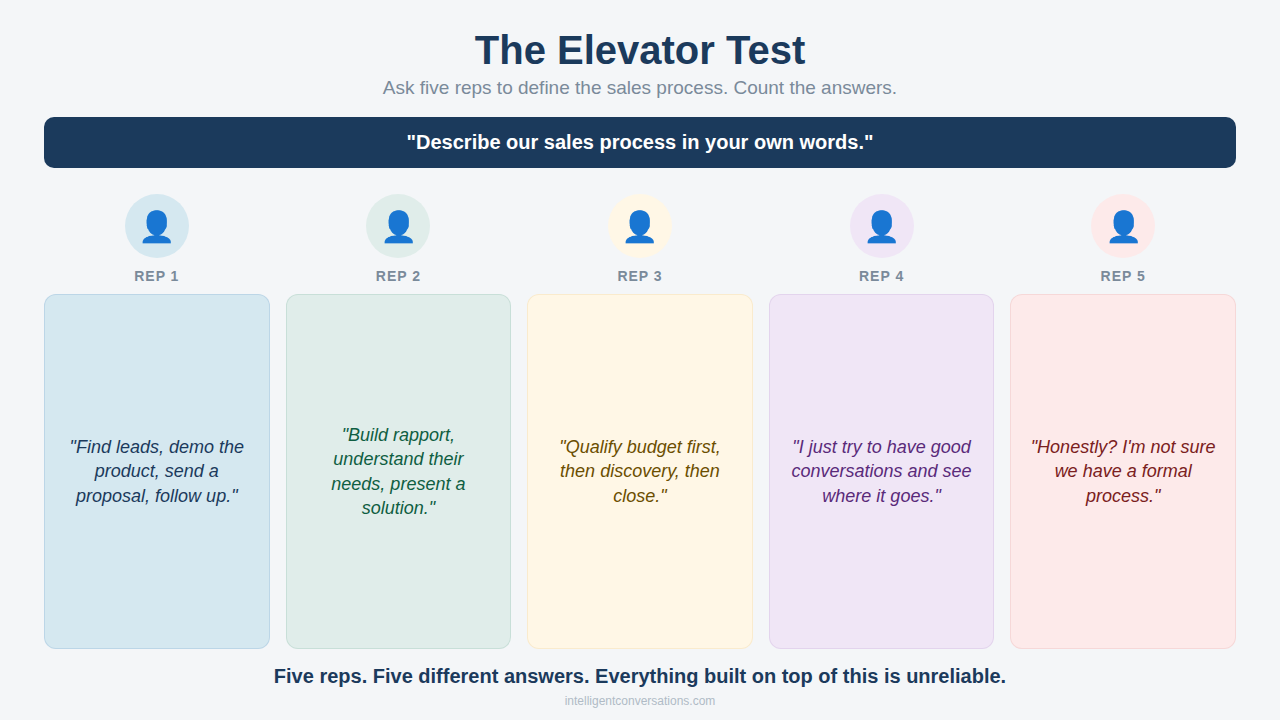
Take the first five salespeople off the elevator and ask each of them to define the company's sales process. How many different answers would you get?
Almost always five or six different versions. Each rep has their own interpretation of what the process is, what steps matter, and what qualifies a deal to move from one stage to the next.
That inconsistency breaks everything built on top of it:
- Pipeline metrics become unreliable because each rep defines stages differently
- Forecasts become unreliable because each rep qualifies differently
- Coaching becomes unreliable because the manager has no shared framework to coach against
- Debriefs have no common language. Deal reviews compare apples to oranges.
Most leaders assume their process is understood because it was communicated during onboarding or a training session. But communication and adoption are different things. The elevator test reveals whether the process has actually been internalized or whether it exists only in a document nobody references.
The Coaching Questions Most Managers Cannot Answer
Sales managers should be able to answer these questions about every person on their team. Most cannot.
"How much time are you actually spending coaching?" The standard from OMG is that managers should spend 50 percent of their time coaching. Very few come close. When managers are asked to estimate their coaching time, they typically overestimate significantly. They count deal reviews, pipeline discussions, and ad hoc conversations as coaching. Those activities are management, not development. Actual coaching, structured conversations focused on growing the individual's capabilities, usually occupies a fraction of the time managers think it does.
"Are your coaching conversations driving development, or just reviewing pipeline?" Pipeline review is necessary. It is not coaching. Coaching means helping the person grow. If every 1:1 is a deal review with no development component, if the manager never asks "what were you thinking at that moment" or "what prevented you from asking that question," the rep is being managed, not coached. The distinction matters because management maintains the status quo while coaching changes it.
"Can you name the one thing each rep needs to improve most this quarter?" A-level coaches can answer this immediately for every person on their team. They have identified the highest-impact development area for each individual, communicated it, and are coaching to it consistently. B-level coaches say, "I just coach whatever comes up" or offer a vague list of general improvements. The distinction between focused coaching and reactive management is one of the clearest indicators of coaching quality.
"When you debrief a call, do you coach the deal or coach the person?" Coaching the deal means discussing what to do next in this specific opportunity. What is the next step? Who else needs to be involved? When is the follow-up? Coaching the person means exploring why they made the choices they made and what beliefs or patterns drove those choices. "What were you thinking when you decided not to ask about their timeline?" Both types of coaching are valuable. Most managers only do the first. That means the rep gets help on individual deals but never develops the underlying capabilities that would make them better across all deals.
The Capability Questions Most Leaders Cannot Answer
These go beyond coaching quality and into the fundamental capabilities of the sales organization. They require data to answer honestly.
|
Question |
Why Most Leaders Cannot Answer It |
What the Answer Reveals |
|
Which reps sell on value and which default to price? |
Leaders have impressions, not evidence. They know top producers but cannot explain why some maintain margin while others erode it. |
Whether margin erosion can be addressed systematically or remains a general complaint. |
|
Who can sell in a shorter cycle without discounting? |
Cycle length is treated as a market characteristic rather than a variable that changes based on the seller's capabilities. |
Which reps tolerate unnecessary delays because of the buy cycle, the need for approval, or discomfort advancing conversations. |
|
How many of your salespeople are actually coachable? |
Leaders confuse willingness to sit in a 1:1 with genuine coachability. Taking notes and nodding is not the same as sustaining behavioral change. |
Where coaching time should be invested and where it is being wasted. |
|
Are your managers respected by the team, or just tolerated? |
Leaders assume their managers are respected. The data often tells a different story. |
Whether the team gives discretionary effort or just compliance. Respected managers get both. Tolerated managers get neither. |
The Accountability Questions That Reveal System Health
"Can you explain why your top performer succeeds, and your bottom performer does not, with specifics?" Not generalities like "she has more drive" or "he is more experienced." Specific, measurable factors. What competencies, behaviors, and beliefs separate them? If the answer relies on impressions rather than data, the organization is making talent decisions, coaching investments, and hiring choices based on feeling rather than evidence.
"If you invested in training last year, what measurably changed?" Not "the team liked it" or "attendance was good." What behaviors are different? What metrics moved? If training produces enthusiasm but not behavioral change, the investment was a cost, not a return. In many cases, the reason training does not stick is that it was layered on top of Sales DNA issues that were never addressed.
"When a rep fails, do you know whether it was a hiring failure, a coaching failure, or a system failure?" These three causes require completely different responses:
- Hiring failure means the screening and interviewing process needs to change
- Coaching failure means the manager needs development
- System failure means the infrastructure (process, tools, onboarding, expectations) needs work
If all failures are treated the same way, the actual root cause never gets addressed. The same problems repeat with the next hire.
What Happens When You Get the Answers?
When leaders start seeing their team through data rather than impressions, the dots connect fast. "That is why coaching has not been working." "That is why we keep losing deals at that stage." "That is why training never sticks."
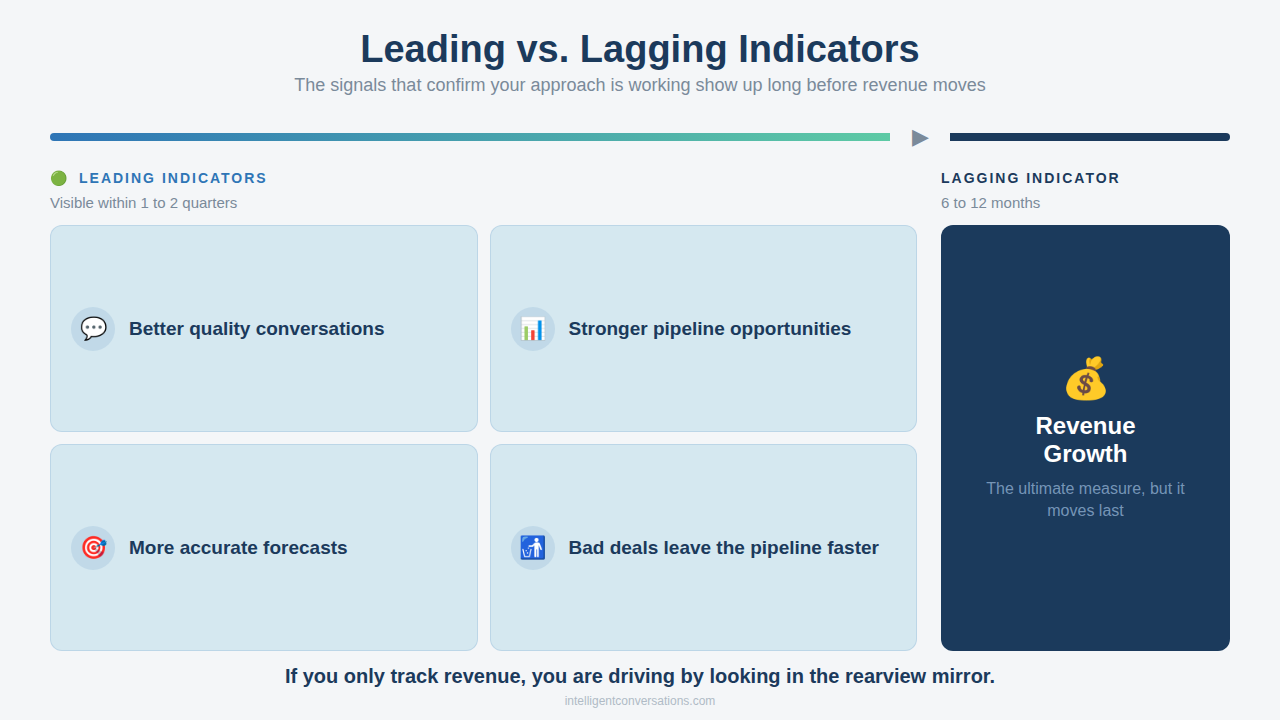
The leading indicators show up much sooner than revenue growth:
- Better quality conversations
- Stronger opportunities in the pipeline
- More accurate forecasts
- Deals leaving the pipeline that should never have been there
- More confidence across the sales team
Those signals typically become visible within one to two quarters of implementing data-driven coaching. Revenue follows. But the leading indicators confirm the approach is working long before the revenue line moves.
The inability to answer these questions today is not a failure. It is where every meaningful improvement begins. The first step is always understanding where you actually are.

Frequently Asked Questions
What is the most important question a CEO should be able to answer about their sales team?
"Can you explain why your top performer succeeds, and your bottom performer does not, with specifics?" If the answer relies on generalities or impressions, the organization is making coaching, hiring, and investment decisions without the evidence needed to make them well. That single question reveals whether leadership has the visibility required to make informed decisions about their sales organization's future.
How do you get answers to these questions without disrupting the team?
OMG evaluations take approximately 45 minutes per participant and are completed online. They do not disrupt daily operations, take salespeople out of the field, or require in-person sessions. The results provide a comprehensive view of each individual's competencies, beliefs, and coachability, plus a team-level analysis that answers most of these questions immediately. The process is designed to be minimally invasive and maximally informative.
How long does it take to see measurable improvement from data-driven coaching?
Revenue growth is a lagging indicator that may take 6 to 12 months to fully materialize, depending on sales cycle length. Leading indicators (better conversations, stronger pipeline quality, more accurate forecasts, reps asking different kinds of questions) typically become visible within one to two quarters of implementing data-driven coaching. The speed of improvement depends on the manager's coaching quality and the team's overall coachability.





Before You Invest in Your Sales Team, Answer These 5 Questions
How do you know whether your next sales investment will actually produce a return?
Ready to Build a High-Performing Sales Team?
Let's create your custom Sales Transformation Program.