
Why Reps Discount Even After You Tell Them to Stop
Written by: Mike Carroll

Executive Summary
Why do salespeople keep giving discounts even after being told not to?
When a rep keeps discounting despite clear instructions to stop, most managers treat it as a discipline problem. The real issue is the rep's buy cycle. OMG's research shows that the way a salesperson buys things in their personal life directly shapes how they allow prospects to buy from them. If they comparison shop and negotiate on price personally, they will tolerate the same behavior from buyers. The manager says, "Stop discounting." The rep agrees. Next deal, same behavior. The behavior runs deeper than disobedience. A belief system is driving it, and that belief system cannot be coached away without making it visible first.
Key Takeaways
- Discounting is a Sales DNA competency called Supportive Buy Cycle, not a discipline problem
- A rep's personal buying habits directly mirror in their selling behavior
- Value selling training wears off quickly for reps with non-supportive buy cycles
- When buy cycle awareness shifts, productivity gains can reach 30 to 40 percent
What Is the Pattern No Manager Can Explain?
The manager delivers clear feedback: "Stop offering discounts. Sell on value. Hold the price." The rep agrees completely. They understand the logic, they know margin matters, they are not being defiant.
Then the next deal comes along. The prospect says, "Your price is higher than the other options we are considering." The rep's instinct takes over. "Let me see what I can do on the pricing." The discount goes out before the rep has even explored what "other options" the prospect is comparing. The deal closes at a lower margin. Again.
The manager has had this conversation a dozen times. The rep keeps agreeing and keeps discounting. From the outside, it looks like willful disobedience or a lack of discipline. Something deeper is driving the behavior.
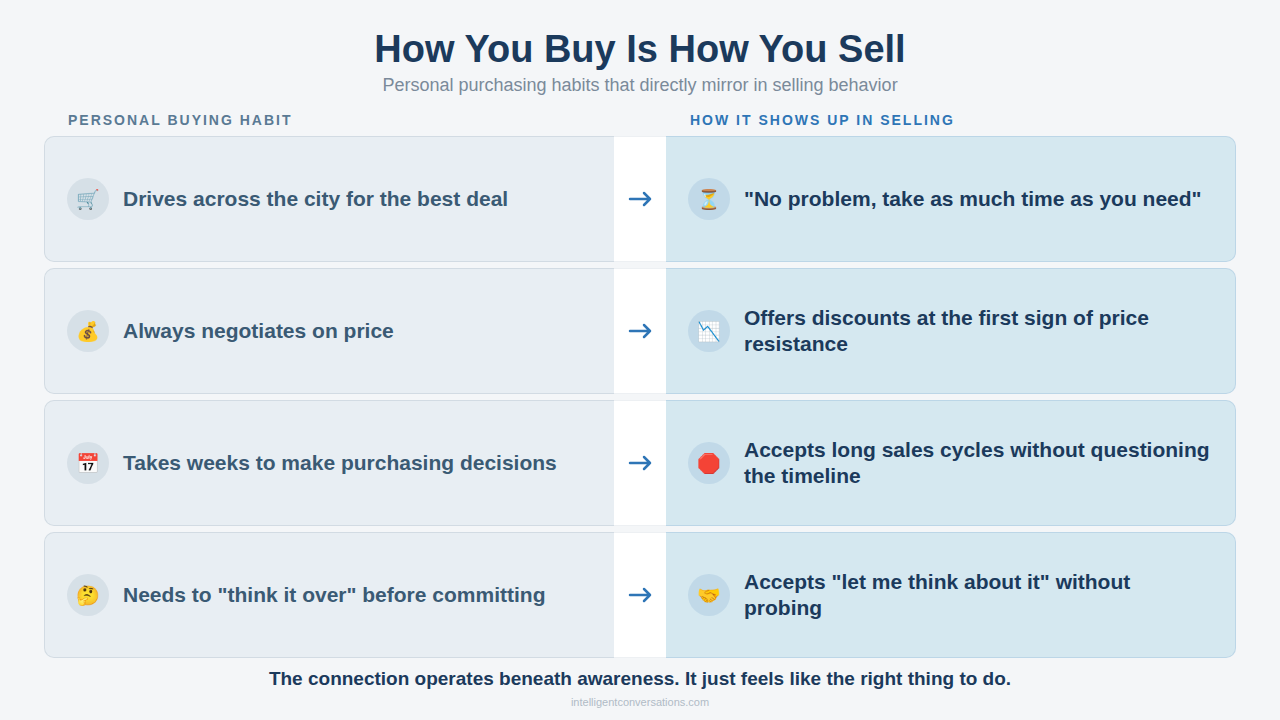
The rep's personal buying behavior is projecting onto the selling situation. If they comparison shop for every major purchase, wait for sales, and negotiate on price as a matter of principle, then when a prospect says "I need to compare prices," the rep's internal reaction is: "Of course you do. That is exactly what I would do."
The request feels reasonable. Accommodating it feels natural. It does not register as a problem because it aligns with the rep's own values around purchasing. The rep defaults to discounting without realizing they are doing it. That requires a fundamentally different solution than coaching discipline.
What Does a Non-Supportive Buy Cycle Actually Look Like?
OMG's research on buy cycle is one of the most counterintuitive findings in sales assessment. The core concept is simple: how you buy is how you sell.
|
Personal Buying Habit |
How It Shows Up in Selling |
What It Costs |
|
Drives across the city for the best deal |
Defaults to "no problem, take as much time as you need" when prospects want to shop around |
Deals exposed to competitors for weeks that were not necessary |
|
Always negotiates on price |
Instinctively offers discounts when a prospect pushes back |
Margin erodes 10 to 20 percent deal by deal |
|
Takes weeks to make purchasing decisions |
Accepts long sales cycles without questioning whether the timeline is real |
Pipeline bloats with stalled deals that should have been resolved or disqualified |
|
Needs to "think it over" before committing |
Accepts "let me think about it" from prospects without probing |
Loses urgency and momentum at the point where the deal should close |
None of this is conscious. The rep does not think, "Because I comparison shop, I should give this prospect a discount." The connection operates beneath awareness. The behavior simply feels like the right and respectful thing to do. That is what makes it so hard to coach.
Why Does Value Selling Training Wear Off?
Many organizations invest in value-selling programs. Reps learn to quantify pain, anchor price to ROI, and hold firm during negotiation. The training makes sense intellectually. Reps leave the workshop energized.
Within two to three weeks, the old behavior returns. Not for every rep. But for every rep with a non-supportive buy cycle, the reversion is almost guaranteed. The reason:
- The training creates a new intellectual framework. The rep understands the concept. They can execute it in a role play inside the workshop.
- The buy cycle is a lifetime of personal habits. It is reinforced every time the rep buys groceries, negotiates a car payment, or waits for a sale before purchasing something for their home.
- The moment a prospect triggers the pattern, the old default wins. "I need to think about it." "Can you match this price?" "We are looking at other vendors." The intellectual framework from training loses to the emotional default of personal habit.
This is why managers get frustrated with training ROI. The training itself may be excellent. Layered on top of non-supportive beliefs, even the best framework cannot stick. The beliefs have to be addressed first.
What Is the Revenue Impact?
A non-supportive buy cycle creates three direct consequences for revenue:
- Longer sales cycles. Deals take weeks or months longer than necessary because the rep tolerates delays and stalls that should be explored and resolved. Each unnecessary week in the pipeline is a week of exposure to competitive displacement.
- More discounting. Margin erodes deal by deal, often by 10 to 20 percent unnecessarily. Over the course of a year, that margin erosion across multiple deals can represent hundreds of thousands in lost revenue.
- More competitive losses. By giving the prospect time and permission to shop around, the rep invites competitors into deals that could have been closed earlier. Deals that were the rep's to lose become genuine competitions.
OMG's data suggests that when buy cycle awareness shifts from non-supportive to supportive, productivity gains can reach 30 to 40 percent. For a rep producing $500,000 in annual revenue, that shift represents an additional $150,000 to $200,000 in production. Multiply that across a team, and the organizational impact is significant.
There is a compounding effect when the manager also has a non-supportive buy cycle. If the manager personally tolerates long sales cycles, discount requests, and competitive comparisons, that tolerance becomes the team standard. The manager does not coach against discounting because discounting feels normal to them. The manager's own DNA caps the team's pricing discipline.
How Do You Actually Address This?
Step 1: Make the pattern visible. The rep needs to see the connection between their personal buying habits and their selling behavior. Assessment data from an OMG evaluation reveals the buy cycle score and shows specifically how it manifests in selling situations. Most reps resist this initially because the buy cycle concept feels personal in a way that other competencies do not. That is why third-party assessment data matters more here than the manager's opinion.
Step 2: Practice specific trigger scenarios. Not a generic value selling role play. Practice the exact moments where the buy cycle gets triggered:
- The prospect says they need to compare options. Practice: "No problem. As you think about it, what specifically are you looking for?"
- The prospect asks for a discount. Practice: "We are almost never the low price. Why do you think people buy from us?"
- The prospect wants more time. Practice: "Take your time. While you are thinking it over, what are the main things you are weighing?"
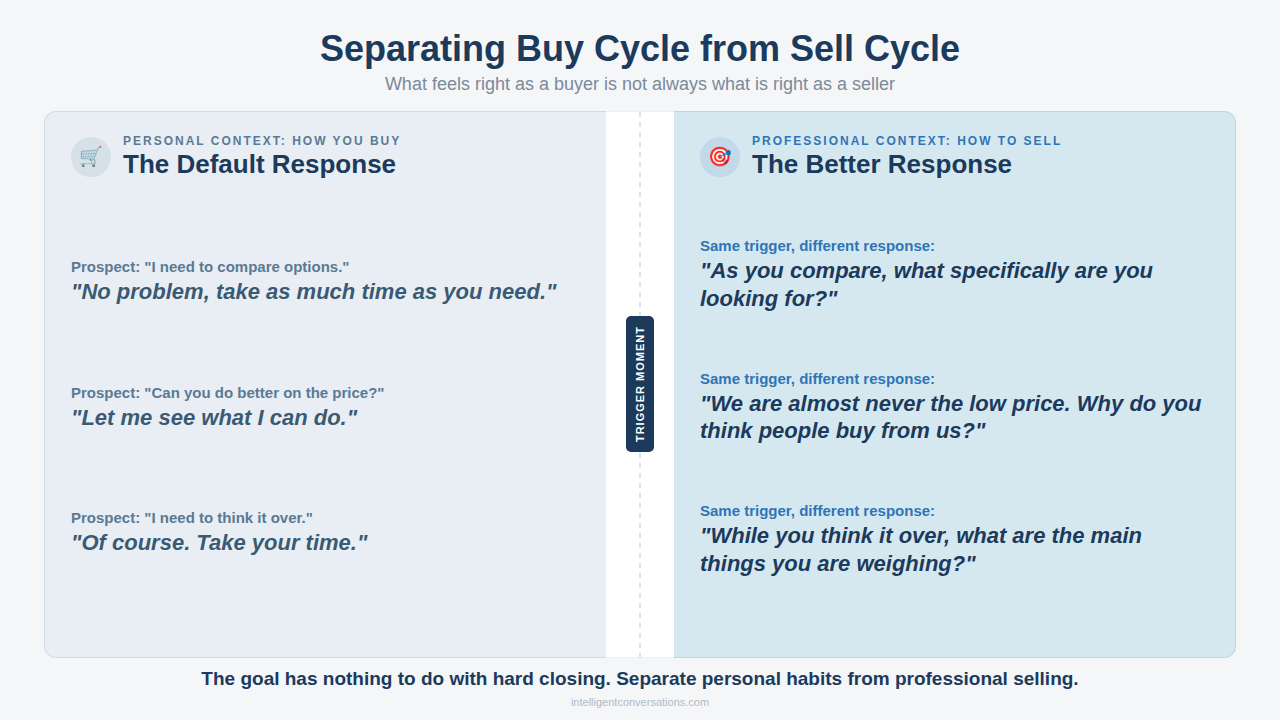
Step 3: Build awareness, not guilt. The rep's buying habits are perfectly fine for personal purchases. Nothing needs to change about how they shop. The coaching conversation is about recognizing that selling requires a different set of responses than buying. Those are different contexts. What feels right as a buyer is not always what serves the deal as a seller. When that distinction becomes clear, the rep's approach to pricing, timing, and competitive displacement shifts meaningfully.

Frequently Asked Questions
What is the difference between a rep who discounts strategically and one with a non-supportive buy cycle?
A strategic discounter uses pricing flexibility as a planned negotiation tactic within defined margins and with management approval. The discount is a tool in a larger strategy. A rep with a non-supportive buy cycle offers discounts reflexively, without strategy, as the default response to any pricing resistance. The discount happens reflexively, driven by personal buying behavior rather than any deliberate strategy.
Can you fix a non-supportive buy cycle, or is it permanent?
It can be shifted, but it takes sustained effort over months, not days. The rep needs to see the data, understand the connection between personal habits and professional behavior, and practice new responses until they replace the old defaults. Many reps report that even after shifting their selling behavior, their personal buying habits remain the same. The key is separating the two contexts.
How does a manager's buy cycle affect the team's pricing behavior?
If the manager has a non-supportive buy cycle, they will tolerate longer sales cycles, accept stall tactics, and not push back on discounting because those behaviors feel normal and reasonable to them. The team internalizes the manager's tolerance level as the standard. Changing the team's pricing discipline often requires changing the manager's awareness first.





Before You Invest in Your Sales Team, Answer These 5 Questions
How do you know whether your next sales investment will actually produce a return?
Ready to Build a High-Performing Sales Team?
Let's create your custom Sales Transformation Program.