
The Rep Who Knows What to Say But Can Never Say It in Time
Written by: Mike Carroll

Why do salespeople know exactly what to say but cannot say it when it counts?
This is a Sales DNA issue. Reps who struggle to stay in the moment are processing internal self-talk while the prospect is still talking. They second-guess, rehearse their next line, worry about how the call is going. They catch what was said after the call ends. The insight lands on the drive home. The buying signal passed ten minutes ago.
Key Takeaways
- Stays in the Moment is one of the six Sales DNA competencies measured by OMG. It determines whether a rep can process and respond to what a prospect says in real time.
- Reps with a gap here do not lack knowledge or skill. They cannot access what they know under the cognitive load of a live selling conversation.
- Self-talk is the most common cause. While the prospect is talking, the rep is already preparing their response.
- This competency is nearly invisible in standard coaching because the rep sounds sharp and self-aware in every debrief. The gap only shows up on the actual call.
- Coaching this requires recorded call review, specific listening exercises, and consistent practice over weeks.
What Does It Look Like When a Rep Cannot Stay in the Moment?
Every sales manager has had this conversation. The rep comes out of a meeting and says: 'When they said that, I should have said this.'
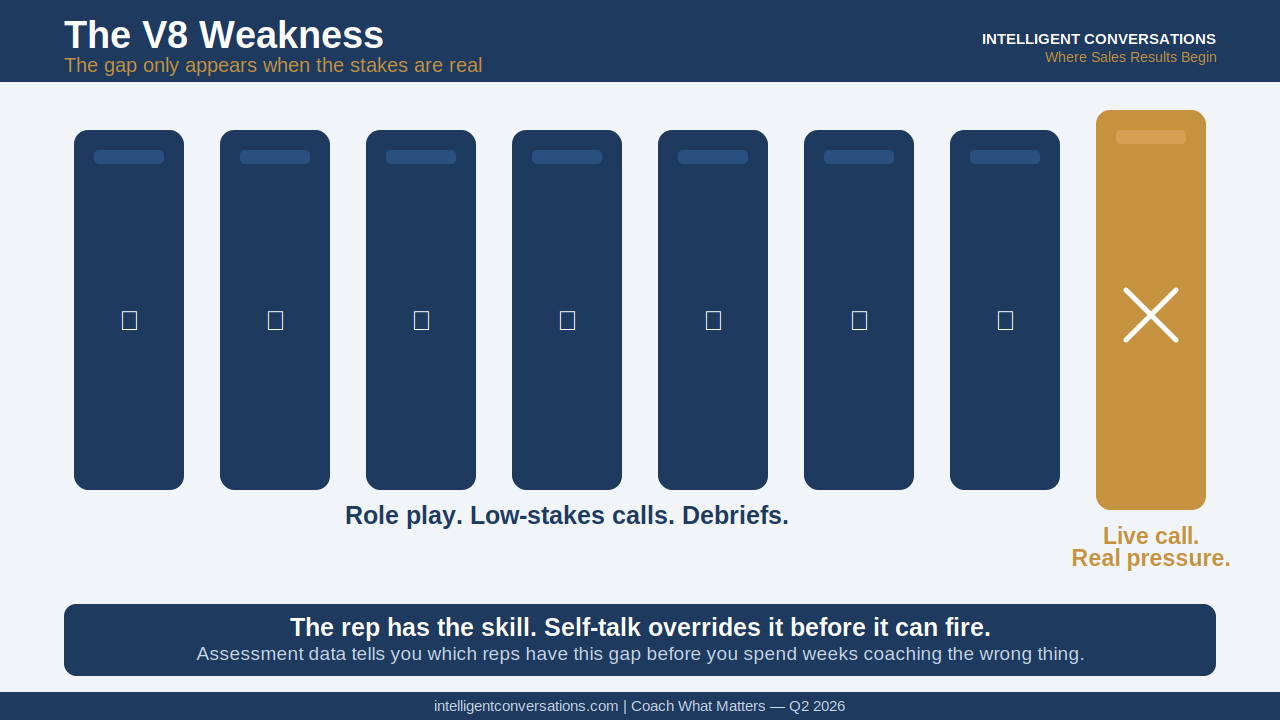
They knew exactly what to say. They have been trained on it. They have role-played it. In a low-stakes practice scenario, they execute it cleanly.
In the actual meeting, it never came out.
Think of it like a V8 engine with one weak cylinder. The car looks fine from the outside and usually runs. But under specific conditions, like high load and real pressure, the cylinder misfires. You only feel it when you need full power.
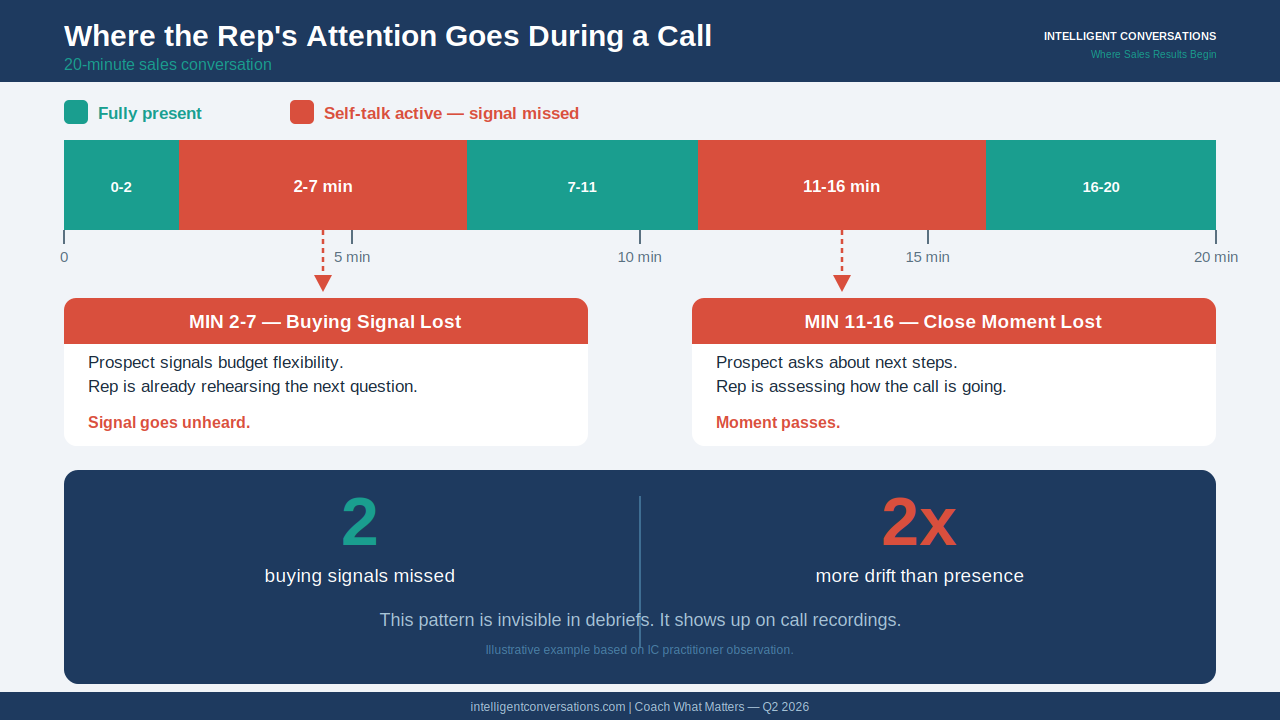
During a live call, the rep's internal self-talk runs in the background. While the prospect is talking, the rep is already:
- Formulating a response
- Assessing how the meeting is going
- Mentally rehearsing the next question
They are physically present in the room. Cognitively, they have drifted.
The prospect says something that signals readiness to move forward. The rep does not catch it. The conversation moves on. The window closes.
Play the call back and ask the rep what they heard at that moment. They say: 'Now that I'm listening, I can hear they were basically saying yes. I had no idea at the time.'
They did not miss it because they were careless. They missed it because they were not actually listening.
Why Do Managers Keep Missing This Competency?
The rep who cannot stay in the moment is often one of the sharpest people on the team in retrospect. That sharpness is what keeps the problem hidden.
After a call, the rep gives a clear, detailed account of what happened. They articulate what they should have done. They ask good questions. They seem to have processed everything thoroughly. The manager concludes: solid rep, good self-awareness, they will get it next time.
The debrief happens at room temperature. The next call happens under pressure. The same cognitive interruption fires. The same window closes. The pattern repeats week after week.
Managers miss it because they coach the deal and skip the cognitive pattern. Nobody asks:
- What were you thinking when the prospect said that?
- What was running through your head in the ten seconds after they asked the question?
The debrief covers what happened and what to do next. It skips what the rep was experiencing inside while it was happening.
Without Sales DNA data, there is no reason to look for this pattern. The manager sees inconsistency. Or nerves. Or lack of focus. All partially true. None of them lead to a coaching approach that addresses the root cause.
|
What Happens in the Debrief |
What Happened on the Call |
|---|---|
|
Rep articulates what went wrong clearly |
Rep was not tracking when it happened |
|
Rep knows the right response in hindsight |
Rep could not access the response in the moment |
|
Manager coaches: do this differently next time |
Same cognitive gap fires on the next call |
|
Rep says: I know, I know — and means it |
The self-talk that interrupted listening is still running |
How Do You Coach Stays in the Moment?
Generic active listening training does not fix this. The rep already knows they should be listening. Telling them to pay closer attention addresses the symptom. The self-talk that interrupts listening runs below conscious awareness. It has to be surfaced before it can be coached.
Four approaches that target the actual problem:
1. Call Review Done Differently
Most call reviews focus on what was said. This version focuses on what the rep was thinking. Stop the recording at a specific moment and ask: what were you thinking right then? If the rep cannot answer with any precision, that is informative on its own. Have them listen to the moment again. Then ask: were you actually hearing this when it happened, or were you already preparing your next question?
Do this consistently across five or six calls and the pattern becomes visible to the rep in a way that coaching conversation alone cannot produce.
2. The One Miss Exercise
After every call, the rep writes down one thing they heard that they did not follow up on. The goal is building the habit of noticing. Over four to six weeks, that noticing begins to happen earlier. Mid-call instead of post-call. The delay between signal and recognition shortens.
3. The Repeat Test
In role plays, stop the rep mid-conversation and ask them to repeat verbatim, not interpret, exactly what the prospect just said. Most reps cannot do it. They have already filtered, processed, and moved to their response. The exercise makes the self-talk visible in a low-stakes environment. It can feel uncomfortable. That discomfort is useful.
4. Identifying the Specific Pattern
Reps with this weakness usually have one of three internal patterns running during calls:
- Anticipating what comes next
- Assessing how they are performing
- Rehearsing
Ask the rep which one tends to take over for them. Most can identify it when asked directly. Once the specific pattern has a name, the rep can recognize it as it starts and practice setting it aside.
None of this works in a single coaching session. It takes a sustained cadence over weeks. The manager needs to know the rep has this gap before structuring the coaching around it. Assessment data tells the manager where to look before spending six weeks focused on the wrong thing.
What Should a Manager Look for on Call Reviews?
Four signals suggest a rep is struggling to stay in the moment. None of them are obvious in real time. All of them become visible in recordings.
|
Signal |
What It Tells You |
|---|---|
|
Rep asks a question the prospect just answered |
Self-talk was active — rep was not tracking the conversation |
|
Rep responds with a feature explanation when the prospect asked about fit |
Rep filtered the question through their prepared response, not through what was actually asked |
|
Rep keeps talking past a point where the prospect signaled readiness |
Missed the transition moment because they were not present for it |
|
Post-call debrief is consistently sharper than the call itself |
Rep processes retrospectively. Present in analysis, absent in real time |
Once a manager knows to look for this pattern, it appears on recordings with regularity. Standard sales management training focuses on deal coaching, so most managers have never been taught to notice it. Assessment data makes it explicit. The manager goes into every call review knowing this is a specific variable to track for this rep.

Frequently Asked Questions
What is the Stays in the Moment sales competency?
Stays in the Moment is one of the six Sales DNA competencies measured by OMG assessments. It measures whether a salesperson can remain fully present during a selling conversation, processing what the prospect actually says rather than running self-talk, planning the next response, or monitoring their own performance. Reps with a weakness here are often perceptive and self-aware in retrospect but miss critical signals while the conversation is live.
How do you tell whether a rep has a skills problem or a Stays in the Moment problem?
Look at performance across contexts. If the rep executes a skill well in role plays and practice scenarios but struggles on live calls, the gap is cognitive. Skills problems tend to be consistent across settings. Stays in the Moment problems appear specifically under the pressure and unpredictability of real conversations, when the self-talk kicks in.
Can coaching improve Stays in the Moment?
Yes, but telling the rep to pay better attention will not produce it. The self-talk that interrupts presence has to be identified and named first. Effective coaching uses recorded call review to surface when cognitive absence starts, builds exercises around noticing what the rep missed, and creates practice habits that slow the internal commentary down over time. Consistent improvement typically takes four to eight weeks of targeted work.
Is this competency common enough to assess across a whole team?
Yes. OMG data consistently shows Stays in the Moment as one of the differentiators between top and average performers across sales teams. Many managers have never named this issue precisely because it is invisible in the formats they typically use to coach. It appears quickly on call recordings once the manager knows what to look for.
Related: Why Sales Coaching Fails (And What Data-Driven Managers Do Differently) →





The Questions Your Sales Managers Should Be Asking (But Are Not)
Executive Summary What are the questions that reveal whether your sales organization is actually healthy?
Ready to Build a High-Performing Sales Team?
Let's create your custom Sales Transformation Program.