
Top Sales Performer vs. Best Salesperson: The Gap
Written by: Mike Carroll

Quick Answer: The salesperson producing the most revenue on your team isn't automatically your best one, because territory, inherited accounts, brand recognition, and timing all show up in that number without showing up in the skill set. The way to tell them apart is to ask what would happen if you took those advantages away, and then look at whether the behaviors that survive are the ones that produce results anywhere.
Key Takeaways
- High revenue and high skill are different things. Circumstance explains more of the top number than most sales leaders expect.
- Structural advantages compound quietly. A strong territory hands someone a head start every January that has nothing to do with how they sell.
- The salesperson near the bottom of the list may be your best one. Durable behavior in a hard market beats good results in an easy one.
- Revenue rank is a bad input for a promotion decision, because it describes where someone has been rather than where they can go.
How Do You Separate Territory Advantage from Actual Selling Skill?
Run the test most sales leaders never run: take the advantages away on paper and see what's left.
Picture the person who just won President's Club. Best territory, strongest brand recognition in their market, the longest-running customer relationships on the team. Now imagine dropping that same person into a market with none of it, where nobody has heard of you, the competition is entrenched, and the job is a list of two hundred companies and a phone.
Would they still be your top performer?
Sometimes the answer is yes, and that tells you something valuable. What should worry you is that most sales leaders can't answer the question at all, because nothing they currently measure would tell them.
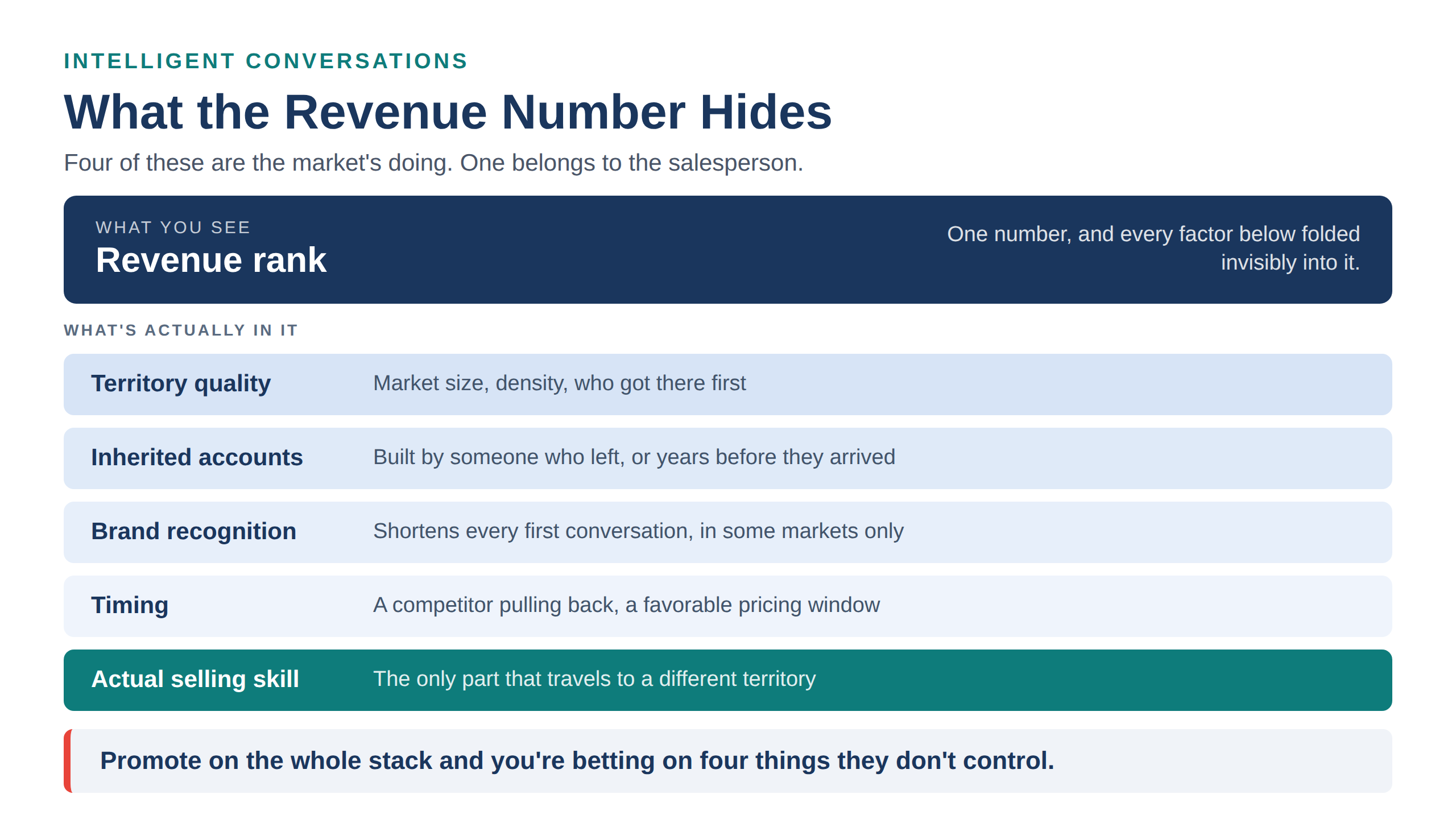
Here's what accumulates inside a revenue number without ever touching the skill set:
- Territory quality, including market size, density, and how much competition is already established there
- Inherited accounts, handed over from someone who left or built years before this person arrived
- Brand recognition, which shortens every first conversation in some markets and doesn't exist in others
- Timing, like a competitor pulling back or a favorable pricing window that nobody on your team created
None of those are the salesperson's doing, and all of them land in their number. When leadership reads that number as a measure of the person, the diagnosis runs backward from the start.
What Actually Separates a Top Producer From a Top Salesperson?
One is producing results in the conditions they were given. The other is producing results that would survive different conditions.
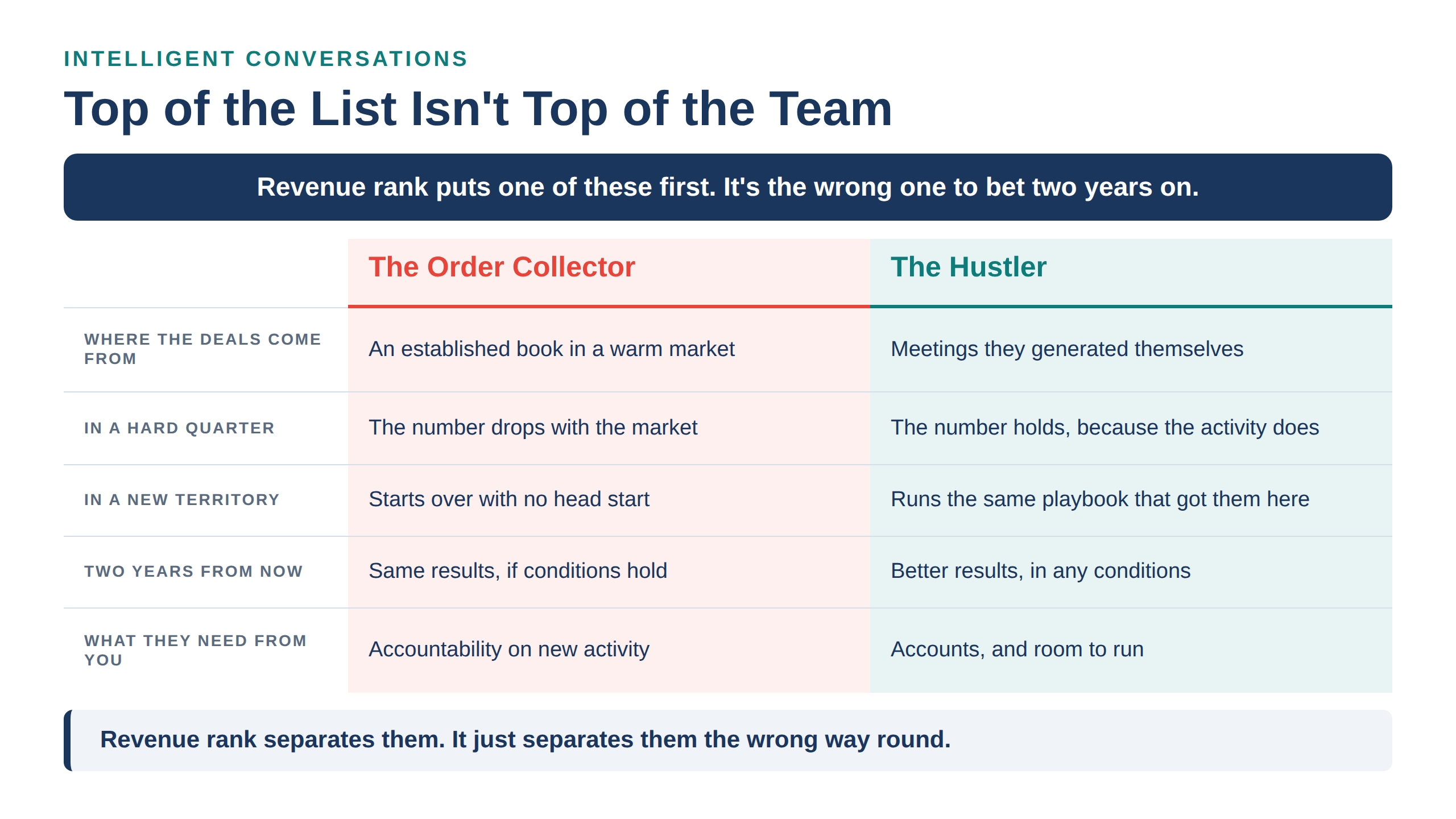
The distinction gets sharpest when you put two people side by side who post similar numbers:
|
The order collector |
The hustler |
|
|---|---|---|
|
Revenue rank |
Top of the list |
Middle or bottom |
|
Where the deals come from |
An established book and a warm market |
Meetings they generated themselves |
|
What a hard quarter does |
Number drops with the market |
Number holds, because the activity does |
|
What happens in a new territory |
Starts over with no head start |
Runs the same playbook that got them here |
|
Two years from now |
Same results, if conditions hold |
Better results, in any conditions |
|
What they need from you |
Accountability on new activity |
Accounts, and room to run |
A salesperson near the bottom of the revenue list who's driving activity, qualifying honestly, and doing all the right things to get a little revenue across is often worth more over two years than someone sitting in the best market collecting orders.
That isn't sentimentality about effort. It's a read on what's durable. The hustler's behavior produces results in any market because the behavior is the thing generating them. The order collector's results depend on conditions holding, and conditions don't hold.
What Should You Look at Instead of Revenue Rank?
Look at what the person generated, not what they closed.
Revenue tells you what crossed the line. These four signals tell you who actually moved it:
- Self-sourced meetings. How many first conversations did this person create without marketing or an inherited relationship handing it to them? This strips out the account buffer faster than anything else on the list.
- Conversion at each stage. A high closer on weak opportunities and a weak closer on strong ones can post the same number. The stage-by-stage view separates them.
- Deal shape. Are they winning the deals the business wants, or the ones that were easiest to reach?
- Behavior under pressure. What happens to their activity in a bad month tells you more than what happens in a good one.
Net-New Meetings: How to Track the Indicator That Predicts Next Quarter covers the first of those in depth, including how to define it so the number means the same thing week to week.
For the barriers sitting underneath these behaviors, the ones a manager can't see from a ride-along, What Your Sales Manager Sees vs. What the Data Says covers why observation alone can't get you there and what to pair it with.
How Do You Act on This Without Blowing Up the Team?
Change what the information is used for before you change anyone's territory.
The instinct once a leader sees this clearly is to start moving accounts around. That's usually the wrong first move, and it's the one that costs you people.
A more useful sequence:
- Stop using revenue rank as a proxy for talent rank. It's the single change that fixes the most downstream decisions, and it costs nothing.
- Spend coaching time where it changes outcomes. Most coaching energy goes to the top of the list, which needs it least, and to the urgent problems at the bottom. The middle of the team is where the biggest gains are available and where the attention rarely lands.
- Name what a strong fit looks like for this role, in plain language, before the next hire or the next promotion.
- Establish a baseline first. Any restructure built on last year's revenue is built on the one number you now know is unreliable.
The 12-Week Playbook lays out that sequence, from baseline to a single play to a close, so the decision comes after the evidence rather than before it.
Get the 12-Week Playbook
Most sales investments start with a decision and work backward to the data. This playbook runs the other direction. It shows how to set a baseline, pick the one play that matters for your team right now, and find out whether the real gap is coaching, process, or talent before you spend on any of them.

Frequently Asked Questions





What Your Sales Manager Sees vs. What the Data Says
Quick Answer: A sales manager watching a salesperson can see what happened, but not why it happened, and that gap is ...
Ready to Build a High-Performing Sales Team?
Let's create your custom Sales Transformation Program.