Your Sales Team Isn't the Problem. Your Manager Is.
Written by: Mike Carroll

Quick Answer
The biggest driver of sales underperformance is not your team, your market, or your competition. It is your front-line sales managers. A 2026 global survey of B2B sales practitioners across 12,000+ client engagements found that 95% named coaching effectiveness as the number one development need for managers. Only 9% said meaningful coaching is actually happening. Nearly half of managers don't know how to coach and don't treat it as a priority. Another 40% conflate coaching with reviewing KPIs. The result: reps plateau, processes don't stick, training fades, and turnover accelerates. Fixing the manager is the single highest-leverage investment a sales leader can make.
Key Takeaways
- 95% of practitioners say coaching is the #1 development need for managers, but only 9% see it happening
- 48% of managers don't know how to coach and don't prioritize it
- 40% reduce coaching to KPI monitoring
- Deals are lost primarily to poor qualification (65%), not competition (fewer than 7%)
- 75% of practitioners named developing managers into coaches as the top priority for 2026
- The skills gaps driving deal loss, including discovery, business acumen, and qualification, are all coaching-dependent capabilities
What 12,000 Client Engagements Tell Us About Sales Performance
Membrain recently published a global survey of B2B sales practitioners. Not academics. Not analysts watching from a distance. These are the consultants, trainers, and coaches called in when performance is broken. They're embedded inside companies, diagnosing problems, redesigning processes, and developing the managers and sellers who execute day to day.
The average respondent has 23.7 years of experience. Collectively, they represent approximately 810 active clients and an estimated 12,000 career engagements across 23 countries.
Here's what they found.
|
What Practitioners See at First Engagement |
% |
|
Fewer than half of reps hitting quota |
78% |
|
Team performance worse than 3 years ago |
51% |
|
No meaningful change in performance |
37% |
|
Seeing any improvement |
12% |
That last row matters. More than a third saw no change. Given the massive investment in AI tools, enablement platforms, and sales training over the same period, flat is its own kind of failure.
Why It's Not the Market and Not the Competition
Here's the conversation that happens at nearly every company with a struggling sales team.
The CEO says: the market got harder. Buyers are more cautious. Competition is tougher.
The sales manager says: the team needs better leads. The pipeline is thin. Prospects aren't returning calls.
Both explanations point outward, and both are wrong.
When practitioners across 12,000 engagements were asked what actually kills deals, competition barely registered. Fewer than 7% named a competitor winning the deal as a primary loss driver.
What's Actually Killing Deals
|
Deal Loss Driver |
% of Practitioners Who Named It |
|
Poor qualification |
65% |
|
Can't articulate value in business terms |
49% |
|
Buyer can't get internal alignment |
48% |
|
Indecision / no decision made |
42% |
|
Not talking to the right people |
37% |
|
Budget cut or reprioritized |
25% |
|
Competition |
6% |
External research from the Martal Group puts an even sharper point on it. The deals aren't being lost to someone else. They're being lost to inaction. To reps who can't build urgency. To sellers who can't make the case for change. To pipelines full of opportunities that drift and eventually die.
Those are internal failures. And they lead to one question: if the team isn't the problem and the market isn't the problem, where does the problem actually live?
The Coaching Crisis
Here's the pattern. A company has a great closer. Best numbers on the team. Leadership promotes them into management. Six months later, the team is worse and the new manager is frustrated.
They're doing what they know. Checking numbers. Reviewing pipelines. Occasionally jumping into deals to rescue them.
That’s not coaching. That's a top performer doing a job nobody prepared them for.
And it's not their fault. The company promoted a seller and expected a coach. Nobody invested in the transition. Nobody taught them how to develop other people. So they default to what's familiar, and the team stagnates.
The survey confirmed this pattern at scale. Nearly every practitioner named coaching effectiveness as the top development need for managers. But almost no one sees it being pulled as a lever.
How Much Coaching Are Front-Line Managers Actually Doing?
|
What Practitioners Observe |
% |
|
Don't know how to coach, don't treat it as a priority |
48% |
|
Conflate coaching with KPI management |
40% |
|
Some meaningful coaching happening (not nearly enough) |
9% |
One practitioner in the survey summed it up: they measure everything and develop nothing.
That's the core of it. Managers are reviewing dashboards. Checking activity metrics. Asking about pipeline numbers. They think that's coaching. It's not. It's scorekeeping. And scorekeeping doesn't make anyone better.
What Skills Are Missing (And Why Coaching Is the Only Fix)
Here's where the coaching gap shows up in real deals.
A rep gets on a discovery call and asks surface-level questions. They never uncover the real problem. They present a generic solution. The prospect says, "This is interesting, let me think about it." Three months later, the deal goes dark.
The skills gap data in this survey lines up almost perfectly with the deal loss data. That's not a coincidence, just cause and effect.
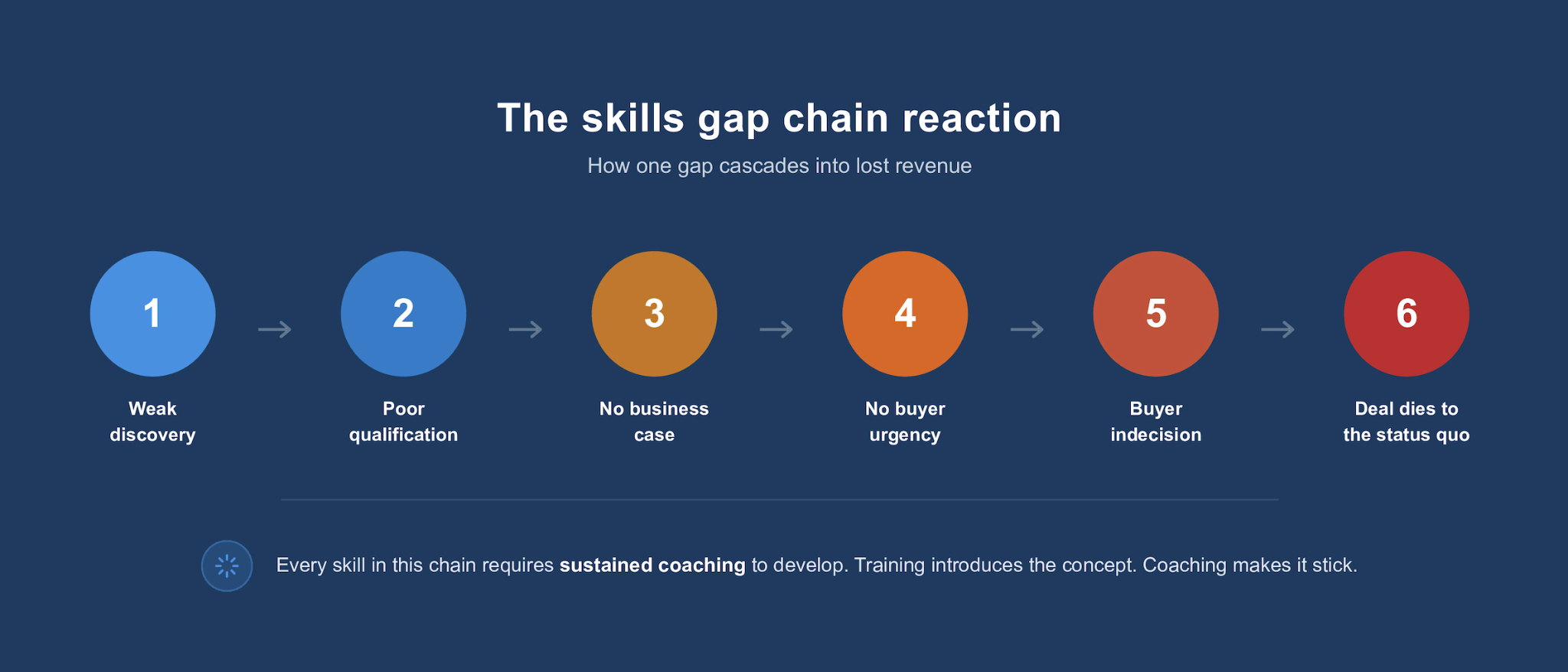
The survey confirmed this pattern. The top skills gaps in sales executives today map directly to the top reasons deals are lost:
|
What Reps Can't Do |
What It Causes |
|
Uncover real problems (discovery) |
Deals aren't qualified well |
|
Speak the language of executives (business acumen) |
Can't articulate value in business terms |
|
Listen to understand, not just respond |
Buyer can't get internal alignment |
|
Identify high-probability deals (qualification) |
Indecision, no decision made |
Every skill on the left requires the same thing to develop: a manager who can coach it in real deals, over time. Not a workshop. Not a training day. Repeated practice with someone who knows what good looks like and can give feedback in the moment.
That developmental loop is almost universally absent.
And there's a layer beneath even these skills that most managers never see. Reps who avoid money conversations. Reps who need approval so badly they won't challenge a prospect. Reps who accept stalls and delays because pushing back feels uncomfortable.
Those aren't technique problems, but deeper competencies, and training alone won't reach them. Only sustained, individualized coaching addresses what's happening underneath.
How Hiring and Coaching Are Connected
If you've been focused on improving your sales hiring process, good. That work matters. But hiring is only half the equation.
The Onboarding and Retention Problem
- 5.7 months average ramp time to productivity (up 32% since 2020)
- 58% of practitioners rate client onboarding as poor and disorganized
- 2% rated onboarding as good
- 35% annual rep turnover (nearly 3x other professional roles)
- 54% named bad management as the #1 driver of turnover
- $97,960 average cost to replace a failed sales hire ($200K+ for top performers)
Most companies are losing reps before they reach peak performance, which typically happens between years two and three.
You can hire the right person and still lose them. If your manager doesn't know how to develop them in the first 90 days, your great hire becomes another data point in a turnover report.
One of the things we evaluate when assessing sales candidates is coachability. How do they take feedback? Are they open to changing how they do things? That matters. But coachability only counts if there's someone on the other side actually coaching.
If your managers aren't equipped to develop new hires through that critical first few months, then even your best talent acquisition work gets wasted. The hire doesn't fail because they were wrong for the role. They fail because the environment wasn't built to help them succeed.
If you're not sure whether your hiring process is setting new people up for success or setting them up to fail, start with the Sales Hiring Diagnostic. It takes less than 10 minutes and gives you an immediate picture of where your process is breaking down.

What Good Actually Looks Like
Three out of four practitioners in this survey named developing front-line managers into effective coaches as the single top priority for 2026. Nothing else came close.
The companies that are winning right now are not the ones with the best technology or the biggest training budgets. They're the ones whose managers sit down with their people every week and work on real deals together. They debrief losses against a process. They role-play discovery calls. They hold people accountable to commitments, not just numbers.
Process without coaching is a document. It exists. Nobody follows it. Coaching without process has no structure. Managers give advice, but it doesn't anchor to anything the rep can internalize. They work together or they don't work at all.
If you're thinking about your own management team right now, start with a few questions:
- When was the last time your sales manager sat in on a live call and gave real-time feedback?
- When did they debrief a lost deal by walking through the process, not just asking what went wrong?
- When did they role-play a discovery conversation with a rep who's struggling?
If you can't answer those questions, you've found the gap.
Frequently Asked Questions
Why do sales managers struggle with coaching?
Most sales managers were promoted because they were strong individual sellers. Selling and coaching are different skill sets. Without intentional development, new managers default to what they know, which is usually reviewing numbers and jumping in to close deals. The survey found that 48% of managers simply don't know how to coach and don't treat it as a priority.
What is the difference between coaching and managing KPIs?
KPI management tracks outcomes. Coaching develops the behaviors that drive those outcomes. Reviewing a dashboard tells you a rep's close rate dropped. Coaching tells you why, and helps them fix it. Forty percent of practitioners in the survey said managers confuse the two.
How do I know if my manager is coaching effectively?
Look at whether reps are improving over time, not just whether they're hitting numbers this quarter. Ask your reps when they last received specific feedback on a deal. If the answer is "I don't remember" or "at the annual review," coaching is not happening.
What is the ROI of investing in sales manager development?
Structured coaching programs correlate with faster ramp times, lower turnover, and better process adoption. The survey found that companies with strong coaching cut ramp time nearly in half and retained reps significantly longer. Given that replacing a sales hire costs an average of $97,960, the math is clear.
How do coaching and hiring connect?
Hiring gets the right person in the door. Coaching determines whether they succeed once they're there. One of the key candidate traits we evaluate is coachability, but it only matters if the manager is equipped to develop the new hire. Bad management was named the number one driver of turnover in this survey.
Can AI replace sales coaching?
Not for the work that matters most. AI is useful for administrative tasks, research, call analysis, and meeting prep. But the skills that drive sales performance, including discovery, qualification, business acumen, and navigating buying committees, require human judgment, real-time feedback, and individualized development. The survey found that 72% of practitioners say AI's impact is still too early to assess, and 17% say it's actively hurting by adding noise to prospecting without improving the quality of selling.






The A-Player Repellent: How Weak Sales Management Silently Kills Your Candidate Pool
Quick Answer: B-level managers attract B and C-level talent. A-players detect weak leadership during interviews and opt ...
Ready to Build a High-Performing Sales Team?
Let's create your custom Sales Transformation Program.