
Sales Technology ROI: The Readiness Questions to Answer Before You Buy
Written by: Mike Carroll

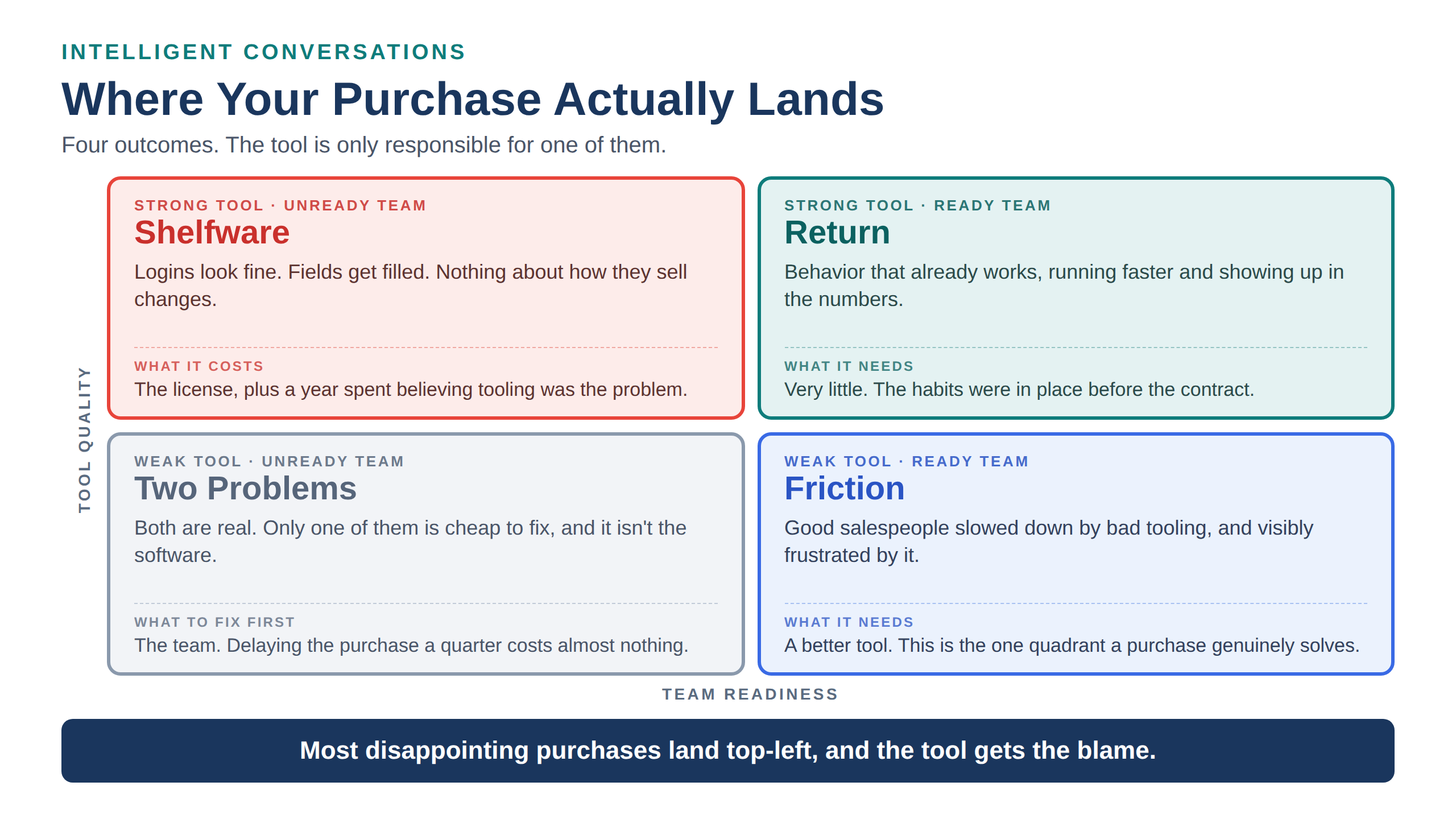
Quick Answer: Sales technology returns value when the team already has the habits the tool is built to accelerate, and becomes an expensive line item when it doesn't. The question worth answering before the contract gets signed isn't whether the platform has the right features. It's whether the salespeople using it prospect consistently, qualify honestly, and work inside a coaching rhythm that can hold a new behavior in place. That answer sits in how the team sells, and no vendor's ROI model can see it.
Key Takeaways
- Software accelerates whatever is already happening. A team that avoids outbound will avoid it faster, with better reporting.
- Compliance and adoption produce the same usage report. Logins and completed fields tell you the tool is being obeyed, not that anything changed.
- The vendor's ROI model runs on their best customers' behavior, so the business case needs a baseline drawn from this team instead.
- Revenue won't tell you whether the purchase worked for at least two quarters, but the activity underneath it will tell you inside one.
What Should You Check Before Buying Sales Technology?
Check whether the behavior the tool is meant to accelerate is already happening somewhere on the team.
Every sales leader heading into budget season gets some version of the same pitch. The right platform will fix the number, the demo is genuinely impressive, and the ROI calculator makes the decision look obvious. What almost never gets asked in that room is whether the salespeople on this team have the habits the tool is designed to amplify.
Software doesn't create behavior. It makes existing behavior faster, more visible and easier to count. A team already prospecting consistently will get more from a sequencing tool in ninety days than a team avoiding the phone will get from it in a year, and the tool is identical in both cases.
Four questions worth answering while the contract is still unsigned:
|
Question to answer |
A ready team looks like |
An unready team looks like |
|
How many net-new meetings does the team generate in a week, and which way is that number moving? |
A number everyone can say out loud, holding flat or climbing |
Nobody can produce it without pulling a report, and the report needs cleaning first |
|
Where does new pipeline come from? |
A real mix, with a meaningful share self-sourced |
Inbound, renewals and a handful of long-standing accounts |
|
What happens to a new process sixty days after the training? |
It's still in the weekly rhythm because something holds it there |
It's gone, and nobody brings it up |
|
Does the manager have a coaching structure, or a standing meeting? |
Named themes, a consistent cadence, notes that carry week to week |
A recurring calendar invite and a pipeline review |
If most of this team sits in the right column, the gap isn't a tooling gap and the purchase won't close it. All a purchase does in that situation is make the same gap more expensive and considerably better documented.
Revenue won't settle any of these four questions either, which is the part that catches leadership teams off guard. Lagging Indicators in Sales: Why Your Revenue Number Is Lying to You covers why the number confirms a problem months after the behavior that caused it.
Why Do Sales Tools Get Bought and Then Go Unused?
Because compliance and adoption produce the same usage report.
Salespeople log in. They fill the required fields ahead of the pipeline review, generate whatever leadership asked to see, and then do their actual selling somewhere else, in a notebook or a spreadsheet or their own memory. From the dashboard, usage looks healthy. Nothing about how they sell has moved.
This usually isn't a training gap, which is why more training so rarely fixes it. Two patterns sit underneath instead. One is a belief that activity tracking exists to catch people rather than help them, and a salesperson who believes that gives the system what the policy requires and not one field more. The other is a habit settled enough that any new workflow registers as friction.
Both are invisible on a usage report, because a usage report counts what happened and never why:
|
What the report shows |
Compliance |
Adoption |
|
Logins |
Daily, ahead of the review |
Daily, because the next call starts there |
|
Field completion |
Filled in the hour before the pipeline meeting |
Filled while the conversation is still fresh |
|
Call notes |
One line that satisfies a required field |
Detail a manager can coach from |
|
Forecast |
Numbers nudged toward what's expected |
Numbers that hold up when questioned |
|
What changed in how they sell |
Nothing |
The part that justifies the spend |
Neither pattern shows up in a revenue report or a feature comparison, so the only place to find them is in how people actually sell. That's a different kind of data than most companies have on hand, and it's worth having up front rather than two quarters into a rollout that isn't landing. What Your Sales Manager Sees vs. What the Data Says covers why observation alone can't get you there and what to pair it with.
How Do You Build the Business Case Before You Buy?
Start from a baseline of how this team sells, not from a model of how the vendor's best customers sell.
Every ROI calculator runs on assumptions about adoption rates, usage patterns and the behavior change that turns usage into revenue. Those assumptions came from the customers the vendor likes to talk about, so they aren't wrong exactly. They're borrowed, and borrowed assumptions are thin ground for a commitment this size.
|
The vendor's model assumes |
A baseline tells you |
|
Salespeople will work inside the tool every day |
Whether they work inside the current one, or around it |
|
Managers will coach off the data it produces |
Whether managers coach off anything today |
|
Pipeline discipline is already in place |
What the pipeline actually looks like at the top |
|
New behavior will stick once the workflow changes |
What happened to the last process change, sixty days in |
The gap between those two columns is the entire business case, and it takes a few weeks and a fraction of the platform cost to measure. The 12-Week Playbook lays out how to build that baseline, pick the single play that matters most right now, and tell whether the real constraint is coaching, process or talent.
What ROI Timeline Should You Put in the Business Case?
Ninety days for an honest read on adoption, six months before pipeline quality moves, and longer than that before revenue says anything useful.
The most common way a technology purchase gets judged unfairly is by asking it for a revenue answer on a quarterly schedule. Revenue was a lagging indicator while the old process ran and it stays one afterward. What moves first, when adoption is real, is the activity underneath it.
Four gates worth writing into the business case, each with a number attached:
- Day 30, usage. Who's in the tool because the work happens there, and who's in it because the review is Friday. The difference shows in when fields get filled, not whether they do.
- Day 90, behavior. Net-new meeting volume, how early weak opportunities get disqualified, and whether call notes are good enough to coach from.
- Day 180, pipeline. Shape at the top of the funnel, stage-to-stage conversion, and forecast accuracy against what actually closed.
- Month 12, revenue. The number everyone wanted on day one, which by now reflects decisions made three quarters earlier.

If the first two gates come back flat, the platform is rarely what failed. What failed is usually the structure around it, because a new workflow without a coaching rhythm behind it fades at the same rate as every other process change. Why Sales Training Wears Off in 3 Weeks (And What to Do Instead) covers that pattern in depth.
Which makes the sustainability question a coaching question wearing a procurement costume. Does the manager have the structure, the time and the specific themes to hold a new behavior in place past the novelty window? When the honest answer is that managers run one-on-ones with no real structure behind them, the platform will underdeliver no matter how good the features turn out to be.
What Should You Fix Before You Spend Anything?
Fix the top of the funnel and the coaching rhythm. Both cost far less than the platform, and both decide whether it works.
None of this argues against buying sales technology. It argues for buying it in an order that gives it a chance:
- Get one number everyone agrees on. Net-new meetings per salesperson per week, defined identically every week, so the baseline means something. Net-New Meetings: How to Track the Indicator That Predicts Next Quarter covers how to define it so the number holds still.
- Find out where the constraint actually is. Coaching, process and talent look alike from the revenue report, and each needs completely different money spent on it.
- Give the manager a structure rather than another meeting. Two or three named coaching themes and a cadence that survives a bad month will do more for adoption than the vendor's onboarding plan.
- Run the purchase as a pilot with a stop date. A small group, a defined read at ninety days, and genuine willingness to walk away if behavior doesn't move.
Done in that order, the platform lands on a team that can use it, and the business case stops being a forecast and starts being a measurement.
Get the 12-Week Playbook
Most technology decisions start with a vendor conversation and work backward to the data. This playbook runs the other direction, from baseline to a single play to a measurable close, so the spending decision comes after the evidence.

Frequently Asked Questions





What Your Sales Manager Sees vs. What the Data Says
Quick Answer: A sales manager watching a salesperson can see what happened, but not why it happened, and that gap is ...
Ready to Build a High-Performing Sales Team?
Let's create your custom Sales Transformation Program.