Beyond the AI Resume: How to Verify Sales Grit in a More Automated Hiring World
Written by: Mike Carroll

You're reviewing a resume that looks perfect. Clean formatting. Strong metrics. All the right keywords. Then you bring them in for an interview, and within ten minutes, you realize something's off. They articulate what they achieved but can't explain how. They know the buzzwords but can't walk through a complex deal.
Welcome to 2026, where nearly 50% of employers report encountering AI-generated content in job applications (Resume Genius). AI tools have made it easier than ever for candidates to present flawlessly on paper while masking gaps in actual capability. Robert Half research shows this creates what they call the "resume illusion," applications that look perfect but collapse under scrutiny.
This post addresses the verification crisis facing sales hiring teams. AI tools are widespread, and polish has gotten cheap. We know that candidates use AI. The real question is whether your hiring process can see beyond that polish to verify real sales grit.

What You Need to Know: Quick Answer
In an era of AI-generated resumes, how do hiring teams verify a candidate's real sales grit?
AI has made resumes and applications dramatically more polished, but that polish doesn't correlate with sales capability. Rather than banning AI or panicking about technology, effective hiring teams must strengthen their verification systems to capture real experience, problem-solving ability, and human judgment. This requires:
- Spotting red flags in resumes that lack personalized, quantifiable achievements or show "attribution gaps" where candidates can't explain their specific role in results
- Using structured interviews and pressure-test questions that reveal how candidates think under stress
- Requiring candidates to demonstrate capability through simulations and tactical scenarios that can't be faked
- Updating screening systems to balance efficiency with authentic signal capture
- Moving from AI detection tools (which mostly fail) to verification platforms that test actual ability
The core insight: If polish is cheap, verification systems must get stronger. The hiring teams that win in 2026 will be those who verify grit, not just credentials.
The 2026 Reality: AI and the Resume Arms Race
According to Resume Genius, 48-50% of hiring managers report seeing AI-generated content in applications, and 58% are concerned about authenticity. Research from Jobseeker shows that up to 90% of job seekers report using AI tools, with 40-50% using them to tailor resumes at scale.
Many organizations use AI or Applicant Tracking Systems to screen resumes, but these systems often can't detect AI-generated content. While 1 in 4 organizations use AI for HR functions, their ability to detect candidate AI use lags significantly behind candidates' ability to use it.
This creates what we call the volume and polish problem. Applications pass keyword scans and formatting checks, but they hide the actual capability signal. You end up with a stack of resumes that all look qualified, but half of them represent presentation skills rather than sales skills.
For sales roles specifically, this creates a verification crisis. In positions where grit, resilience, tactical thinking, and relationship-building matter more than credentials, AI polish makes shallow screening systems obsolete. A candidate can use AI to describe consultative selling approaches they've never actually practiced. They can generate compelling narratives about quota achievement without being able to explain the tactical decisions that drove those results.
AI tools are not inherently problematic. They're widely available tools that candidates use the same way they'd use spell check or grammar software. The issue emerges when hiring systems built on surface signals (keywords, formatting, generic qualifications) can't distinguish between polish and capability.
The presentation versus capability gap is wider in 2026 than it's ever been. Candidates are using AI not just for resumes but for cover letters, interview preparation, follow-up emails, and even practice responses to common sales interview questions. The polish extends across your entire candidate experience.
Red Flags: What AI-Polished Applications Look Like
Here's what to watch for when reviewing applications. These red flags don't prove someone used AI, but they signal that deeper verification is needed.
Surface-Level Indicators
|
Red Flag |
What It Looks Like |
Why It Matters |
|
Buzzword Overload |
Generic corporate jargon without specific outcomes |
AI pulls from common patterns but lacks personal context |
|
Low Personal Detail |
Polished but missing unique accomplishments or stories |
Real experience includes specificity AI can't fabricate |
|
Keyword Overfill |
Over-optimized for ATS with repetitive structure |
Signals resume was built for algorithms, not humans |
|
Formatting Artifacts |
Subtle inconsistencies suggesting template outputs |
AI-generated content sometimes has placeholder remnants |
Sales-Specific Red Flags
The Attribution Gap is the most important signal for sales roles. AI excels at describing what was done but struggles to explain how the candidate personally influenced results.
For example: "Increased territory revenue by 40%" sounds impressive. But when you ask follow-up questions in an interview, candidates relying on AI polish can't explain:
- The specific tactics they used
- The relationships that made the difference
- The pivots they made when the original approach wasn't working
- The moment a deal almost fell apart and exactly how they saved it
Real sales grit shows up in tactical details AI cannot invent.
A candidate who actually increased territory revenue by 40% can walk you through the market conditions, the competitive landscape, the specific accounts that moved the needle, and the conversations that changed outcomes.
Other sales-specific red flags include:
- Quota achievement claims without context about territory size, market conditions, or product-market fit
- Generic "consultative selling" language without deal-specific examples or customer names (when appropriate)
- Discrepancies between resume claims and LinkedIn history or documented work artifacts
- Inability to articulate what they learned from deals they lost

Verification Tactics: Seeing Beyond the Resume
Here's what you can implement immediately to strengthen your verification system.
Behavioral and Situational Interviews
Force candidates to explain specific decisions, outcomes, and thinking processes. According to Robert Half, behavioral interviews remain one of the most effective tools for seeing past polished presentations.
The Pressure-Test Question is your most powerful verification tool:
"Walk me through a specific moment in your biggest deal where it almost fell apart. What was the exact phrase or approach you used to save it?"
AI cannot invent this level of tactical grit. Real sales professionals can recall these moments in vivid detail because they lived through the stress, made the decisions, and experienced the outcome. AI-polished candidates will stumble. They'll give you generic responses about "building trust" or "consultative approaches" without the tactical specificity that proves they were actually there.
Follow-up questions that work:
- What was going through your mind at that moment?
- What would you do differently now?
- How did the other stakeholders react?
- What did this teach you about your approach?
Work Simulations
Give candidates realistic tasks that reveal their process, not just their polish. Robert Half research shows that simulations are highly predictive when they're job-relevant and hard to fake.
Effective simulations for sales roles:
- Analyze your Ideal Customer Profile and explain how they'd approach it
- Review a real deal scenario with multiple stakeholders and map out their strategy
- Listen to a recorded sales call and provide coaching feedback
- Walk through how they'd handle a specific objection in your market
Watch how they think, not just what they conclude. Strong candidates show their work. They ask clarifying questions. They reference past experience and explain why certain approaches work in certain contexts.
Quantifiable Follow-Ups
Dig into the numbers. Press on how they achieved results, not just what the results were:
- How much of your quota increase came from new business versus account expansion?
- What was your win rate, and how did it compare to team average?
- Walk me through your three biggest deals last year and why you won them.
- Tell me about the deals you lost and what you learned.
Real performers can articulate this level of detail. They remember the metrics because they lived with them. AI-assisted candidates will give you high-level summaries without the tactical texture that proves authenticity.
Cross-Check Signals
Compare resume claims with LinkedIn history, work artifacts, and references. Look for consistency in narrative across platforms. Check:
- Do the dates align?
- Do the responsibilities match?
- Can references validate specific achievements?
- Does their LinkedIn activity show engagement with sales topics, or is it dormant?
Cognitive and Problem-Solving Tests
Use live scenarios that can't be scripted or AI-generated. Put candidates in situational challenges that reveal how they think under pressure:
- Give them incomplete information and watch how they seek clarity
- Present a problem with no obvious answer and see their approach
- Introduce a complication mid-scenario and observe their adaptability
These tactics map directly to the Screening and Interviewing bucket of the Sales Hiring Diagnostic. They measure whether your process reveals capability or rewards polish. If your interviews consistently fail to predict performance, the diagnostic will show you where the signal breaks down.
AI and Screening Tools: Moving from Detection to Verification
About 50% of companies now use AI and ATS for screening, according to SHRM. AI can free HR teams from repetitive tasks so humans can focus on deeper evaluation. That's valuable.
But many AI detectors have high false-positive rates. Research from AIQ Labs shows they reject qualified candidates while missing sophisticated AI-generated deception. The detection approach has failed.
The 2026 shift is from detection to verification. Instead of trying to catch someone using AI (which is mostly a losing battle), smart companies are using:
Audio and Video Intros Where AI can't hide lack of communication skills or authentic presence. A 90-second video answering "Why sales?" reveals more than ten pages of polished resume copy.
Proctored Challenges Real-time problem-solving that can't be outsourced to ChatGPT. Live scenarios where candidates must think on their feet without time to consult tools.
Multi-Dimensional Frameworks According to arXiv research on candidate evaluation, context-aware systems that inform human reviewers (rather than replace them) show promise in improving both screening efficiency and authenticity detection.
The right integration uses AI to reveal patterns while keeping human judgment for capability evaluation. AI handles efficiency (filtering obvious mismatches). Humans assess nuance (does this person have real sales grit).
Use AI as an accelerant for the parts of screening that don't require judgment. Keep humans in the verification loop where judgment matters most.

Process Redesign for an AI-Driven Hiring World
If AI has changed the game, your hiring process needs structural updates to match the new environment.
Revise Job Descriptions
Move beyond keyword lists. Include role behaviors, KPIs, and real scenarios:
- Who will they call on (title, industry, buying committee structure)?
- What does success look like in the first 30, 60, and 90 days?
- What's the average deal size and sales cycle?
- What level of technical or industry depth is required?
Be specific enough that candidates can self-select out if they lack the right experience.
Update Scorecards
Focus on behavioral evidence and decision-making patterns, not credentials and buzzwords:
- Have they sold to similar buyers?
- Have they navigated comparable deal complexity?
- Have they demonstrated resilience under quota pressure?
- Can they articulate their sales philosophy and back it with examples?
Build consistency across your hiring team so everyone evaluates candidates on the same criteria.
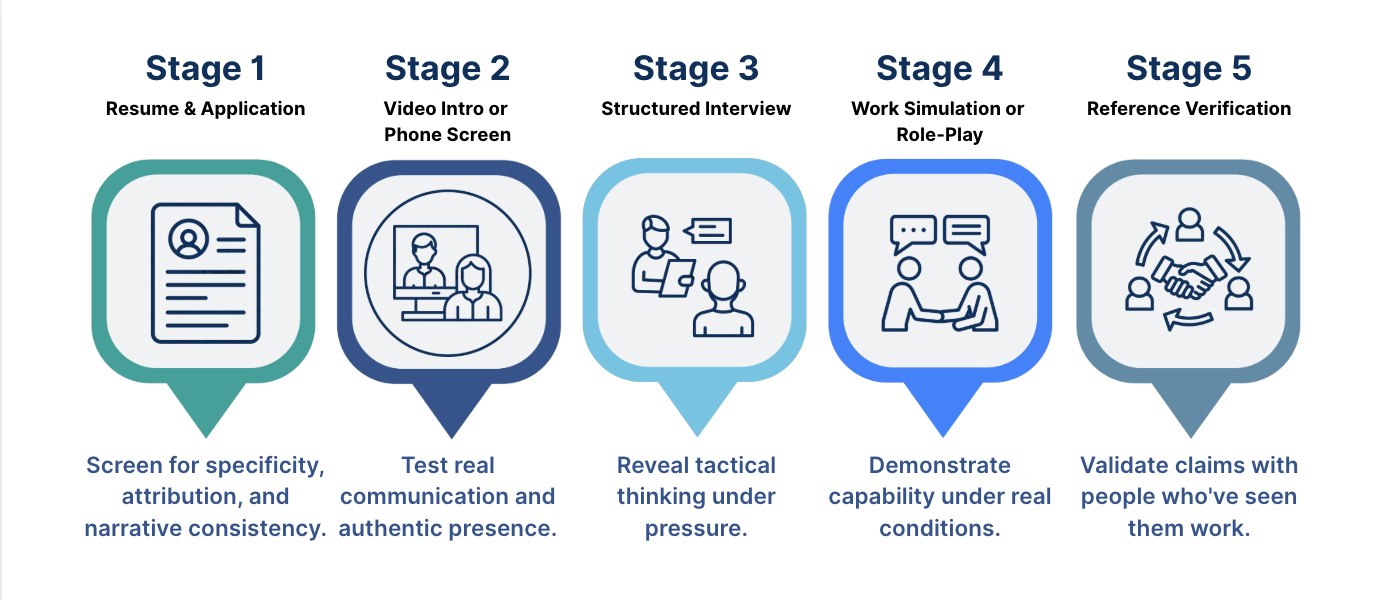
Integrate Multi-Stage Assessments
Escalate from screening to simulation to live conversations to reference verification. Each stage should test different aspects of capability:
- Stage 1: Resume and application (screens for baseline fit)
- Stage 2: Brief video intro or phone screen (tests communication and authenticity)
- Stage 3: Structured interview with pressure-test questions (reveals tactical thinking)
- Stage 4: Work simulation or role-play (demonstrates capability under conditions similar to the job)
- Stage 5: Reference verification (validates claims with people who've seen them work)
Make it progressively harder to fake your way through. Candidates who rely on AI polish will drop out at stage 3 or 4.
Train Interview Teams
Your interviewers need to spot polished but hollow responses. Train them to:
- Press on "how" not just "what"
- Ask for tactical specifics, not high-level summaries
- Notice when answers feel rehearsed or generic
- Dig deeper when something doesn't add up
Develop human judgment patterns that AI polish can't fool.
Measure Screening Accuracy
Track the correlation between screening signals and actual performance after hire:
- What percentage of hires hit quota in their first year?
- Do candidates who score well on simulations actually perform better?
- Which interview questions predict success, and which predict nothing?
Tie recruiting KPIs to quality of hire, not just time to fill. If you're only measuring speed, you're optimized for the wrong outcome.
The critical principle to remember:
Automation without diagnosis is just faster failure. Without diagnosing what signal your screening actually captures, AI and automation simply accelerate hiring noise. Speed without accuracy is expensive.
Before you invest in more tools or technology, diagnose whether your current system measures the right signals. The Sales Hiring Diagnostic reveals whether your Screening process rewards capability or polish.
Frequently Asked Questions
Are AI-generated resumes hurting my ability to hire good salespeople?
AI-generated resumes are not inherently harmful. They reflect candidates using available tools, which is exactly what you'd want salespeople doing in their roles. The problem emerges when hiring systems rely exclusively on surface signals that AI can easily replicate. If your screening process can't distinguish between polished presentation and real sales capability, then yes, AI is hurting your hiring outcomes. The solution is not banning AI from your process. The solution is strengthening verification systems that test for grit, tactical thinking, and proven results under pressure.
How can hiring teams tell if a resume was written using AI?
Look for buzzword overload without specificity, generic phrasing that lacks personal context, repetitive structure optimized for keywords, and what we call the "attribution gap" where results are described but personal contribution is not explained. Discrepancies between resume content and LinkedIn or reference checks are also red flags. However, AI detection tools have high false-positive rates and limited effectiveness. Rather than trying to catch AI use, focus on verification through structured interviews that pressure-test claims, work simulations that reveal thinking, and questions that surface tactical decision-making AI cannot fabricate.
Is using AI to write a resume a sign of a lazy salesperson?
No. Using AI to write a resume is a sign of a salesperson using modern tools, which is exactly what you want them doing in a sales role. The red flag is not AI use. The red flag is lack of depth beneath the polish. Strong candidates use AI to organize and present their experience clearly, but they can still articulate specific tactics, explain pivotal deal moments, and demonstrate thinking under pressure. Weak candidates rely on AI to mask inexperience, and that becomes obvious during structured interviews when you press for specifics they cannot provide.
What interview techniques help see past AI polish?
Behavioral and situational questions that force candidates to explain specific decisions and outcomes work best. Use pressure-test questions like "What was the exact moment your biggest deal almost fell apart, and what did you do to save it?" Implement work simulations that reveal process and thinking. Ask quantifiable follow-ups that dig into how they achieved numbers, not just what the numbers were. Use live problem-solving scenarios that cannot be scripted or rehearsed. The goal is making candidates demonstrate capability in real time rather than recite polished narratives they've prepared in advance.
Can AI tools help detect fake or AI-generated resumes?
AI detection tools exist but have limited effectiveness. High false-positive rates mean they often flag legitimate candidates while missing sophisticated AI use. The 2026 shift is toward verification platforms instead of detection tools. Use audio and video intros where communication skills are visible, proctored challenges that test real-time thinking, and multi-stage assessments that reveal capability progressively. AI can support human judgment through pattern recognition and efficiency gains, but keep verification decisions in human hands. AI assists, but humans verify.
How does this fit with my sales hiring diagnostic process?
These verification tactics directly map to the Screening and Interviewing bucket of the Sales Hiring Diagnostic. The diagnostic reveals whether your process captures real capability signals or rewards surface presentation. If polish has gotten cheaper in 2026, your verification system needs to get stronger. Run the diagnostic to see where breakdowns are happening in your process. Most leaders assume their interviews reveal grit and capability. The data usually shows something different.
Grit Is What AI Can't Fake
AI has changed how first impressions are formed in hiring, but it has not made human verification obsolete. If anything, AI has raised the bar for what effective verification must include.
Polish without depth is not predictive of sales performance. Never has been. AI has just made it easier to generate polish at scale, which means your hiring process needs to dig deeper to find the capability underneath.
Here's what matters: the trait AI cannot fake is grit. In 2026, a candidate can prompt AI to write a resume that describes resilience, quota achievement, and consultative selling. But they cannot prompt AI to handle a high-pressure role-play, explain the tactical pivots in a real deal they closed, or demonstrate composure under scrutiny in a live interview.
The hiring teams that will win are those who adapt their verification systems faster than candidates adapt their use of AI tools.
Before your next sales hire, run the Sales Hiring Diagnostic to see whether your Screening process measures capability or rewards presentation. Most leaders assume their interviews reveal grit. The data usually shows something different. Score your Screening process, and find out where the signal breaks down.






The True Cost of a Bad Sales Hire in 2026 (and How to Stop Repeating It)
You've done this before. You've invested months recruiting, weeks interviewing, and six figures onboarding a sales rep ...
Ready to Build a High-Performing Sales Team?
Let's create your custom Sales Transformation Program.