
The A-Player Repellent: How Weak Sales Management Silently Kills Your Candidate Pool
Written by: Mike Carroll

Quick Answer: B-level managers attract B and C-level talent. A-players detect weak leadership during interviews and opt out silently. You never know you lost them. If your candidate pool feels thin, the problem is in your system, not the market. Strong candidates read signals you don't know you're sending: lack of role clarity, reactive management, and onboarding that doesn't exist. They walk away without telling you why.
Here's a scenario that plays out weekly across middle-market companies.
A CEO is frustrated because the sales manager can't seem to hire anyone good. The candidates look fine on paper. The interviews go well. But the strong ones always accept other offers. The ones who say yes end up being average performers who need constant management.
The CEO thinks it's a market problem. Too much competition for talent. Not enough A-players to go around.
The sales manager thinks it's a candidate problem. Nobody wants to work hard anymore. Everyone wants remote work and inflated salaries.
They're both wrong.
The problem is the sales manager.
B Managers Attract B and C Talent
This is not an insult. It's a pattern.
A-level managers attract A-level talent because strong people want to work for someone who can develop them. B-level managers attract B and C-level talent because strong people can smell weak leadership in the interview, and they walk away.
You never even know you lost them.
The candidate sends a polite email declining the offer or accepts another position. They don't explain that they chose your competitor because your sales manager couldn't articulate what success looks like or describe a real onboarding plan.
They just move on.
And your candidate pool gets thinner.
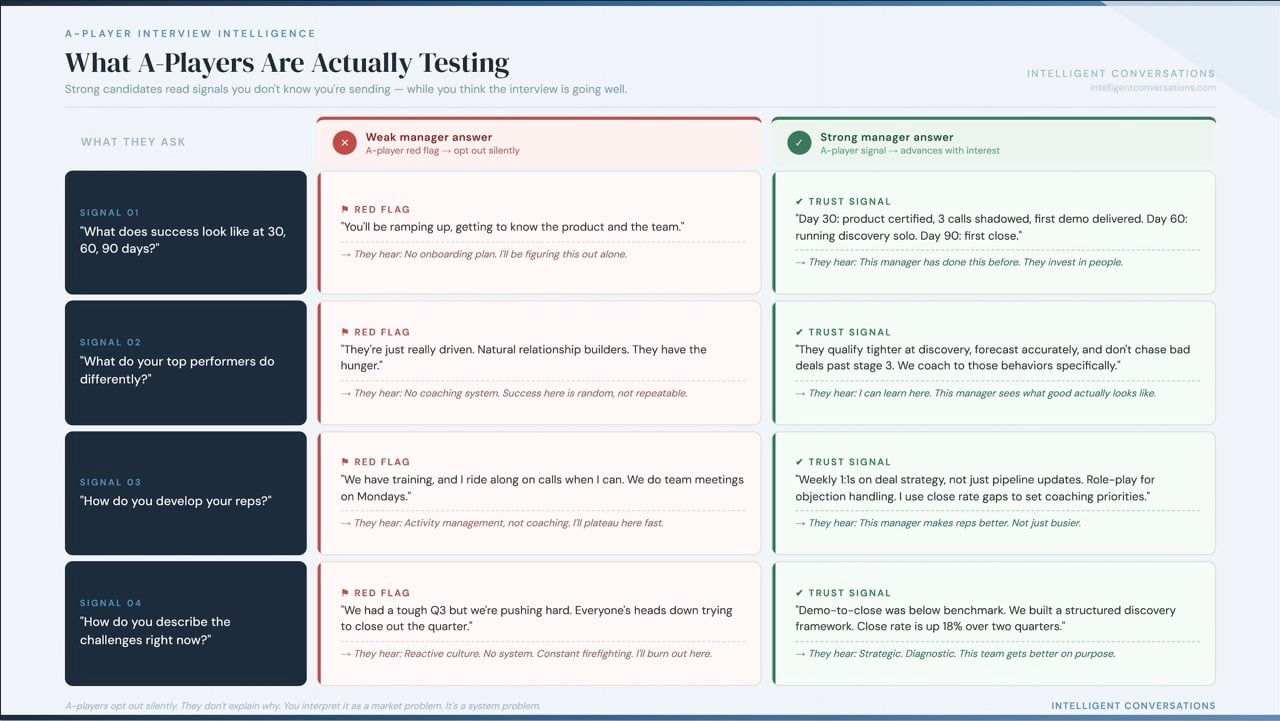
What A-Players Notice That You Don't
Top sales talent isn't evaluating your company the way you think they are.
They're not impressed by your brand or your growth story. They've heard growth stories before. They know half of them don't pan out.
They're evaluating whether the person across the table can actually make them better at their job.
Here's what they're reading while you think the interview is going well:
Can this person define what good looks like?
Strong salespeople ask: "What does success look like in the first 30, 60, 90 days?" If the hiring manager gives a vague answer about "ramping up" or "getting to know the product," that's a red flag.
A-players want specifics. They want to hear: "In the first 30 days, you'll complete product certification, shadow three customer calls, and deliver your first demo to a prospect with coaching. By day 60, you'll be running discovery calls independently. By day 90, you'll close your first deal."
If the manager can't paint that picture, the candidate knows there's no real onboarding plan. Which means they'll be left to figure it out on their own. Which means the company doesn't actually develop people.
Does this person know what the role actually requires?
Top talent asks about deal size, sales cycle, stakeholder complexity, and technical depth. Not because they're trying to negotiate. Because they're testing whether the hiring manager has role clarity.
If the manager says, "It varies" or "We're flexible," the candidate hears: This person doesn't know what they're hiring for.
That means six months from now, when the candidate is being evaluated, the goalposts will move. Expectations will shift. Success criteria will be undefined.
Strong salespeople don't accept roles with moving targets. They accept roles with clear scorecards.
Is this manager reactive or strategic?
A-players listen to how the manager describes challenges. Do they talk about firefighting and scrambling to hit the quarterly number? Or do they talk about pipeline discipline, forecast accuracy, and how they coach to close rate gaps?
Reactive managers say things like: "We had a tough Q3, but we're pushing hard this quarter."
Strategic managers say things like: "We identified that our conversion rate from demo to close was below benchmark, so we've implemented a structured discovery framework, and our close rate has improved 18% in the last two quarters."
The way people talk shows how the system works. A-players know great salespeople don’t do well with reactive management. They do well with clear and consistent management.
Does this person actually coach, or just manage activity?
When candidates ask, "How do you develop your reps?" weak managers talk about training programs or "riding along on calls."
Strong managers talk about weekly 1:1s focused on deal strategy, role-play sessions where they pressure-test objection handling, and how they use pipeline reviews to coach qualification rigor, not just count opportunities.
A-players have worked for both types of managers before. They know the difference. And they're not interested in working for someone who just checks CRM data and asks why deals are still in Stage 3.

The Signals You're Sending Without Knowing It
Here's the uncomfortable part.
Most of the time, weak sales managers don't realize they're repelling strong talent. They think the interview went great. The candidate was engaged. The conversation felt natural.
But while you were talking about your company's values and team culture, the candidate was reading signals you didn't know you were broadcasting.
Signal: You can't explain why your top performers succeed.
If a candidate asks, "What do your best people do differently?" and you say, "They're just really driven" or "They're natural relationship builders," you've lost them.
Strong candidates know great results are not magic. They come from clear actions that you can repeat and coach. If you can’t explain what makes top performers different from average ones, you are not coaching those actions. That means the candidate has to figure it out on their own.
Signal: You describe onboarding as "shadowing" or "getting ramped."
A-players have been through bad onboarding before. They know what it looks like. It looks like being handed a laptop, watching a few product demos, and being told to "start reaching out to prospects."
When they ask about your onboarding process, and you describe it in vague terms, they hear: There is no onboarding process.
They're not going to say that out loud. They're just going to take the offer from the company that described a structured 30/60/90 plan with defined milestones, skills assessments, and manager check-ins.
Signal: You talk more about what you need than what you offer.
Weak managers spend interviews explaining their challenges. "We need someone who can hunt." "We need someone who can handle a long sales cycle." "We need someone who's self-motivated."
Strong managers spend interviews explaining what they provide. "Here's how we support deal strategy." "Here's our coaching rhythm." "Here's how we help reps when they hit a losing streak."
A-players aren't auditioning to solve your problems. They're evaluating whether your environment will make them better. If all you talk about is what you need, they assume you don't offer much.
Why You Never Know You Lost Them
Here's what makes this pattern so damaging.
When weak managers repel A-players, the feedback loop is broken.
The candidate doesn't say, "I'm declining because you couldn't articulate role clarity, and I don't think you have a real coaching system." They say, "I've decided to pursue another opportunity that's a better fit."
The manager reports back to the CEO: "We made an offer, but the candidate went somewhere else. Probably got more money."
The CEO thinks it's a compensation problem and approves a salary increase for the next search.
But the next strong candidate has the same conversation with the same manager and reaches the same conclusion. And opts out the same way.
Meanwhile, B and C-level candidates don't notice the red flags because they're not evaluating leadership quality. They're just looking for a job. So they accept the offer.
And six months later, when they're underperforming, the CEO and the sales manager blame the candidate.
The real problem never gets diagnosed.
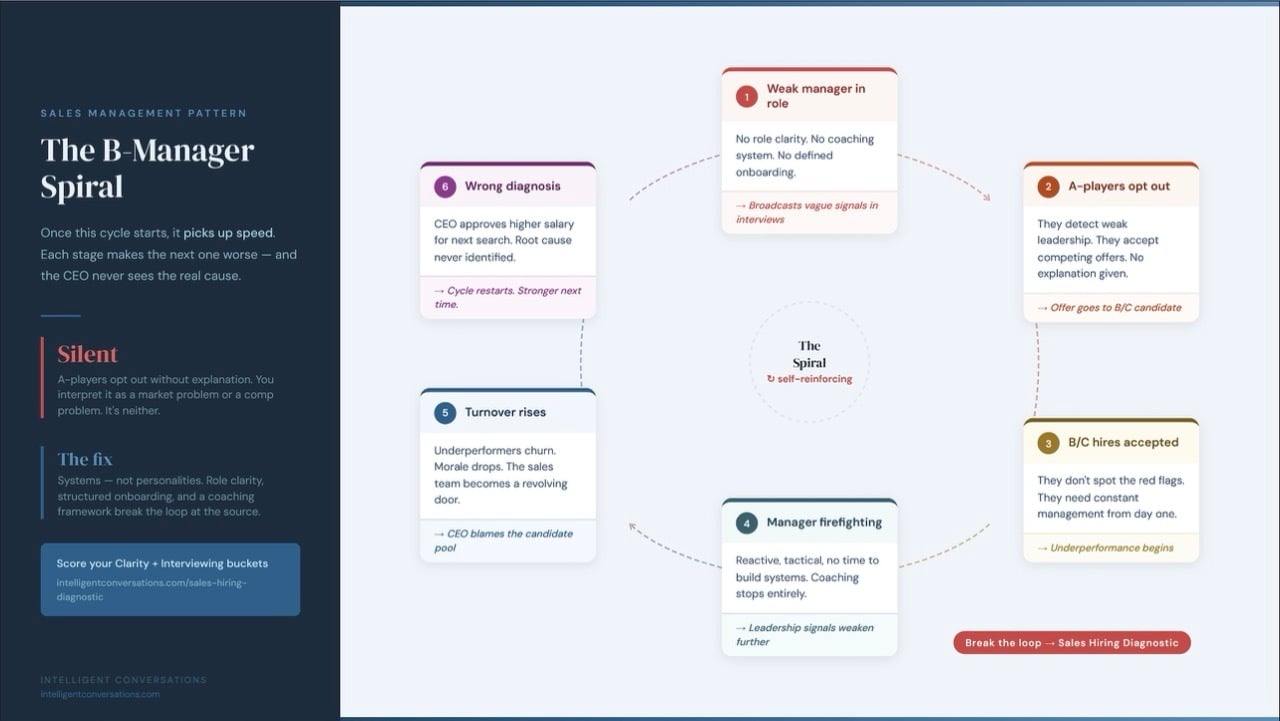
The Spiral Effect
Once this cycle begins, it picks up speed.
B-level managers hire B- and C-level talent. Those hires underperform. The manager spends more time putting out fires and less time building systems. That makes the manager look weaker in the next round of interviews, which drives away even more A-players.
The candidate pool shrinks, turnover rises, and the sales team becomes a revolving door of average performers who need constant supervision.
And the CEO can't figure out why hiring has become so hard.
It's not the market. It's not the compensation. It's not the candidates.
It's the person doing the hiring.
How This Shows Up in Your Interviewing Bucket
When we run the Sales Hiring Diagnostic for companies, the Interviewing bucket reveals this pattern immediately.
The questions are designed to surface whether your interview process can actually detect capability or if it's just checking boxes.
Strong interviewing systems test for:
- Role clarity (can the hiring manager describe success milestones?)
- Behavioral depth (are interviews structured to pressure-test past performance?)
- Coaching capability (can the manager articulate how they develop people?)
- System consistency (do multiple interviewers reach the same conclusion?)
Weak interviewing systems rely on:
- Gut feel and rapport
- Vague questions about "culture fit"
- Managers who can't explain what separates top performers from average ones
- Lack of structured evaluation criteria
If your Interviewing score is low, it's not because you're bad at conducting interviews. It's because the person conducting them doesn't have the clarity or the system to attract strong talent.
How This Connects to Your Clarity Bucket
The real problem with interviewing usually starts with a lack of clarity.
Without clear roles, managers can’t explain what success looks like in the first 90 days. Without defined top-performer behaviors, managers can’t show what sets great reps apart. Without a structured onboarding plan, managers can’t convince candidates they’ll be developed.
Weak interviews are just the symptom, and lack of clarity is the cause.
A-players notice both.
What to Do About It
If your candidate pool feels thin, don't blame the market.
Audit your system first.
Ask these questions:
Can your sales manager clearly articulate what top performers do differently?
If not, they can't coach to those behaviors. And A-players will hear that in the interview.
Can your sales manager describe a structured 30/60/90 onboarding plan?
If not, candidates will assume they'll be left to figure it out on their own.
Does your sales manager spend interview time explaining what they provide or what they need?
If they spend most of the conversation describing challenges, candidates will assume the environment is reactive and unsupportive.
Can your sales manager explain the role with enough specificity that candidates know exactly what success looks like?
Without that clarity, top candidates will go elsewhere.
The problem comes from the system, not personalities, and systems can be fixed.
The Diagnostic You Need
Before you blame your candidate pool, score your system.
Run the Sales Hiring Diagnostic. It takes 15 questions and under 10 minutes. You'll get immediate results across three buckets:
- Clarity: Do you know what you're hiring for?
- Screening & Interviewing: Can you detect capability?
- Onboarding & Ramp: Can you validate your hiring decisions?
If your Clarity and Interviewing scores are low, that's why A-players are opting out.
You'll also get a personalized video from Mike Carroll breaking down where your gaps are and what to fix first.
No sales pitch. No lengthy forms. Just a clear diagnosis of whether your system is built to attract A-players or repel them.
If your candidate pool feels thin, the market isn’t the issue. The system is sending signals that drive top talent away, often without you realizing it.

FAQ
Q: How can I tell if my sales manager is repelling A-players?
Look at your offer acceptance rate and who's accepting. If strong candidates consistently decline and average candidates consistently accept, your sales manager is likely broadcasting weak leadership signals during interviews. A-players opt out silently. They don't tell you why.
Q: What's the difference between a B-level manager and an A-level manager in interviews?
A-level managers can articulate what top performers do differently, describe a structured onboarding plan with specific milestones, explain their coaching rhythm, and define success with clarity. B-level managers talk in vague terms about "getting ramped," rely on gut feel for hiring decisions, and spend interview time describing challenges instead of what they provide.
Q: Can a B-level manager become an A-level manager?
Yes, but it requires fixing the system underneath them. B-level management is usually a symptom of a lack of clarity, no structured onboarding, and a reactive instead of a strategic approach. Give them role scorecards, a 30/60/90 onboarding framework, and a coaching system, and many can improve. But you can't fix the manager without fixing the system first.
Q: Why don't candidates just tell us they're declining because of the manager?
Because it's professionally risky and offers no upside. Candidates know that criticizing a hiring manager burns bridges. So they use polite language: "I've accepted another opportunity that's a better fit." You interpret that as a compensation issue. They meant it as a leadership quality issue. The feedback loop never closes.
Q: How do I know if a lack of clarity is causing my interviewing problems?
If your sales manager can't clearly define what the role requires (deal size, cycle length, stakeholder complexity, technical depth), can't explain what separates top performers from average ones, and can't describe success milestones for the first 90 days, you have a clarity problem. And that clarity problem will show up as weak interviewing. Candidates will hear the vagueness and opt out.
Q: What if we've always hired this way and it worked before?
The market has changed. A-players have more options now, and they're evaluating leadership quality more critically. What worked in 2018 when candidates were grateful for offers doesn't work in 2026 when candidates are choosing between multiple opportunities. Weak systems that used to be tolerable are now deal-breakers.





Wisconsin CEOs: Lessons Your Sales Team Should Learn from the Packer’s Stunning Defeat
I’m still shocked. The collapse I witnessed during the NFC Championship Game on Sunday is going to bother me for a long ...
Ready to Build a High-Performing Sales Team?
Let's create your custom Sales Transformation Program.