
Year-End Sales Team Assessment: Who to Keep, Coach, or Cut Before Q1
Written by: Mike Carroll

The decisions you make about your team in the next two weeks will determine whether you dominate or struggle through Q1.
Right now, you're finalizing budgets, setting territories, and planning your 2026 strategy. But there's one critical question most leaders avoid until it's too late:
Do you have the right people to execute that strategy?
Performance metrics tell you what happened in 2025. Relationships and culture fit tell you what's going to happen in 2026. Most sales leaders focus exclusively on quota attainment and miss the warning signs that signal who's truly committed, who's coasting, and who's actively looking for their next opportunity.
By the time resignation emails arrive on January 2nd, you've lost the window to make strategic team decisions. You're scrambling to backfill instead of executing your plan.
December is your assessment window. Use it to make honest evaluations about who should be on your team when Q1 begins.
Why the Year-End Team Assessment Matters Now
Tolerating wrong-fit team members doesn't just cost you their salary. The real cost compounds across multiple dimensions.
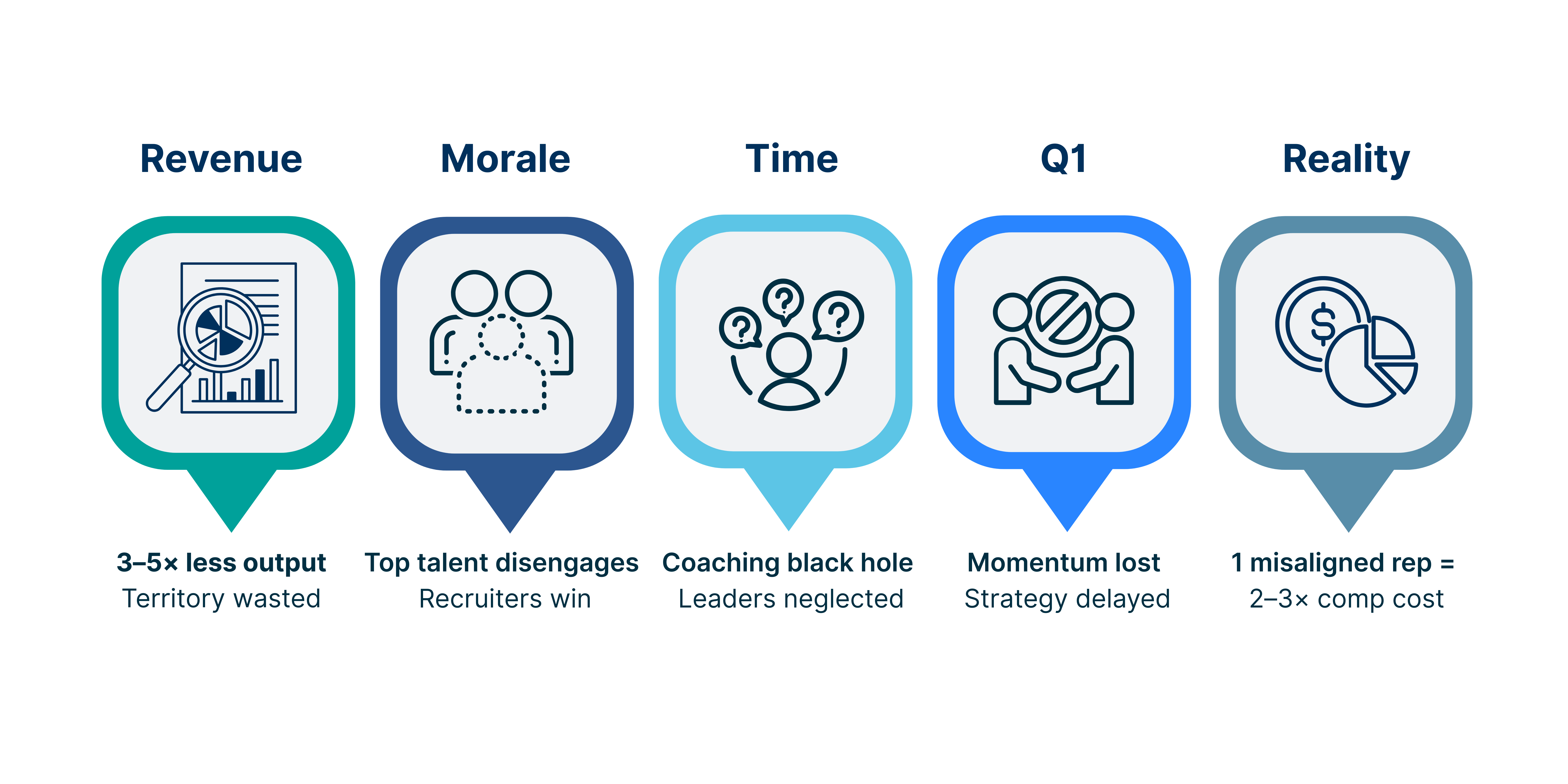
Revenue opportunity cost: An A-player typically generates 3-5x the revenue of an average performer. Every territory or account assigned to someone who won't succeed is revenue you're leaving on the table.
Team morale erosion: Your actual top performers notice when you tolerate underperformance or toxic behavior. They start questioning whether excellence matters. Some start taking recruiter calls.
Coaching time waste: Hours spent trying to improve someone who's fundamentally misaligned is time not spent developing your genuine high-performers who could become leaders.
Q1 momentum kill: Starting the year with team members who shouldn't be there means you're managing performance problems when you should be executing strategy.
The math is brutal but clear: One mis-aligned player costs you approximately 2-3x their total compensation when you factor in lost revenue, team impact, and management time.
Making the hard decision in December costs you two weeks of discomfort. Postponing it until March costs you an entire quarter of results.
The Performance vs. Culture Matrix: Your Assessment Framework
Evaluating your team requires looking at two dimensions simultaneously.
Performance (vertical axis): Quota attainment, revenue contribution, results delivery
Culture fit (horizontal axis): Teamwork, values alignment, positive influence on others
Use this 2x2 matrix to plot every team member. Be honest. No one sees this assessment but you.
How to Plot Your Team: The Assessment Exercise
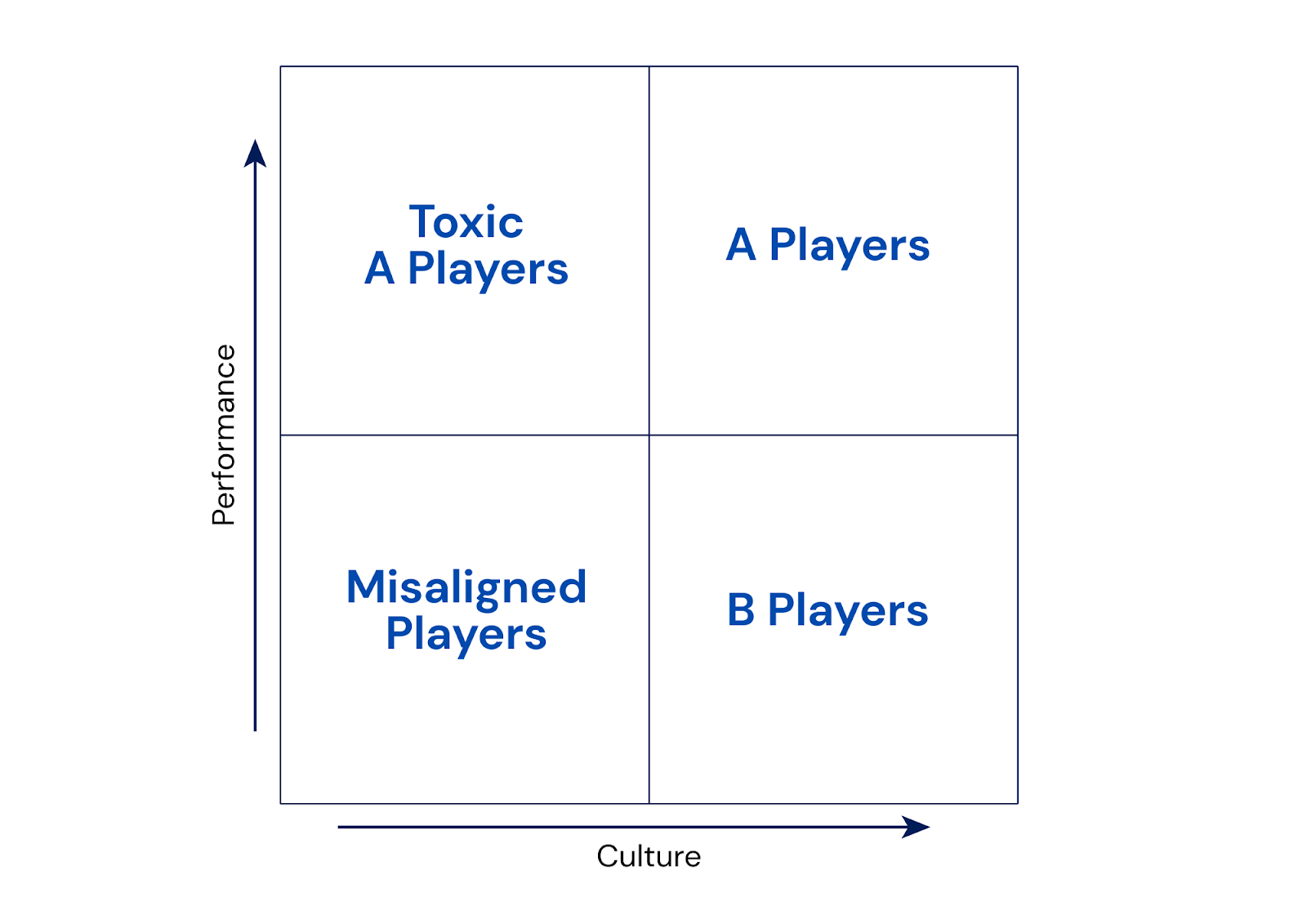
Take 30 minutes with this matrix and a list of your team members. For each person, assess both dimensions:
Rate Performance (Vertical Axis):
- High: Consistently exceeds quota, top 20% of team, reliable results
- Low: Misses quota regularly, bottom 30% of team, inconsistent execution
Rate Culture Fit (Horizontal Axis):
- High: Teammates want to work with them, embodies values, positive influence, lifts others up
- Low: Creates friction, negative influence, values misalignment, drags team morale down
Be ruthlessly honest. This assessment has nothing to do with whether you like them personally. You're evaluating objective performance data and observable culture impact.
Now, let’s dive into what each quadrant actually means.
Upper Right Quadrant: A-Players (High Performance + High Culture Fit)
These people crush their numbers and make everyone around them better. They hit quota consistently, they help newer reps without being asked, they bring solutions instead of complaints, and they embody the values you want across your entire team.
Why they matter: If you lose these people, you lose your competitive advantage. They're not just producing revenue, they're multiplying it through their influence on others.
Warning signs you're at risk:
- You haven't had a career development conversation with them in 6+ months
- They're not being challenged or given growth opportunities
- Compensation hasn't kept pace with their contribution
- They're covering for lower performers without recognition
What to do before year-end:
Schedule 1-on-1 career conversations this week. Ask about their 3-year goals. Understand what keeps them engaged and what would make them consider leaving. Don't assume loyalty, earn it through investment.
Create Q1 development opportunities that challenge them. Maybe they mentor a struggling rep, lead a strategic initiative, or get exposure to leadership decisions. Growth keeps A-players engaged.
Ensure their 2026 compensation reflects their value. If market rate has increased and you haven't adjusted, they know it. Don't give recruiters an easy opening.
Give them visibility and recognition. A-players don't need constant praise, but they do need to know their contribution is seen and valued by leadership.
Lower Right Quadrant: B-Players (Solid Performance + High Culture Fit)
These are steady contributors who consistently hit quota without drama. They're reliable, they help teammates, they embody your values. They may never be superstars, but they're the backbone of most sales organizations.
Why they matter: Steady and reliable beats erratic and difficult. B-players create stability while A-players create growth. Many B-players make excellent account managers, customer success professionals, or specialized role players.
The coaching question: Can they move to A-player status with the right development, or have they reached their performance ceiling?
What to do before year-end:
Assess honestly whether the gap is skill, effort, or capacity. If it's skill, coaching can bridge it. If it's capacity, you're fighting their ceiling. If it's effort, that's a different conversation.
For B-players with growth potential, create a specific Q1 development focus. One skill, one behavioral change, one competency improvement. Make it concrete and measurable.
For B-players at their ceiling, recognize their value for what it is. Ensure they have appropriate territories and accounts where steady execution matters. Don't set them up for failure by expecting A-player performance.
Consider whether a role change could unlock more potential. Sometimes a B-player in sales becomes an A-player in customer success or account management.
Upper Left Quadrant: Toxic A-Players (High Performance + Low Culture Fit)
This is the most difficult dilemma. Great numbers, terrible teammate. They might be rude to support staff, cut corners on process, undermine team morale, or create drama that exhausts everyone around them.
Why this matters: You're paying for those numbers with culture erosion. Your actual A-players are compensating for this person's bad behavior. Some are quietly job searching because they don't want to work in that environment.
The hidden cost: When toxic A-players leave or get fired, managers consistently report the same thing—the relief their team feels is palpable and immediate. Performance often improves because people aren't managing around the toxic behavior.
What to do before year-end:
Try direct coaching first. Have the explicit conversation: "Your numbers are strong, but your impact on team culture is negative. Here are specific examples. This needs to change by [date]." Sometimes people don't realize their impact.
Create buffers if possible. Can they work more independently? Can an assistant handle interactions where they're difficult? Sometimes you can contain the culture damage while maintaining the production.
Make the exit decision if coaching fails. If they won't change after clear feedback and reasonable time, exit them. The revenue loss is real but temporary. The culture gain is immediate and lasting.
Lower Left Quadrant: Misaligned Players (Low Performance + Low Culture Fit)
This isn't necessarily a bad person. They're just in the wrong role or wrong company. They're not hitting numbers, and they're not meshing with the team culture.
Why this matters: Prolonging the inevitable helps no one. They're probably miserable. You're frustrated. The team is carrying their load. Nobody wins.
What to do before year-end:
Have the honest conversation: "This doesn't seem to be working for either of us. Let's talk about what a better fit might look like." Often, this conversation is a relief for both parties.
Help them transition compassionately. Give reasonable notice, support their job search if appropriate, and be professional in references. This is about fit, not character.
Move quickly once you've decided. Leaving someone in a role where they're clearly failing is unkind to them and unfair to your team. Make the call and execute it professionally.
Document appropriately and consult HR/legal as needed. Do this right so everyone moves forward cleanly.
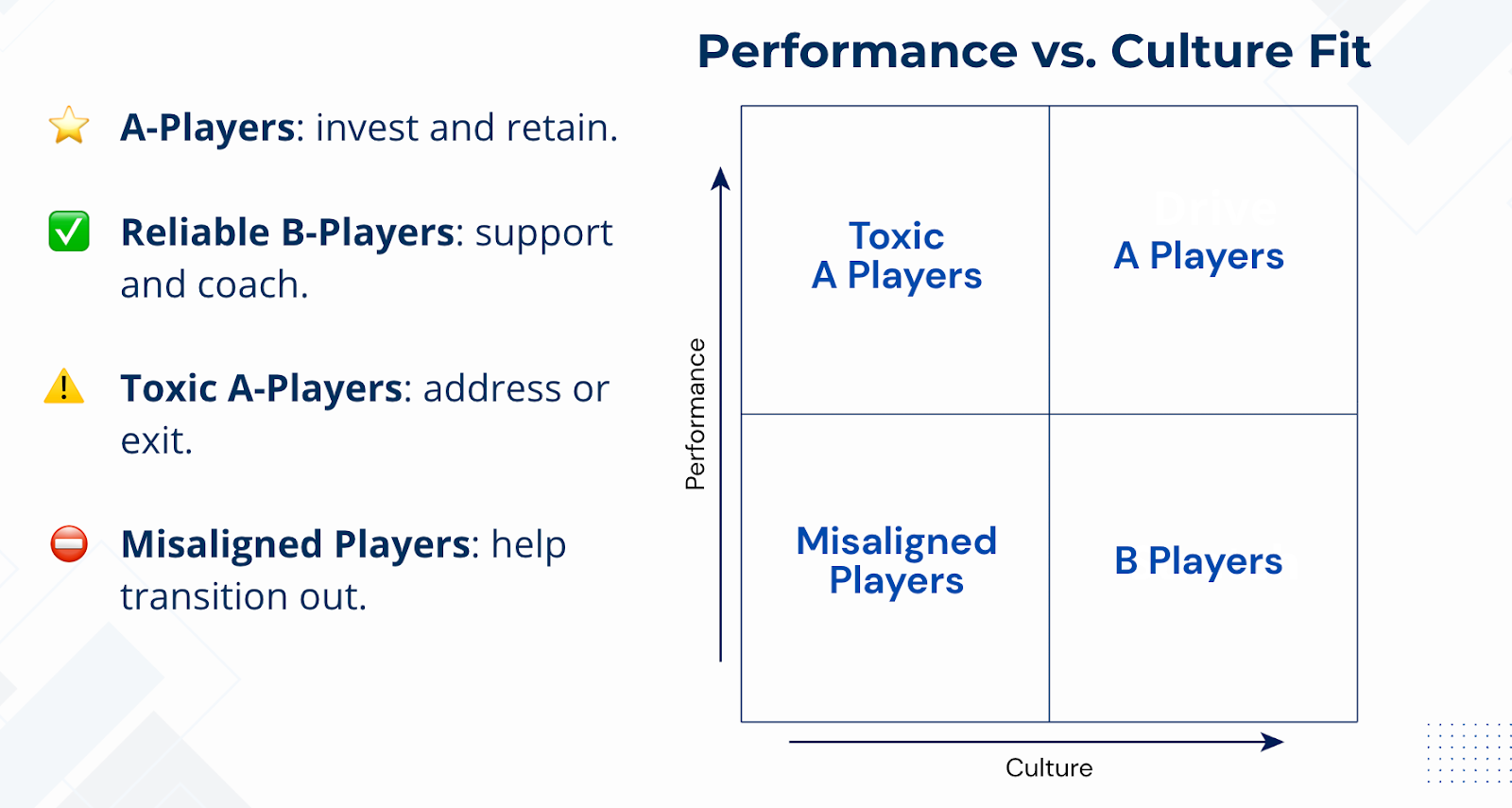
Quick Reference: What to Do With Each Player Type
When Coaching Works vs. When It Enables Underperformance
You've been coaching someone all year. The numbers haven't improved. How do you know if you should keep coaching or make a change?
Coaching works when:
- The person has the capacity but is missing specific skills or knowledge
- They demonstrate self-awareness and take ownership of gaps
- You see incremental improvement, even if they're not at the goal yet
- They're coachable (they implement feedback and adjust behavior)
- The culture fit is strong (the issue is purely performance)
Coaching becomes enabling when:
- You've had the same conversation multiple times with no behavior change
- They externalize blame instead of taking ownership
- There's no improvement despite clear guidance and support
- You're spending disproportionate time on them vs. your entire team
The honest question: If this person left tomorrow, would you try to replace them with someone exactly like them? If the answer is no, you know the coaching phase is over.

The Financial Reality: What A-Players Generate vs. What Mis-Aligned Players Cost
Let's make this concrete with typical numbers for a $150K base + commission sales role:
An A-player generates:
- 150-200% of quota = $2.25M-$3M in revenue (assuming $1.5M quota)
- Mentors 1-2 struggling reps, improving their performance 15-20%
- Creates positive team culture that reduces turnover
- Total value: $2.5M-$3.5M+ when you include their multiplier effect
A misaligned player costs:
- 60-70% of quota = $900K-$1.05M in revenue (missed $450K-$600K)
- Total compensation: $180K-$200K
- Management time: 40% of your coaching time for 10% of your team
- Territory opportunity cost: What an A-player would have generated
- Team morale impact: Harder to quantify but very real
- Total cost: $600K-$800K+ in direct and opportunity costs
Making the tough decision to replace a misaligned player with an A-player is worth $3M+ in revenue impact annually.
That calculation should inform your December decisions.
Refining Your Coaching Approach for Q1 2026
Your team assessment might reveal the issue isn't just about who's on your team but how you're coaching them.
Questions to ask yourself:
Do you spend most of your coaching time with your lowest performers while neglecting your A-players? That's a common mistake. Your best people deserve development investment too.
Are you using the Coaching Triangle framework, or are you only coaching on tactics and metrics? Without the relationship foundation and career destination conversations, even good tactical coaching feels transactional.
Have you set clear expectations and given direct feedback, or have you been hinting and hoping? Most performance issues stem from lack of clarity, not lack of capability.
Are you coaching everyone the same way, or adapting your approach to what each person needs? A-players need challenge and autonomy. B-players need structure and skill development. Different approaches for different needs.
Your Q1 coaching commitment:
For A-players, schedule monthly development conversations focused on their growth, not just their deals.
For B-players with potential, create specific skill development plans with measurable milestones.
For everyone, implement the Coaching Triangle if you haven't already—relationship foundation, tactical coaching, career destination.
Building Your Q1 2026 Team Strategy
You've assessed your team. You know who's an A-player, who's a B-player with potential, who's toxic, and who's misaligned. Now what?
Before December 31st:
For A-players you're keeping:
- Document their Q1 development plan.
- Schedule first-quarter career conversations now.
- Ensure compensation is competitive.
- Identify stretch opportunities that will keep them engaged.
For B-players you're developing:
- Create specific coaching plans with 30-60-90 day milestones.
- Set clear expectations: what improvement looks like and by when.
- Schedule weekly coaching sessions for Q1.
For toxic A-players:
- Make the decision: are you coaching them to change or exiting them?
- If coaching, have the explicit conversation before year-end with a clear timeline and consequences.
- If exiting, execute before January.
For misaligned players:
- Have the conversation this week. Work with HR on the transition timeline.
- Don't start Q1 with people who shouldn't be there.
If you're making changes: Begin recruiting now. Update job descriptions. Activate your network. Plan your hiring timeline so you're not running territories short-handed through Q1.
Your December Action Plan: Week by Week
Week of December 16th:
- Complete performance vs. culture matrix for every team member
- Identify A-players and schedule career development conversations
- List B-players and define coaching plans vs. role changes
- Make decisions on toxic A-players and misaligned players
Week of December 23rd:
- Have difficult conversations with people you're exiting
- Work with HR/legal on any terminations
- Communicate changes appropriately to broader team
- Begin documenting Q1 coaching plans for keepers
Week of December 30th:
- Finalize 2026 compensation adjustments for A-players
- Confirm Q1 development opportunities and stretch assignments
- If hiring, finalize job descriptions and begin recruiting
- Send year-end message to team with clear Q1 expectations
The Conversation Framework for Difficult Decisions
When you need to exit someone, use this approach:
Be direct: "I need to talk with you about your role here. This isn't working out, and we need to make a change."
Be specific: Reference clear performance data and previous conversations. "We've discussed your pipeline activity three times this quarter, and the numbers haven't improved."
Be compassionate: "I don't think this is the right fit, and I don't think it's fair to either of us to continue."
Be professional: Explain severance, benefits continuation, job search support if you're offering it. Handle the logistics with dignity.
Be brief: This isn't a debate or negotiation. Make the decision, communicate it clearly, and move forward.
Most people know when things aren't working. The conversation is often a relief, not a surprise.
Starting Q1 Strong: Your Team Is Your Strategy
January 2nd arrives whether you're ready or not. The question is: Do you have the right team to execute your 2026 strategy?
Every territory assigned to the wrong person is revenue you're giving away. Every month you tolerate toxic behavior is morale you're destroying. Every quarter you postpone hard decisions is momentum you're losing.
Your A-players deserve teams that match their commitment. Your strategy deserves people who can execute it. You deserve to lead a team that's aligned, capable, and ready to win.
The honest team assessment isn't comfortable. But it's necessary.
Make the hard calls this week. Start 2026 with the right people in the right roles, and watch what your team can actually accomplish.
Ready to build your 2026 team strategy?
We'll help you complete your team assessment, navigate difficult decisions, and create development plans for the people you're keeping.





What UNC Coach Dean Smith Taught Us About Sales Metrics
Legendary University of North Carolina basketball coach Dean Smith died on Saturday. Sales managers across the country ...
Ready to Build a High-Performing Sales Team?
Let's create your custom Sales Transformation Program.