
Why Sales Teams Avoid Money Conversations (And Managers Miss It)
Written by: Mike Carroll

Executive Summary
Why do deals keep stalling at the proposal stage?
Most sales managers think their reps are qualifying budget. Most reps think so too. But there is a difference between asking whether a prospect "has budget" and actually testing their willingness to invest at the level required. That gap exists because the rep is personally uncomfortable talking about money. And the manager takes surface-level answers at face value without realizing the real conversation never happened.
Comfort discussing money is one of the six Sales DNA competencies measured in OMG evaluations. It reflects a salesperson’s beliefs about money, value, and financial conversations. Because of that, improving it takes more than teaching better discovery questions. It requires coaching that changes how the rep thinks about money discussions.
Key Takeaways
- Most reps who say they qualified the budget asked a surface question and accepted a surface answer
- Discomfort with money is rooted in personal beliefs and upbringing, not a lack of training
- Deals that stall or explode at the proposal stage often trace back to money conversations that never happened
- Managers miss this because they ask whether the budget was qualified and accept yes without probing
What Is the Surface Question Problem?
In a typical deal review, the exchange goes like this:
|
What the Manager Asks |
What the Rep Says |
What Actually Happened |
|
"Did you qualify their budget?" |
"Yes, they said they have a budget." |
The rep asked something like "Do you have a budget allocated for this?" and accepted a vague answer like "We should be able to make it work." |
|
"Are they ready to move forward?" |
"They seemed positive." |
No specific number was discussed. No willingness to invest at a particular level was tested. No comparison was made between the cost of the problem and the cost of the solution. |
|
"How's this deal looking?" |
"Good. I think we're in a strong position." |
The prospect has never heard a number. The first time they see one will be in the proposal. |
The manager moves on. The deal stays in the pipeline with a green light next to it.
The rep did not skip this on purpose. Going deeper felt uncomfortable. Asking "What specific number have you set aside for this?" or "Is this a $50,000 investment or a $500,000 investment in your mind?" feels intrusive. It feels presumptuous. It feels like it might damage the rapport they have been building. So the rep asks the safe version and moves on, relieved that the moment has passed.
Weeks or months later, the proposal lands. The prospect sees the number for the first time and reacts with shock. "That is way more than we expected." The deal stalls or dies. The rep reports it as a pricing issue. The manager reports it as a lost deal. Nobody traces it back to the discovery call where the real money conversation should have happened.
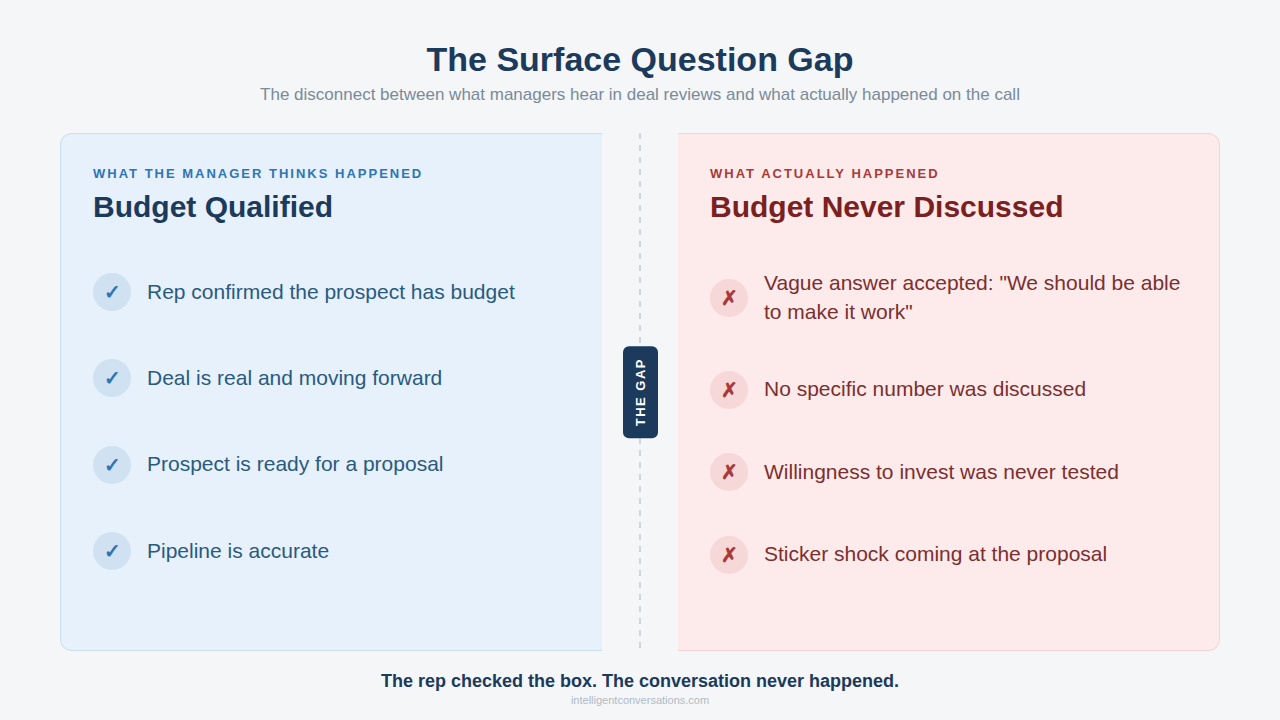
This is one of the most expensive patterns in B2B sales. It wastes the rep's time, the prospect's time, and the company's resources. It inflates the pipeline with deals that were never real. And it happens repeatedly because the root cause is invisible to the manager in a standard deal review.
Where Does Discomfort with Money Come From?
This is a conceptual issue, not a technical one. The distinction matters because it determines the coaching approach entirely.
A technical issue means the rep does not know the right question to ask or the right time to ask it. Nobody taught them the mechanics of a budget conversation. That is fixable with instruction. Teach them the question. Show them where it fits in the process. Role-play it. Problem solved.
A conceptual issue is different. The rep knows exactly what to ask. They know when to ask it. They have been coached on it before. They have even practiced it. But in the actual sales moment, they cannot bring themselves to do it because of an underlying belief about money.
Those beliefs come from personal experience and upbringing:
- A rep who grew up in a household where money was scarce may feel that $1,000 is an enormous amount. Now they are selling a $600,000 solution. They cannot even envision that number in a personal context. Large investment conversations feel wrong to them at a gut level.
- A rep who was raised to believe that discussing money is private or impolite carries that belief into every sales conversation. Asking "What is your budget?" feels like asking a stranger how much they make.
- A rep who personally avoids financial conversations (lets their spouse handle bills, does not negotiate, accepts the sticker price on everything) will mirror that avoidance with prospects. They defer the money conversation because deferring is what they do in their own life.
- A rep who believes "if the solution is good enough, the money will take care of itself" will consistently under-qualify the budget because they genuinely think price should not matter if the fit is right.
These beliefs feel like professionalism to the rep. They do not recognize them as self-sabotaging. They think they are being respectful and patient. In reality, they are setting the deal up to fail at the proposal stage.
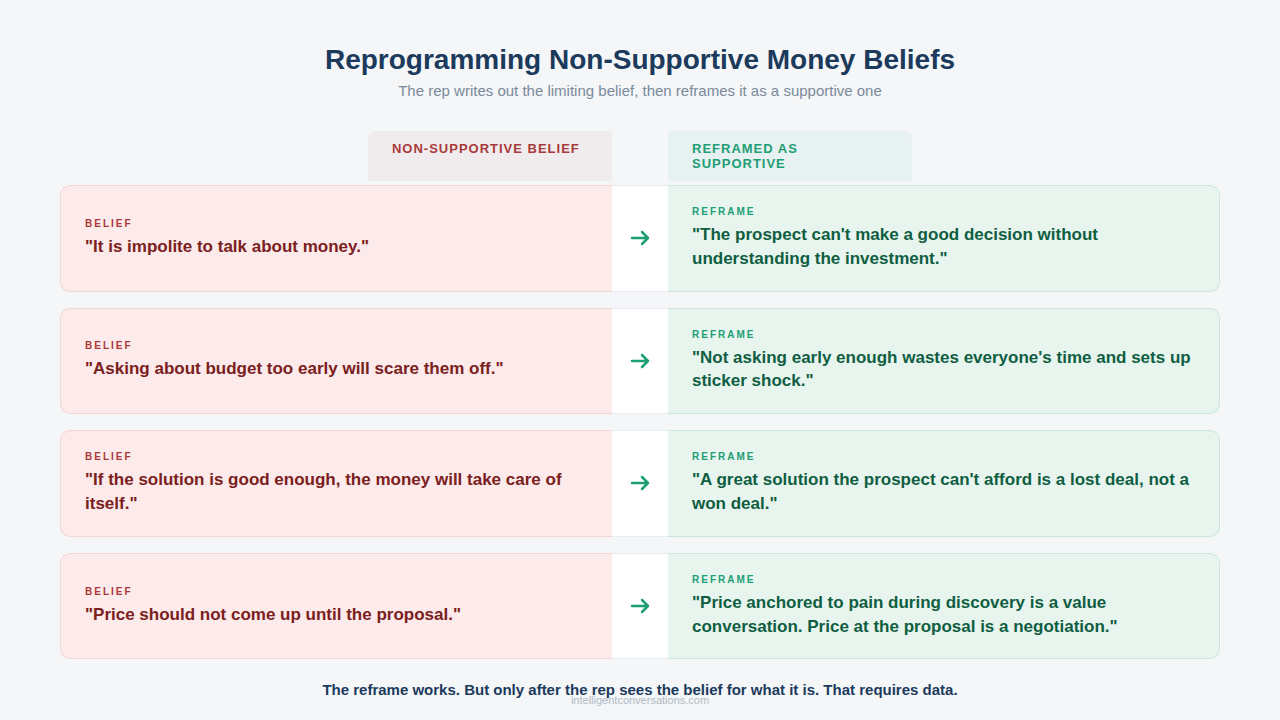
The good news: these beliefs can be reprogrammed. The process starts with making the belief visible through assessment data. Then the rep writes out the non-supportive belief and reframes it:
|
Non-Supportive Belief |
Reframed as Supportive |
Why It Matters |
|
"It is impolite to talk about money." |
"The prospect cannot make a good decision without understanding the investment. It is my job to make sure they have that information early." |
Shifts the rep's self-image from being intrusive to being helpful. |
|
"Asking about budget too early will scare them off." |
"Not asking about budget early enough wastes everyone's time and sets the deal up for sticker shock." |
Connects avoidance to the negative outcome the rep is actually trying to prevent. |
|
"If the solution is good enough, the money will take care of itself." |
"A great solution that the prospect cannot afford or has not budgeted for is a lost deal, not a won deal." |
Breaks the magical thinking that quality alone closes deals. |
|
"Price should not come up until the proposal." |
"Price anchored to quantified pain during discovery is a value conversation. Price introduced at the proposal is a negotiation." |
Reframes early money talk as a strategic advantage, not an awkward moment. |
The reframe works. But only after the rep sees the belief for what it is. That requires data. Without an OMG evaluation revealing the specific belief, the manager and the rep both assume the issue is tactical. They keep coaching the technique. The rep keeps agreeing. And the money conversation keeps not happening.
What Is the 2x Pain Rule and How Does It Change the Conversation?
Strong salespeople quantify the prospect's pain during discovery before they ever discuss price. The benchmark is simple: find at least twice the pain relative to the cost of the solution.
Selling a $300,000 solution? Find $500,000 to $600,000 in quantifiable problems first. That means asking the right questions during discovery:
- What is this problem costing you in lost revenue?
- How much time does your team spend working around it?
- What happens when it fails? What does that cost?
- What does it cost to replace the people you lose because of it?
- What opportunities are you missing while this problem persists?
Add those numbers up. Be conservative. Let the prospect validate the math. Then anchor the investment to their own numbers.
Without the 2x rule, the rep presents a price in a vacuum. The prospect has no framework to evaluate whether $300,000 is reasonable. They compare it to other line items in their budget. It feels expensive. Pushback follows.
With the 2x rule, the conversation changes completely:
"Based on what you have shared, it sounds like this problem is costing your organization roughly half a million dollars a year. If we can solve it, the investment is typically in the $200,000 to $300,000 range. That is a meaningful return in the first year."
Now the prospect is comparing the cost of the solution to the cost of doing nothing. That is a fundamentally different decision from comparing vendors on price.
Another phrase that works well early in the conversation: "We are almost never the low price. Why do you think people buy from us?" This is powerful because the prospect answers the question for you. Quality. Service. Expertise. Reliability. Whatever they say supports the value proposition. They are building the case for the premium before they ever hear a number.
|
Approach |
What the Rep Does |
What the Prospect Thinks |
|
No pain quantified |
Presents a $300K proposal after a strong demo |
"That is way more than I expected. Let me shop around." |
|
Pain quantified at 1x |
Finds $300K in problems, presents a $300K solution |
"So I am spending the same amount to fix it as it costs me to live with it. Not sure it is worth the hassle." |
|
Pain quantified at 2x+ |
Finds $600K in problems, presents a $300K solution |
"We are losing twice what this costs. Every month we wait is money gone." |
The 2x rule does not guarantee a close, but it changes the conversation from defending a price to discussing a return on investment. And it gives the rep confidence to discuss money because the numbers are the prospect's numbers, not a quote pulled from a pricing sheet.
What Should Managers Look for in Deal Reviews?
The fix starts with how managers debrief deals. The standard question, "Did you qualify budget?" needs to be replaced with questions that reveal whether the real money conversation happened.
Better questions for the debrief:
- "What specific number did the prospect give you for their budget?" If the rep cannot answer with an actual number, the budget was not qualified. It was acknowledged in vague terms and then left alone.
- "How did the prospect react when you discussed the investment range?" If the rep never discussed a range, the prospect is going to see a number for the first time in the proposal. That is a setup for sticker shock.
- "What is the cost of the problem you are solving, in the prospect's own words?" If the rep cannot articulate this, the pain was not quantified during discovery, which means there is no anchor for the investment.
- "Did you anchor the price to their quantified pain, or did you present a number on its own?" Presenting a number without context is the most common reason proposals generate pushback.
The deeper coaching question behind all of these: is this a technical gap (the rep does not know how to have the conversation) or a conceptual gap (the rep knows how but cannot bring themselves to do it)? The coaching approach is completely different for each. A technical gap is solved with instruction and practice. A conceptual gap requires belief reprogramming, self-awareness, and sustained accountability over time.
Managers who start asking these questions in debriefs often discover that deals they thought were well-qualified were actually floating on vague assumptions. That discovery is uncomfortable. It is also the beginning of a much stronger pipeline.


Frequently Asked Questions
How do you know if money avoidance is a skill gap or a belief gap?
Ask the rep to explain exactly how they would bring up the budget in a specific scenario. If they can articulate the question and the timing clearly but still do not do it consistently in the field, the issue is conceptual. If they struggle to even describe how they would approach it, it may be both a skill and a belief gap. Assessment data from an OMG evaluation makes this distinction clear.
At what point in the sales process should money come up?
Money should be introduced during discovery, not at the proposal stage. The goal is to quantify the prospect's pain, establish the cost of doing nothing, and then anchor the investment to those numbers. Waiting until the proposal means the first time the prospect hears a number, they have no context for evaluating whether it is reasonable. That is how sticker shock happens.
Can a rep who is uncomfortable with money still be successful?
In smaller deal sizes with transactional sales, sometimes. But for complex B2B sales with six-figure investments, discomfort with money creates a performance ceiling. The rep will consistently underqualify deals, avoid premium pricing conversations, and lose to competitors who address money directly during discovery. The ceiling is not about talent. It is about the belief system limiting what the rep is willing to do.





Why Sales Coaching Fails: A Data-Driven Guide to Coaching What Actually Matters
Executive Summary Why do sales managers keep coaching without seeing results? Most sales coaching fails. Not because ...
Ready to Build a High-Performing Sales Team?
Let's create your custom Sales Transformation Program.