The 6-Minute Phone Screen: The Fastest Way to Catch the Wrong Sales Hire Early
Written by: Mike Carroll

The most expensive part of your sales hiring process is the time your team spends interviewing people who never should have made it past the resume.
You schedule four one-hour interviews. You pull your sales leader off calls. You coordinate calendars across three time zones. You invest six collective hours of organizational time into a candidate who, ten minutes into the first real conversation, reveals they're not even close to what you need.
The resume looked perfect. The LinkedIn checked out. The cover letter hit all the right notes. But the basics weren't there—wrong deal size experience, uncomfortable with your sales cycle, mismatched expectations on quota structure, or relying too heavily on AI-polished presentation without substance underneath.
Most organizations treat phone screens as a formality, a calendar logistics call to schedule the "real" interview. That's a mistake. A structured phone screen is your fastest, cheapest filter for catching wrong-fit candidates before they consume your team's time.
In 2026, with AI making resumes nearly indistinguishable and application volume higher than ever, the phone screen has become more critical. It's your first live conversation. It's where polish meets reality. It's where you separate candidates who can think on their feet from candidates who needed ChatGPT to sound qualified on paper.
This post shows you how to run a 6-minute phone screen that filters for commitment, baseline fit, and real capability before anyone on your team invests serious interview time.
What You Need to Know: The Quick Answer
What should a sales phone screen accomplish, and how long should it take?
A sales phone screen should filter out wrong-fit candidates in 6-10 minutes before your team invests hours in formal interviews. The goal is not to fully evaluate capability—that happens in structured interviews. The goal is to catch disqualifying gaps early: wrong experience level, mismatched expectations, lack of baseline sales fundamentals, or AI-polished resumes that fall apart in live conversation.
An effective phone screen tests:
- Commitment signal: Are they actually interested, or resume-blasting?
- Baseline fit: Do the deal size, cycle, and market align with their experience?
- Communication under pressure: Can they think and respond in real-time without preparation?
- Authenticity: Does their story hold up when you dig one level deeper than the resume?
In the STAR Hiring framework, phone screens are the first filter in the Screening stage. They're efficient but diagnostic—designed to save your team's time by catching obvious mismatches before they enter your structured interview process.
The principle: Six minutes on the phone beats six hours in interviews with the wrong candidate.
Why Phone Screens Matter More in 2026
The Signal-to-Noise Problem Has Gotten Worse
Application volume has increased as remote work expands candidate pools. AI tools have made resumes nearly indistinguishable in polish and presentation. ATS systems filter on keywords, not capability, creating false positives. Your team is drowning in "qualified-looking" candidates who aren't actually qualified.
As we covered in "Beyond the AI Resume," polish is now cheap. Candidates can generate compelling cover letters, tailor resumes to job descriptions, and optimize for ATS—all without having the actual experience. The resume gets them in the door, but the phone screen is where reality shows up.
The cost of skipping early filters: Every candidate who makes it to a full interview panel costs 4-6 hours of organizational time. When half of those candidates shouldn't have been there, you've wasted 20-30 hours per hire. Phone screens take 6-10 minutes and eliminate 40-60% of candidates who look good on paper but aren't actually fits.
Phone screens aren't calendar coordination calls. They're diagnostic filters. They're your first live signal-detection opportunity. They're where you test whether the resume represents real capability or just good AI prompting.
What a 6-Minute Phone Screen Actually Tests
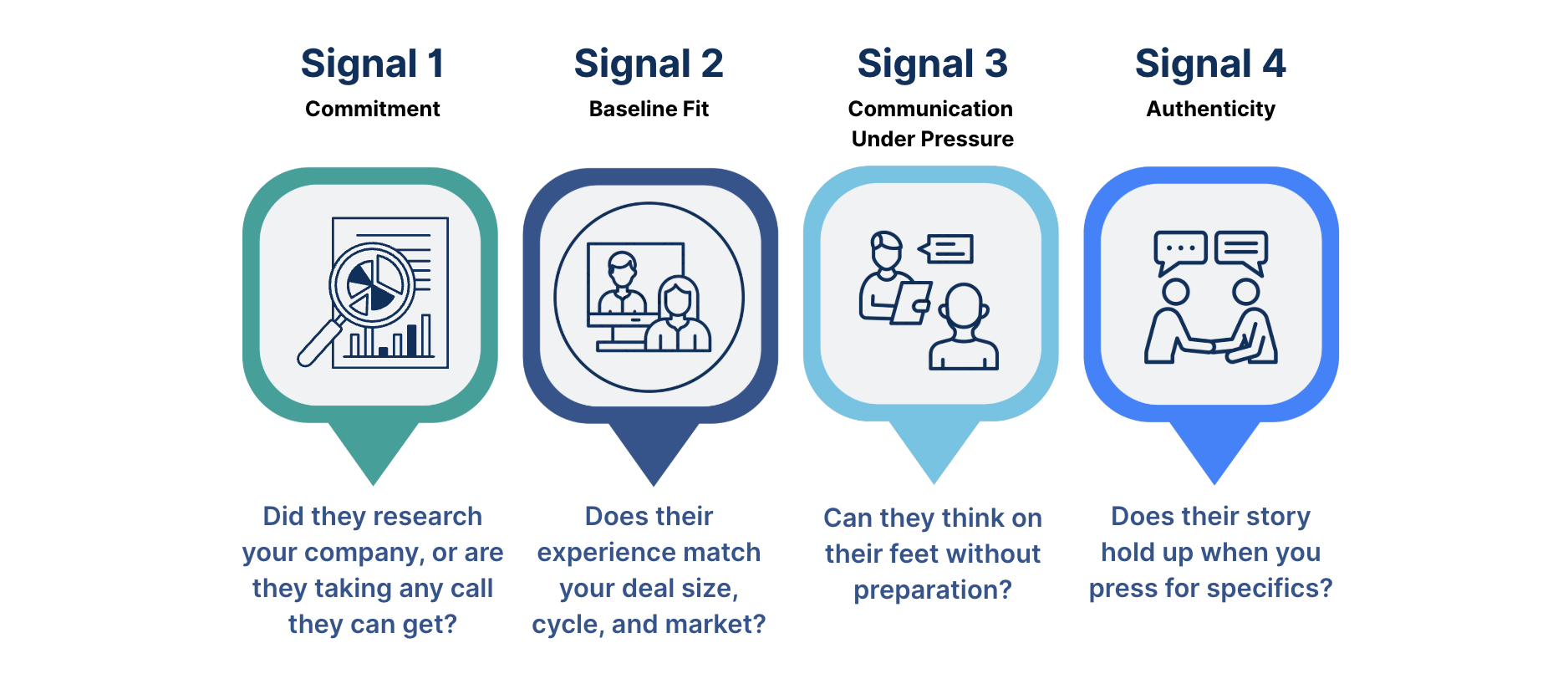
Four Signals the Phone Screen Reveals
Signal 1: Commitment
Are they actively job searching, or resume-blasting? Did they research your company, or are they taking any call they can get? Can they articulate why this role specifically interests them?
Candidates who aren't serious waste everyone's time. If they can't explain why they applied beyond "it seemed interesting," they're not committed.
Signal 2: Baseline Fit
Does their experience align with your deal size, sales cycle, and market? Are their quota expectations realistic for your role? Do they understand what the role actually involves?
A rep who sold $10K transactional deals can't step into a $500K enterprise role. Catch this in 6 minutes, not after three interviews.
Signal 3: Communication Under Pressure
Can they think on their feet without preparation? Do they communicate clearly and concisely in real-time? Do they handle unexpected questions without deflecting?
Sales is live conversation under pressure. If they struggle in a low-stakes phone screen, they'll struggle in high-stakes sales calls.
Signal 4: Authenticity
Does their story hold up when you press for specifics? Can they provide tactical details about their resume claims? Do they sound like a real person, or a rehearsed script?
This is where AI-polished candidates fall apart. They can generate a great resume, but they can't generate real experience. Ask one follow-up question, and the gap shows.

The 6-Minute Phone Screen Framework
The Structure: Six Minutes, Four Questions
Introduction (30 seconds):
"Thanks for taking the time. I have about six minutes to learn more about your background and see if there's mutual fit before we move forward. Sound good?"
This sets expectations. It's short. It's not the full interview. You're screening, not selling.
Question 1: Why This Role? (90 seconds)
Ask: "Walk me through why you applied for this role specifically."
What you're listening for:
- Did they mention anything specific about your company, product, or market?
- Is their answer generic ("I'm looking for my next opportunity") or specific?
- Does their career trajectory logically lead to this role?
Red flags: "I'm just exploring options," can't name anything specific about your company, applied because a recruiter reached out but they don't know what you do.
Question 2: Deal Size and Sales Cycle Fit (90 seconds)
Ask: "In your current or most recent role, what's your average deal size and how long is your typical sales cycle?"
What you're listening for:
- Do the numbers align with your role requirements from the job scorecard?
- Can they answer without hesitation?
- Do they understand the difference between transactional and complex sales?
Follow-up if needed: "Our average deal is [your number] with a [your cycle length] cycle. How does that compare to what you're used to?"
Red flags: Vague answers ("It varies a lot"), numbers that are dramatically different from your requirements, inability to articulate deal size or cycle with specificity.
Question 3: Quota Pressure Test (90 seconds)
Ask: "Walk me through a recent quarter where you were behind on quota. What did you do?"
What you're listening for:
- Can they recall a specific situation?
- Do they provide tactical actions they took, or generic platitudes?
- Do they demonstrate accountability or blame external factors?
This is where AI-polished candidates struggle. They can claim "consistently exceeded quota" on a resume, but they can't fabricate a real story about being behind and what they actually did about it.
Red flags: "I've never been behind quota" (unlikely and defensive), vague answers about "working harder" without tactics, blame-heavy responses that don't show ownership.
Question 4: The Unexpected Curveball (90 seconds)
Ask: "If you had to choose between hitting 80% of quota with perfect process adherence or 120% of quota by ignoring process entirely, which would you choose and why?"
What you're listening for:
- How do they think through a no-perfect-answer scenario?
- Do they show nuance, or do they give a binary response?
- Can they articulate trade-offs in real-time?
This question is unexpected. It can't be rehearsed. It reveals thinking process, not polished answers.
Closing (60 seconds):
"Thanks for your time. Based on this conversation, [I'd like to move you forward to a full interview / I don't think this is the right fit right now]. Either way, you'll hear from us within [timeframe]."
Be direct. Don't leave them hanging.
Where AI Polish Falls Apart
AI can generate a compelling resume. It can optimize for keywords. It can describe accomplishments in polished language. But AI can't fabricate real experience.
Phone screens are live, unscripted, and time-pressured. Candidates can't pause to consult ChatGPT. They can't rehearse. They can't edit their answers.
What happens when you pressure-test:
Ask about a specific deal, and AI-polished candidates get vague. Ask about a quarter where they were behind, and they struggle to provide tactical details. Ask an unexpected question, and they deflect or freeze.
Real candidates vs. AI-polished candidates:
|
Real Experience |
AI-Polished Resume |
|
Can recall specific deals, numbers, and decisions |
Provides generic summaries |
|
Answers follow-ups with tactical detail |
Gets vague when pressed |
|
Thinks through unexpected questions |
Deflects or gives rehearsed frameworks |
|
Story is consistent across questions |
Story has gaps or contradictions |
Six minutes of live conversation reveals what six pages of AI-generated resume hide.
How to Implement This in Your Hiring Process
Who Conducts Phone Screens: Hiring manager, recruiter, or sales operations. Does not need to be the final decision-maker. Needs to understand the job scorecard and disqualifying criteria.
When to Use Them: After resume review, before formal interviews. As the first live conversation with every candidate. Before you schedule panel interviews or invest team time.
How to Score Them:
Simple pass/fail based on four signals:
- ✓ Commitment: Yes/No
- ✓ Baseline fit: Yes/No
- ✓ Communication: Yes/No
- ✓ Authenticity: Yes/No
If any signal is "No," don't advance. Save your team's time.
Document What You Learn:
Take notes on red flags and strengths. Share them with your interview team if the candidate advances. This creates continuity and helps structured interviews dig deeper.
In the STAR Hiring framework, phone screens are the first layer of the Screening stage. They filter before you invest in challenge-based interviews (the Interview stage).
Frequently Asked Questions
How long should a sales phone screen take?
A sales phone screen should take 6-10 minutes. Longer than that, and you're conducting a full interview. Shorter, and you're not gathering enough signal. Six minutes is enough to test commitment, baseline fit, communication under pressure, and authenticity. It's efficient but diagnostic—designed to catch disqualifying gaps early before your team invests hours in formal interviews.
What questions should you ask in a sales phone screen?
Ask four types of questions: commitment ("Why this role specifically?"), baseline fit ("What's your average deal size and sales cycle?"), capability pressure-test ("Walk me through a quarter where you were behind quota—what did you do?"), and unexpected thinking ("Choose between 80% quota with perfect process or 120% ignoring process—why?"). These reveal whether candidates are serious, aligned with your requirements, have real experience, and can think under pressure.
Can phone screens catch AI-polished resumes?
Yes. Phone screens are live, unscripted conversations where candidates can't pause to consult AI tools. When you pressure-test resume claims with follow-up questions, AI-polished candidates struggle to provide tactical specifics because they don't have the real experience. Real candidates can recall specific deals, numbers, and decisions in detail. AI-polished candidates get vague when pressed. Six minutes of live conversation reveals what AI-generated resumes hide.
Should phone screens be part of every sales hiring process?
Yes. Phone screens are your fastest, cheapest filter for catching wrong-fit candidates before they consume your team's interview time. They take 6 minutes and eliminate 40-60% of candidates who look good on paper but aren't actually fits. Skipping phone screens means your team wastes hours interviewing people who should have been filtered out in the first live conversation.
How does the phone screen fit into the STAR Hiring methodology?
In STAR Hiring, phone screens are the first layer of the Screening stage. They filter for commitment and baseline fit before candidates enter structured, challenge-based interviews. Phone screens are efficient diagnostic tools—they don't fully evaluate capability (that happens in interviews), but they catch obvious mismatches early. This saves your team's time and ensures only qualified candidates advance to the more rigorous Interview stage of STAR.
What are the biggest red flags in a sales phone screen?
Generic answers about why they applied, inability to articulate deal size or sales cycle with specificity, vague responses when asked about quota challenges, and defensive reactions when pressed for details. These signal lack of commitment, experience mismatch, or AI-polished resumes without substance. If a candidate can't handle a 6-minute conversation with basic follow-up questions, they won't handle complex sales conversations under real pressure.
The Most Expensive Interview Is the One You Shouldn't Have Scheduled
Phone screens are the fastest, cheapest filter in your hiring system. Six minutes catches what six hours of formal interviews would reveal anyway. In 2026, with AI making resumes unreliable, live conversation is your first real signal.
Test for commitment, baseline fit, communication under pressure, and authenticity. Filter out 40-60% of wrong-fit candidates before they waste your team's time.
Use this 6-minute phone screen as your first filter. Then confirm whether your full screening system is structured correctly. Run the Sales Hiring Diagnostic at intelligentconversations.com to score your Screening process and see where candidates are slipping through. Most companies discover their filters aren't catching what they think they're catching.




How to Run Sales Interviews That Actually Reveal Capability
Here's what most sales interviews actually measure: how well someone interviews.
Ready to Build a High-Performing Sales Team?
Let's create your custom Sales Transformation Program.