How to Run Sales Interviews That Actually Reveal Capability
Written by: Mike Carroll

Here's what most sales interviews actually measure: how well someone interviews.
Not how well they sell. Not how they handle quota pressure. Not how they navigate a stalled deal with six stakeholders. How articulate they are in a 45-minute conversation with a hiring manager who wants to like them.
The correlation between "strong interview" and "strong sales performance" is weaker than most leaders realize. But we keep running the same interview process, getting the same results, and wondering why our hiring keeps missing.
Managers vary their questions wildly from candidate to candidate. Hiring decisions get made based on likability, mood, or "gut feel." Teams walk out of interviews saying "I liked them" instead of "Here's the evidence they can do this job."
But here’s the thing: anecdotes are not a system.
In 2026, with AI making resumes more polished, interviews are now the last line of defense for verifying capability. Yet, most companies still run interviews that reward polish over proof.
This post shows you how to run sales interviews that actually reveal whether candidates can do the job.
What You Need to Know: The Quick Answer
How do you run sales interviews that actually reveal capability instead of just feeling productive?
Most sales interviews fail because they test presentation skills instead of sales capability. Interviews feel productive when candidates are polished and articulate, but feeling good doesn't predict performance.
Effective sales interviews require:
- Structured consistency across all candidates (same topics, not scripted questions)
- Behavioral evidence over hypothetical scenarios ("Tell me about a time..." beats "What would you do if...")
- Pressure-testing claims with follow-up questions that force tactical specificity
- Challenge-based scenarios that reveal thinking process, not just polished answers
- Multiple interviewers evaluating different competencies with clear scorecards
The core principle: If your interviews vary wildly from candidate to candidate, you're measuring mood and likability, not capability. Consistency reveals signal. Variation creates noise.
In the STAR Hiring framework, interviews are where capability either gets verified or gets missed. Most organizations miss it because they optimize for interview comfort instead of interview rigor.

Why Most Sales Interviews Feel Good But Predict Nothing
Most interviews are performance theater. Candidates who interview well get hired, but interviewing skills don't correlate with selling skills. The "good interview" is often just a comfortable conversation between two people who got along. Managers mistake chemistry for capability, rapport for readiness.
The pattern most companies follow:
- Ask generic questions ("Tell me about yourself," "Why sales?" "What's your greatest strength?")
- Accept polished, rehearsed answers at face value
- Vary questions significantly from candidate to candidate
- Make decisions based on "feel" rather than evidence
- Walk out saying "I liked them" instead of "Here's the proof they can do this"
Research shows low correlation between interview performance and job performance when interviews lack structure. Unstructured interviews perform barely better than random selection in predicting outcomes. Structured interviews with behavioral evidence improve prediction significantly.
Your instinct after 45 minutes is not predictive. Likability bias, similarity bias, and recency bias dominate unstructured interviews. Confident, articulate people interview well—but that's not the same as selling well under quota pressure.
If your interview process can't tell the difference between a great interviewer and a great salesperson, you don't have a hiring system. You have a likability contest.
What Actually Reveals Sales Capability in Interviews
Behavioral Evidence Over Hypothetical Scenarios
"Tell me about a time when..." reveals actual experience. "What would you do if..." reveals what they think you want to hear.
Past behavior is the best predictor of future behavior. Hypothetical questions let candidates guess. Behavioral questions require real examples. Strong candidates can walk through specific situations with tactical detail. Weak candidates struggle to provide specifics because they haven't lived the experience.
Examples of behavioral vs. hypothetical:
|
Weak (Hypothetical) |
Strong (Behavioral) |
|
"How would you handle an objection?" |
"Walk me through your last deal where the prospect said your price was too high. What specifically did you say?" |
|
"What would you do if a deal stalled?" |
"Tell me about a deal that stalled in your pipeline. What caused it, and what did you do to move it forward?" |
|
"How do you handle quota pressure?" |
"Describe the quarter where you were furthest behind quota. What was going through your mind, and what actions did you take?" |
Pressure-Testing with Follow-Up Questions
When a candidate says "I exceeded quota by 30%," don't stop there. Pressure-test:
- "Walk me through how you did that. What specific deals made up that number?"
- "How much came from new business versus account expansion?"
- "What was your win rate compared to team average?"
- "Tell me about the deals you lost that quarter. Why did you lose them?"
First-level answers are often polished and rehearsed. Second and third-level follow-ups reveal whether the experience is real. Candidates with real capability can go deep—they remember details because they lived them. Candidates relying on presentation struggle when you dig deeper.
Challenge-Based Scenarios
Live problem-solving exercises that simulate real sales situations work because they can't be scripted or prepared in advance. They reveal how candidates actually think under pressure.
Examples:
- Give them your ICP and ask them to map out their approach for the first 90 days
- Present a multi-stakeholder deal scenario and ask them to identify risks
- Share a real objection from your market and ask them to handle it in real-time
- Describe a pipeline situation and ask them to prioritize
These scenarios show problem-solving approach, not memorized frameworks.
The STAR Challenge Methodology: Consistency Without Scripts
In the STAR Hiring methodology, challenge-based interviews focus on consistency across evaluation areas, not scripted questions word-for-word.
What this means:
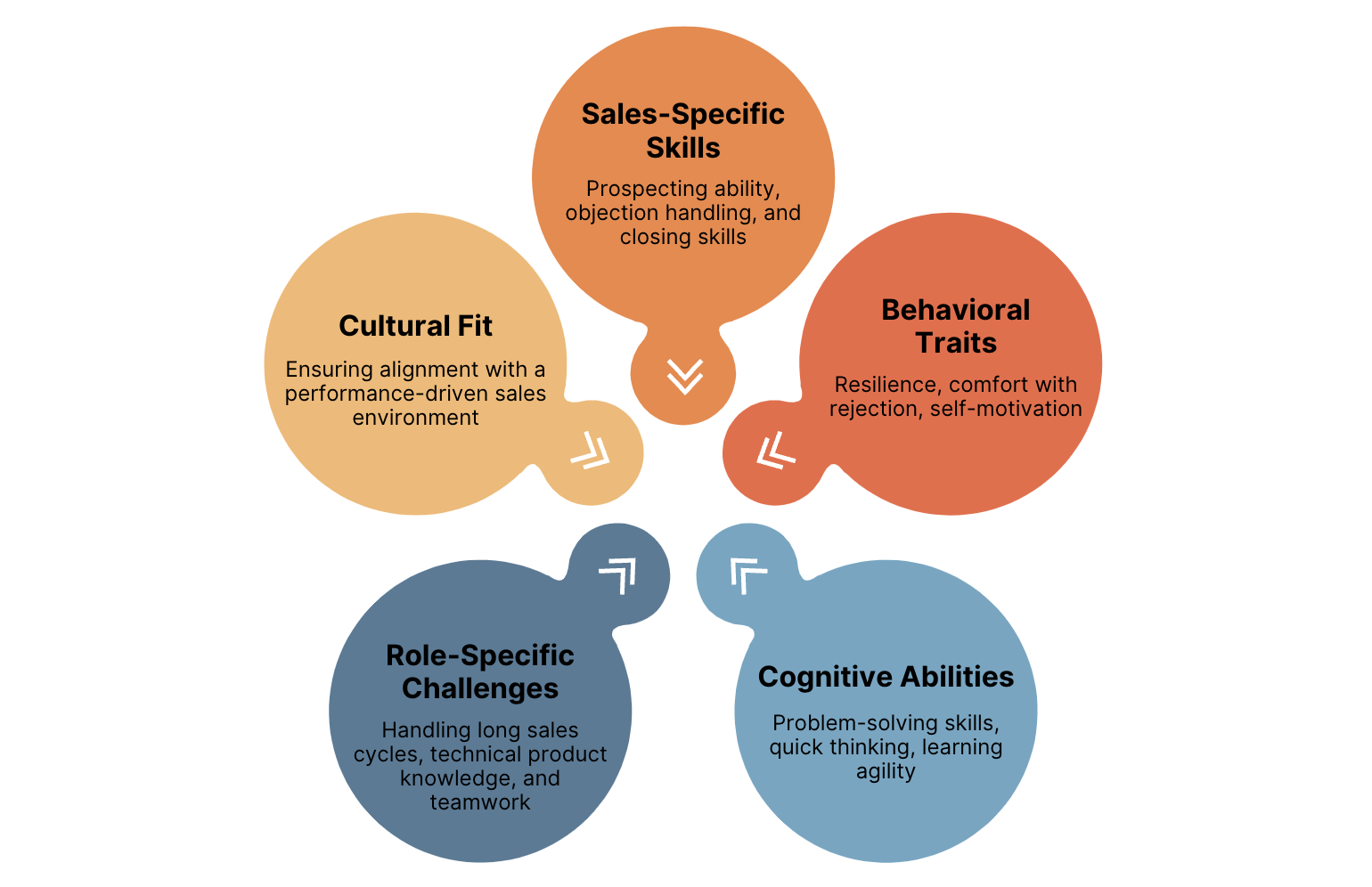
- Every candidate gets evaluated on the same competencies
- Interviewers cover the same topics but can ask different questions to get there
- The goal is consistent evaluation criteria, not robotic questioning
The topics that matter for sales roles:
- Quota performance and pressure resilience
- Pipeline management and forecast accuracy
- Stakeholder navigation in complex deals
- Objection handling and pricing conversations
- Coachability and continuous improvement
- Self-management and accountability
How it works in practice: Interviewer A covers quota performance with every candidate but might phrase questions differently based on the candidate's background. Interviewer B evaluates stakeholder complexity for every candidate but adapts scenarios to the candidate's experience level. Every interviewer uses the job scorecard as their evaluation rubric.
The difference between consistency and scripting:
|
Scripted Interviews |
Consistent Interviews |
|
Ask identical questions word-for-word |
Cover identical topics and competencies |
|
Feel robotic and inflexible |
Feel natural but rigorous |
|
Easy to game with preparation |
Harder to fake with real follow-ups |
|
Focus on process compliance |
Focus on evidence capture |
Scripts create the illusion of consistency. Real consistency comes from evaluating the same competencies with the same rigor, regardless of how the conversation flows.
How to Structure Sales Interviews That Actually Work
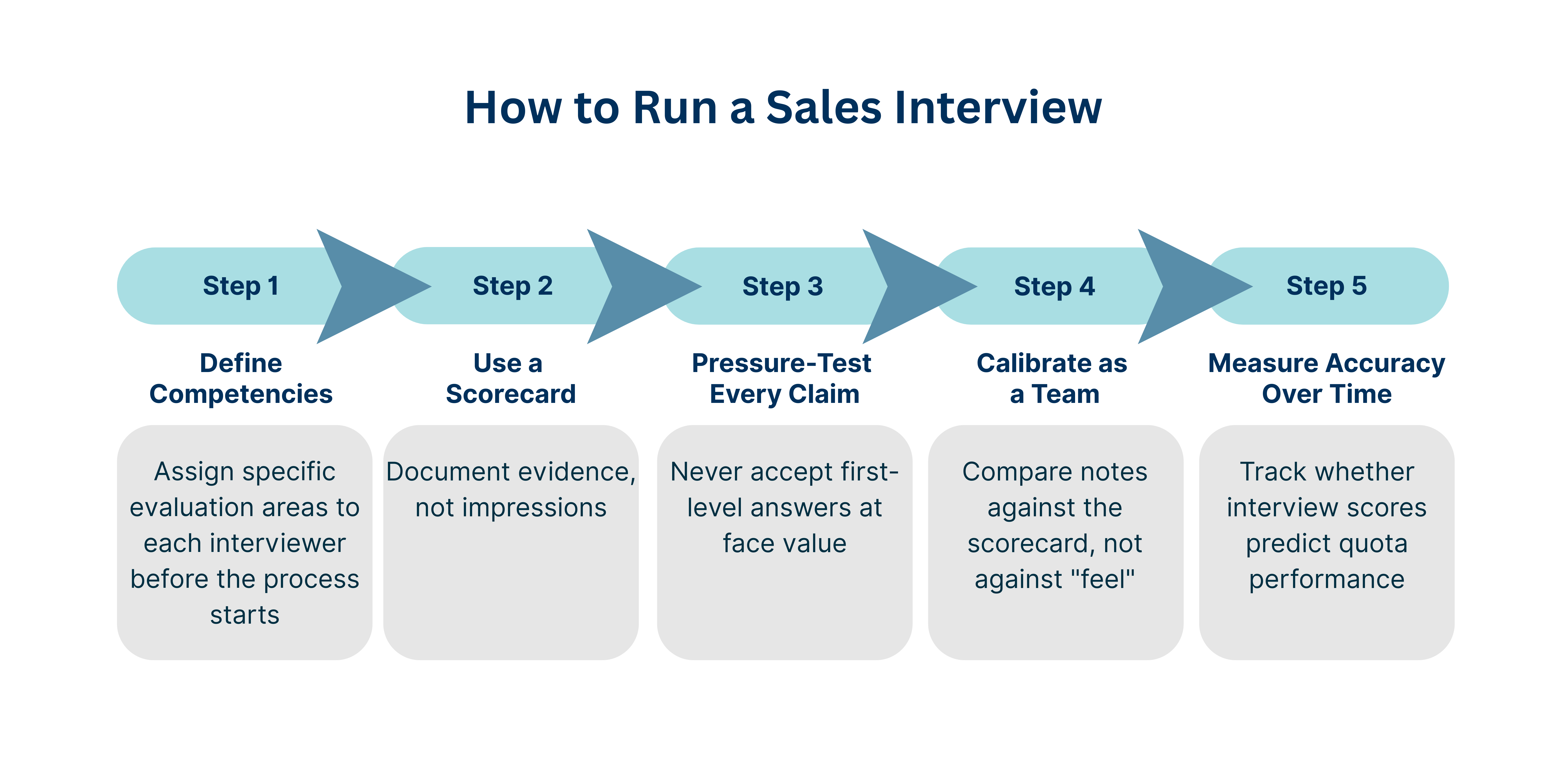
Step 1: Define What Each Interviewer Evaluates
Before the interview process starts, assign specific competencies to each interviewer based on the job scorecard. Don't have everyone ask the same questions—divide and conquer.
Example interview panel structure:
- Hiring Manager: Quota performance, pipeline management, accountability
- Sales Leader: Stakeholder complexity, deal navigation, strategic thinking
- Peer Rep: Day-to-day execution, coachability, culture alignment
Step 2: Use a Scorecard for Every Interview
Each interviewer should have:
- The competencies they're evaluating
- 3-5 behavioral questions that reveal those competencies
- A scoring rubric (evidence-based, not gut-feel)
- Space to document specific examples the candidate provides
Step 3: Pressure-Test Every Claim
Train your interviewers to:
- Never accept first-level answers at face value
- Always ask for tactical specifics
- Dig into numbers, timelines, and decisions
- Request examples of what didn't work, not just successes
Step 4: Calibrate as a Team
After interviews, compare notes against the scorecard, not against "feel." Look for evidence gaps where candidates couldn't provide specifics. Identify inconsistencies in the candidate's story across interviewers. Make hiring decisions based on documented evidence, not mood.
The calibration question: "Based on what we heard, can this person do the job we defined in our scorecard?" Not "Did we like them?" but "Is there evidence they can execute?"
Step 5: Measure Interview Accuracy Over Time
Track whether your interview process predicts performance. Do candidates who score high in interviews hit quota? Which interview questions correlate with success? Which interviewers are most accurate in their assessments?
If your interviews aren't predicting performance, fix the interviews. Don't blame the candidates.
Frequently Asked Questions
What makes a sales interview effective?
An effective sales interview reveals capability through behavioral evidence and pressure-testing, not gut feel. It uses structured consistency—covering the same competencies with every candidate but allowing natural conversation flow. Effective interviews require candidates to provide tactical specifics about past performance, handle challenge-based scenarios that can't be rehearsed, and demonstrate thinking under pressure. The interview should produce documented evidence that the candidate can do the job, not just a feeling that you "liked" them.
How do you know if your sales interview process is working?
Track whether candidates who score well in interviews actually hit quota after hire. If your "strong interviews" don't correlate with strong performance, your interview process is broken. Look for patterns: Do interviewers disagree frequently? Do hiring decisions come down to "gut feel" debates? Do new hires say "I didn't realize the role involved X"? These signal that interviews aren't revealing what matters. Effective interview processes produce predictable hiring outcomes, not surprises.
What's the difference between structured and scripted interviews?
Scripted interviews ask identical questions word-for-word to every candidate. Structured interviews evaluate the same competencies with every candidate but allow interviewers to adapt their questions based on the candidate's background. Scripts feel robotic. Structure feels natural but rigorous. The goal of structure is consistent evaluation criteria—not identical wording. You want every candidate assessed on quota performance, but how you dig into that topic can vary based on their experience.
Why do behavioral questions work better than hypothetical questions?
Behavioral questions ("Tell me about a time...") reveal actual experience. Hypothetical questions ("What would you do if...") reveal what candidates think you want to hear. Past behavior is the best predictor of future behavior. Strong candidates can provide tactical specifics about real situations because they lived them. Weak candidates struggle with behavioral questions because they lack the experience. Hypothetical questions are easier to fake—anyone can describe what they'd do. Fewer people can describe what they actually did with detail.
How do you pressure-test a candidate's claims in an interview?
Never accept first-level answers at face value. When a candidate says "I exceeded quota by 30%," dig deeper: "Walk me through how you did that. What specific deals made up that number? How much came from new business versus expansion? What was your win rate compared to team average? Tell me about deals you lost." Strong candidates can go three to four levels deep because they remember details. Weak candidates get vague or defensive because the surface claim isn't backed by real experience.
How does interview structure connect to the STAR Hiring methodology?
In STAR Hiring, interviews are the stage where capability gets verified or missed. The job scorecard from the Clarity stage defines what competencies to evaluate. Challenge-based interviews in STAR use behavioral evidence and pressure-testing to reveal whether candidates actually have those competencies. Interview structure in STAR means consistency across evaluation areas—every candidate gets assessed on the same criteria using the same rigor, which produces predictable, evidence-based hiring decisions.

Stop Asking "Did We Like Them?" Start Asking "What's the Evidence?"
Most sales interviews feel good but predict nothing because they test presentation skills instead of sales capability. Anecdotes are not a system. Comfortable conversations are not capability verification.
The death of the "good interview" means letting go of gut feel and embracing evidence-based evaluation. Interviews that reveal capability require behavioral questions, pressure-testing follow-ups, challenge-based scenarios, and structured consistency.
Your interview process should make you uncomfortable. If every interview feels great, you're probably not digging deep enough.
If your interviews feel strong but performance doesn't validate them, your Interviewing score will show why. Run the Sales Hiring Diagnostic at intelligentconversations.com to see where your interview process breaks down. Most leaders believe their interviews reveal capability. The data usually shows they reveal likability instead.





The 6-Minute Phone Screen: The Fastest Way to Catch the Wrong Sales Hire Early
The most expensive part of your sales hiring process is the time your team spends interviewing people who never should ...
Ready to Build a High-Performing Sales Team?
Let's create your custom Sales Transformation Program.