
Sales Onboarding: The 30/60/90 Day Ramp Plan (2026 Guide)
Written by: Mike Carroll
%20featured%20image.jpeg)
It's Friday afternoon. Your new sales hire starts Monday. HR has their laptop ready. IT set up their accounts. Their manager blocked time for a welcome meeting. Everything's in place.
Except one thing: nobody defined what "good" looks like at 30, 60, or 90 days.
Monday morning, the new hire shows up. They get the laptop. They sit through the welcome meeting. They watch some training videos. By Wednesday, they're "onboarded." By Friday, they're on their own.
Three months later, they're still ramping. Six months in, you're wondering if this was the right hire. Nine months later, you're having performance conversations that should have happened at day 45.
The problem: Most companies confuse orientation with onboarding. Orientation is administrative. Onboarding is strategic. Orientation gets people started. Onboarding gets people productive.
The difference shows up in ramp time. Companies with structured 30/60/90 ramp systems get new hires to quota 40-60% faster than companies that wing it. That's not just faster revenue. That's fewer early-tenure exits, higher confidence, and better long-term performance.
This post shows you how to build a 30/60/90 ramp system that turns "strong hire, slow start" into "strong hire, fast ramp."
What You Need to Know: The Quick Answer
What's the difference between orientation and onboarding, and why does it matter for sales ramp time?
Orientation is administrative—paperwork, logins, welcome meetings. Onboarding is strategic—defined milestones, clear expectations, structured ramp plans that get new hires productive faster.
Most "onboarding programs" are actually orientation programs. They check compliance boxes but don't answer the critical questions:
- What should this person know by day 30?
- What should they be able to do by day 60?
- What does full productivity look like at day 90?
Without answers to these questions, you're relying on hope, not process. New hires guess their way through ramp. Managers provide inconsistent feedback. Performance gaps don't surface until it's too late.
A structured 30/60/90 ramp system defines:
- Knowledge milestones (what they learn)
- Capability milestones (what they can do)
- Performance milestones (what results they produce)
- Clear metrics at each stage
- Manager checkpoints and feedback loops
The principle: If you haven't defined what "good" looks like at 30, 60, and 90 days, you don't have onboarding. You have hope.
The "Strong Hire, Slow Start" Problem
You hired someone great. Their resume was strong. They interviewed well. References validated capability. Everyone was excited.
Then they start. And the ramp drags.
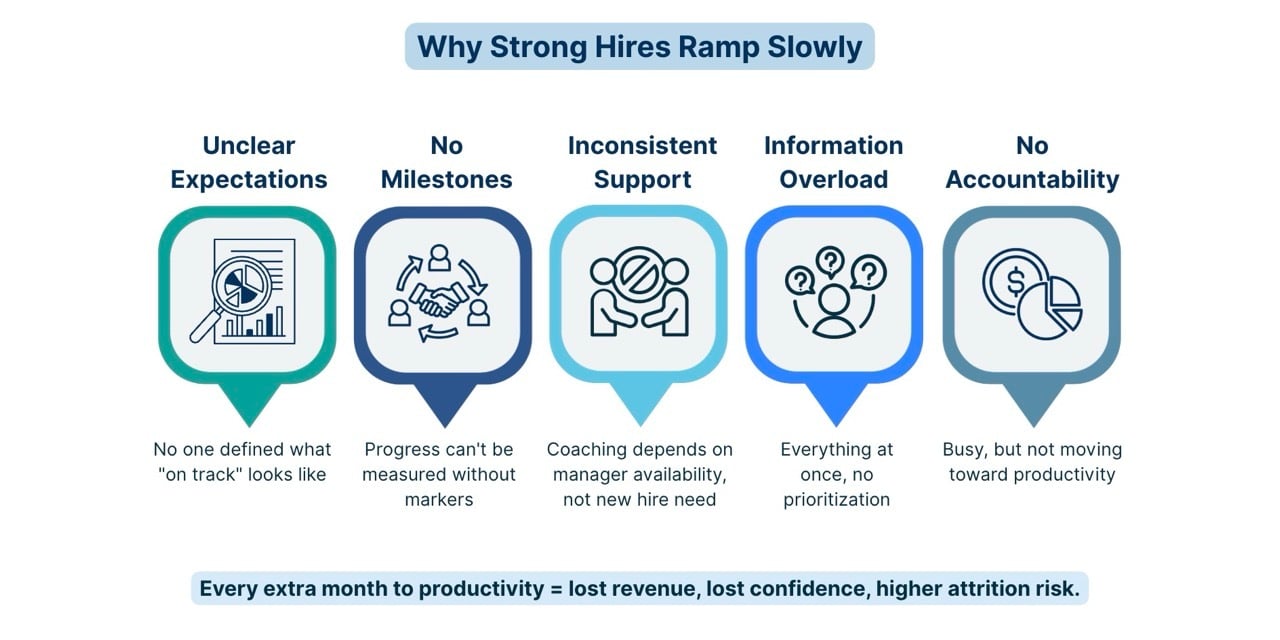
Why this happens:
Unclear expectations. New hire doesn't know what "on track" looks like. They're busy, but they don't know if they're making progress or falling behind.
No defined milestones. Manager can't tell if they're progressing or struggling. Without clear markers, assessment becomes subjective.
Inconsistent support. Some days they get attention, some days they're on their own. The level of coaching varies based on manager availability, not new hire need.
Information overload. Too much thrown at them with no prioritization. They're drowning in product training, process docs, and system tutorials without knowing what matters most.
Activity without accountability. They're busy but not productive. Lots of motion, little progress toward actual selling capability.
The cost of slow ramp:
Every extra month to productivity is lost revenue. Confidence erodes when new hires don't know if they're succeeding. Early attrition increases—people leave when they feel set up to fail. Team morale suffers when new hires struggle publicly.
Average sales ramp time has increased as deal complexity grows and remote/hybrid environments make informal learning harder. New hires need more structure, not less.
The insight: Slow ramp is rarely a hiring mistake. It's usually an onboarding problem. Strong hires need strong onboarding.
What Onboarding Actually Means
Onboarding vs. Orientation
Orientation answers: Where do I sit? How do I log in? When do I get paid? Who's on my team?
Onboarding answers: What do I need to know to be effective? What should I be able to do at 30/60/90 days? How will I be measured? What does success look like in my first quarter?
The difference:
|
Orientation |
Onboarding |
|
Administrative checklist |
Strategic ramp plan |
|
One-time event |
Continuous process |
|
HR-driven |
Manager-driven |
|
Compliance-focused |
Performance-focused |
|
"Welcome to the company" |
"Here's how you succeed in this role" |
Onboarding is not something you do to new hires. It's something you build for them. It's engineered, not accidental.
In STAR Hiring, onboarding is the final stage where capability gets activated. You've hired the right person through structured sourcing, screening, and interviewing. Now you need to deploy them effectively.
Building Your 30/60/90 Ramp Plan
Each phase has a different focus, different milestones, and different expectations.
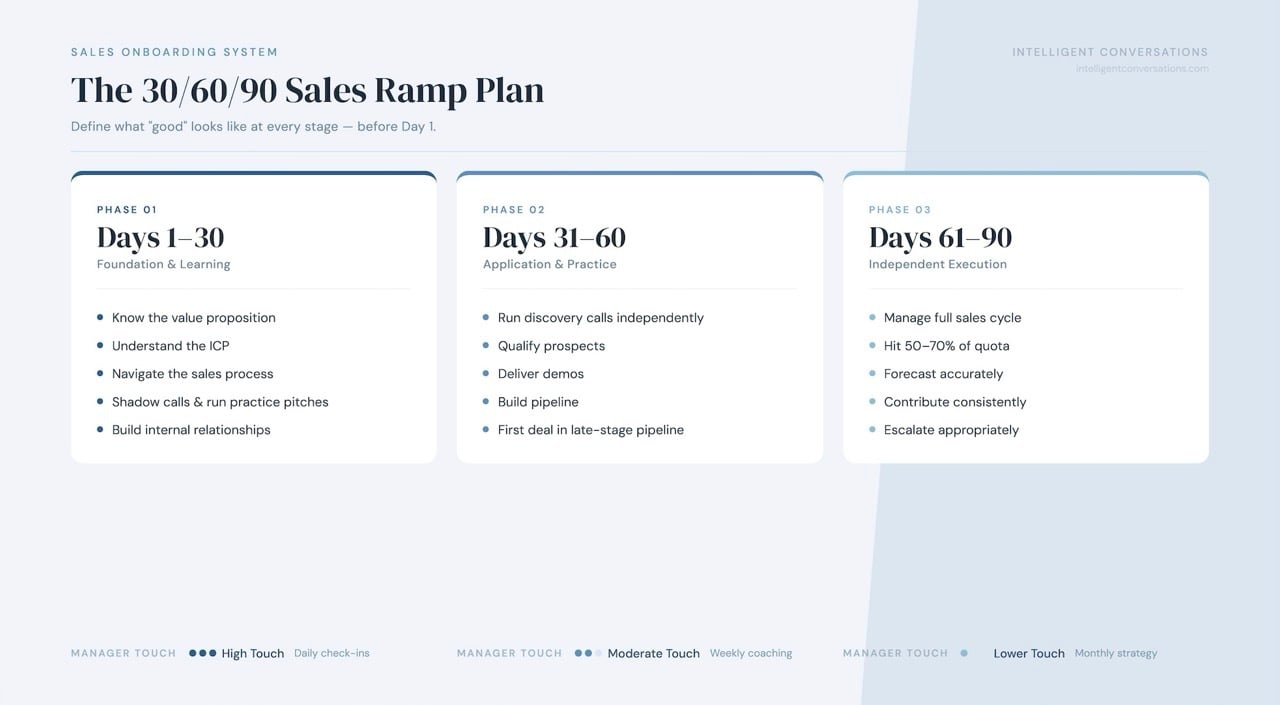
Days 1-30: Foundation and Learning
Focus: Knowledge acquisition, relationship building, process familiarity
What "good" looks like at Day 30:
Knowledge milestones:
- Understands company value proposition and positioning
- Can articulate ICP and buyer personas
- Knows product features and key differentiators
- Familiar with CRM, sales tools, and internal systems
Capability milestones:
- Can navigate sales process stages
- Can conduct discovery call (supervised)
- Can demonstrate product (with coaching)
- Understands pipeline management basics
Performance milestones:
- Completed required hours of product training
- Shadowed minimum number of sales calls
- Conducted practice pitches with feedback
- Built relationships with key internal stakeholders
Manager checkpoint: Week 2 and Week 4 formal 1:1s to assess progress and address gaps.
Days 31-60: Application and Practice
Focus: Supervised execution, skill development, confidence building
What "good" looks like at Day 60:
Knowledge milestones:
- Understands common objections and how to handle them
- Knows competitive landscape and differentiation
- Familiar with pricing, contracts, and deal structures
Capability milestones:
- Can run discovery calls independently
- Can qualify prospects using company methodology
- Can present solutions to prospects
- Can navigate objections in real-time
Performance milestones:
- Defined outbound activity per week (calls/emails)
- Qualified conversations conducted
- Demos delivered
- Opportunities created in pipeline
- First deal in late-stage pipeline (doesn't need to close yet)
Manager checkpoint: Weekly 1:1s focused on skill gaps and tactical coaching.
Days 61-90: Independent Execution
Focus: Quota contribution, independent performance, full productivity ramp
What "good" looks like at Day 90:
Knowledge milestones:
- Deep product knowledge across full portfolio
- Understands ideal deal profile and red flags
- Can coach peers on specific areas of strength
Capability milestones:
- Manages full sales cycle independently
- Forecasts accurately
- Prioritizes pipeline effectively
- Escalates appropriately when needed
Performance milestones:
- Percentage of full quota (usually 50-70% depending on cycle)
- Minimum opportunities in pipeline
- Deals closed (or in final stages for long cycles)
- Consistent activity metrics
Manager checkpoint: Monthly 1:1s focused on quota attainment and strategic development.
Manager's Role at Each Stage
Days 1-30: High touch, daily check-ins, active coaching Days 31-60: Moderate touch, weekly coaching, supervised execution Days 61-90: Lower touch, monthly strategy sessions, independent execution
Start Before They Start
The pre-start window—between offer acceptance and Day 1—is when new hires are most nervous and most likely to reconsider. Stay connected.
What to send:
- Welcome email from hiring manager (personal, not HR template)
- Calendar invite for Day 1 agenda
- Pre-reading: company overview, product materials, team bios
- Access to internal resources when possible
- Expectations doc: what to expect in first week and month
This reduces Day 1 anxiety, demonstrates organization, and prevents ghosting or reneging.
The "No Desk on Day 1" Horror Story
A new sales hire shows up Monday morning. No desk assigned. No laptop ready. Manager is traveling. They spend Day 1 waiting in a conference room reading old slide decks. By Day 3, they're questioning the decision to join.
The damage: First impressions matter. Disorganized Day 1 signals disorganized company. New hires assume: "If they can't get this right, what else is broken?"
How to avoid:
- Assign workspace before Day 1
- Have tech ready and tested
- Manager must be present (or designate backup)
- First week agenda must be planned and communicated
- Assign a "buddy" for informal questions
The Friday onboarding trap: Never start new hires on Friday. They get orientation, then sit alone over the weekend. Start Monday or Tuesday for a full-week immersion.

Engineered vs. Accidental Onboarding
Engineered onboarding measures:
- Time to first deal
- Time to quota attainment
- 90-day retention rate
- New hire confidence scores (survey at 30/60/90)
- Manager assessment of readiness
Accidental onboarding results:
- Inconsistent ramp times across new hires
- High early-tenure attrition
- Performance conversations at month 6 that should have happened at month 2
- New hires who "figured it out" despite the process, not because of it
The diagnostic question: If two identical candidates join your team at the same time, do they ramp at the same speed with the same support? If not, your onboarding is accidental.
Frequently Asked Questions
What should a 30/60/90 day plan include for a new sales hire?
A 30/60/90 day plan should define knowledge milestones (what they learn), capability milestones (what they can do), and performance milestones (what results they produce) at each stage. Days 1-30 focus on foundation and learning. Days 31-60 focus on supervised execution and skill development. Days 61-90 focus on independent performance and quota contribution. Each phase should have clear metrics, manager checkpoints, and documented expectations so both the new hire and manager know what "on track" looks like.
How long should sales onboarding take?
Sales onboarding is a 90-day process, not a one-week orientation. The first 30 days build foundational knowledge. The next 30 days develop capability through supervised practice. The final 30 days transition to independent execution. Full productivity varies by sales cycle—transactional roles may hit quota by day 90, while complex enterprise roles may take 4-6 months to full quota. The 90-day structure provides the framework regardless of cycle length.
What's the difference between onboarding and orientation?
Orientation is administrative (paperwork, logins, welcome meetings). Onboarding is strategic (ramp plans, milestone expectations, performance development). Orientation is a one-time event focused on compliance. Onboarding is a continuous 90-day process focused on productivity. Most companies call their orientation program "onboarding," but if it doesn't define what success looks like at 30/60/90 days, it's just orientation.
Why do new sales hires ramp slowly even when they're qualified?
Slow ramp is usually an onboarding problem, not a capability problem. Common causes: unclear expectations (new hire doesn't know what "on track" means), no defined milestones (manager can't assess progress), inconsistent support (some days high-touch, some days none), and information overload without prioritization. Strong hires need strong onboarding. Without structure, they guess their way through ramp, which delays productivity and erodes confidence.
How does onboarding connect to the STAR Hiring methodology?
In STAR Hiring, onboarding is the final stage where capability gets activated. You've sourced the right candidates, screened for fit, interviewed for capability, and hired strong talent. Onboarding is where you deploy that talent effectively. The 30/60/90 ramp system ensures new hires reach productivity faster, which protects your hiring investment and validates the work done in earlier STAR stages.
What are the biggest onboarding mistakes companies make?
Three biggest mistakes: confusing orientation with onboarding (checking admin boxes without defining performance expectations), starting new hires on Friday (they get orientation then sit alone over the weekend), and failing to define what "good" looks like at 30/60/90 days (leaving new hires to guess what success means). These create slow ramp, low confidence, and early attrition. The fix: build a structured 30/60/90 plan before the new hire's first day.
You Don't Have Onboarding. You Have Hope.
Onboarding is not orientation—it's strategic ramp engineering. The 30/60/90 system defines what "good" looks like at each stage. Strong hires need strong onboarding to reach productivity faster. Pre-start communication and Day 1 execution set the tone. Engineered onboarding produces consistent results. Accidental onboarding produces inconsistent ramp times.
If you haven't defined what "good" looks like at 30, 60, and 90 days, you don't have onboarding. You have hope.
The Onboarding bucket of the Sales Hiring Diagnostic reveals whether your ramp system is engineered or accidental. Run the diagnostic at intelligentconversations.com to score your Onboarding process and see where new hires are falling through the cracks. Most companies discover their "onboarding program" is actually just orientation in disguise.





Are AI Interviews Making Sales Hiring Better (or Just Faster)?
Quick Answer: AI interviews deliver speed and consistency, but consistency doesn't equal capability detection. Most ...
Ready to Build a High-Performing Sales Team?
Let's create your custom Sales Transformation Program.