Are AI Interviews Making Sales Hiring Better (or Just Faster)?
Written by: Mike Carroll

Quick Answer: AI interviews deliver speed and consistency, but consistency doesn't equal capability detection. Most candidates still want human interaction for final hiring decisions, and unstructured interviews predict job success at barely better than random. The companies getting this right use AI for efficiency while keeping human judgment where it matters most, evaluating whether someone can actually sell.
More than half of companies now use AI somewhere in their hiring process. Many report it improved the quality of their hires. But the same companies also say they're concerned AI is screening out qualified candidates.
That's the paradox. AI is everywhere. It's fast. And nobody's entirely sure if it's working.
The AI Interview Arms Race
A growing number of companies now let AI conduct interviews directly, without a human in the room. Candidates show up expecting a conversation and instead face an algorithm asking questions, analyzing tone, and sometimes tracking facial expressions.
Meanwhile, hiring managers suspect candidates are using AI to game the process. AI-generated resumes. AI-coached responses. AI tools that whisper answers during virtual interviews.
So we've arrived at a strange place: AI interviewing AI. Both sides are automating. Both sides suspicious. The result is what Harvard Business Review calls an "AI doom loop" where hiring has become more inhumane for everyone involved.
The question isn't whether AI is being used. It's whether it's making hiring decisions better or just making them happen faster.
What AI Interview Tools Actually Do Well
AI brings legitimate value to parts of the hiring process.
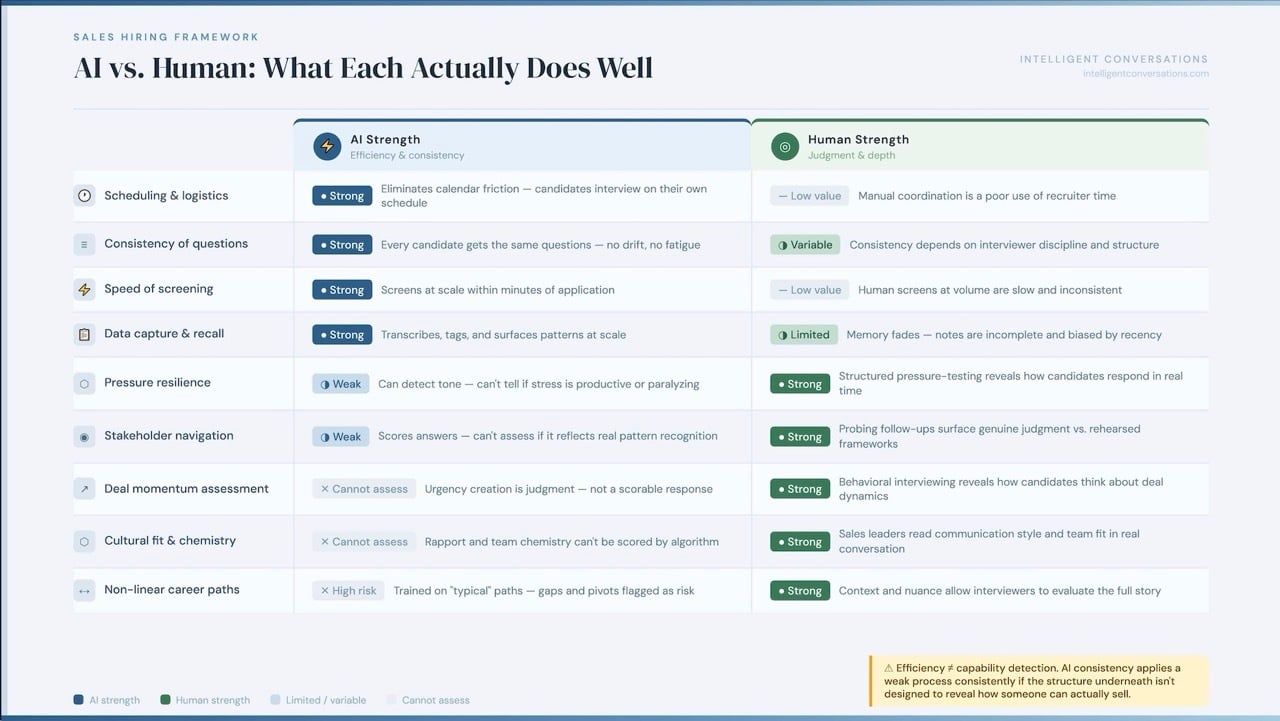
Scheduling and logistics. AI eliminates calendar coordination. Candidates can interview on their own schedule. Recruiters spend less time on administrative work.
Consistency in evaluation. Every candidate gets asked the same questions in the same order. No conversational drift. No screening fatigue where the 50th candidate gets less attention than the first.
Speed. AI can conduct initial phone screens within minutes of application instead of days. Time-to-hire drops significantly when AI handles early-stage screening.
Data capture. Interview intelligence platforms transcribe conversations, tag key moments, and surface patterns hiring managers might miss. Teams can review exactly what was said instead of relying on memory or vague notes.
For companies drowning in applications, these aren't small wins.
But efficiency and capability detection are not the same thing.
Where AI Interviews Fall Short and Why It Matters for Sales
The challenge with AI interviews isn't what they automate. It's what they can't evaluate.
Consistency doesn't equal capability detection.
Unstructured interviews (AI or human) have a predictive validity of 0.2 to 0.3 on a scale of 0 to 1. That's barely better than random. AI can make interviews more consistent. It can't make them more predictive unless the structure underneath is designed to reveal capability.
For sales roles, this gap is critical. Sales success depends on skills AI struggles to evaluate:
- Pressure resilience. Can this person recover after a buyer goes cold? AI can detect stress in tone, but it can't tell you whether someone uses pressure as fuel or folds under it.
- Stakeholder navigation. Does this person understand how to map influence in a complex buying committee? AI can score an answer, but it can't assess whether the answer reflects real pattern recognition or rehearsed frameworks.
- Deal momentum. The best salespeople create urgency without burning relationships. That's judgment, not a scripted response.
AI can't assess cultural fit or team chemistry.
Candidates still want human interaction for final hiring decisions. They're recognizing that rapport, communication style, and team chemistry can't be scored by an algorithm. Top-tier sales candidates notice when they're being evaluated by AI instead of the sales leader they'd be working with.
AI has difficulty interpreting unconventional career paths.
Sales careers rarely follow straight lines. A candidate might have spent two years in customer success, moved to sales, then taken six months off to care for a parent. AI systems trained on "typical" backgrounds may flag gaps as risk, screening out candidates with valuable cross-functional experience.
Regulatory complexity is growing.
- New York City requires annual bias audits for automated employment decision tools.
- California extends anti-discrimination protections to AI systems.
- Colorado's AI Act (effective June 2026) classifies employment-related AI as "high-risk."
Employers are legally liable for their vendor's algorithm. If your AI interview tool introduces bias, you face the consequences.
What Candidates Actually Think About AI Interviews
Most candidates say they prefer AI-enhanced processes for initial screenings. That sounds like a mandate. But dig one level deeper and you'll find they still want human interaction for final decisions. They want transparency about when and how AI is being used. And they have concerns about algorithmic fairness.
Candidates chose AI because they believed it would be less biased and more consistent, not because they thought it would evaluate them better.
Candidates trust AI to be fair. They don't trust it to see them clearly.
For sales hiring, that distinction matters. You're assessing whether someone can build trust with buyers, navigate objections, and close deals under pressure. If your interview process can't build trust with the candidate, what does that signal about the kind of sales talent you're attracting?
Where AI Fits Responsibly in Sales Hiring
AI isn't the enemy. Unstructured, unmeasured hiring is the enemy. AI just makes the problem faster when it's deployed without a real capability detection framework.
Used responsibly, AI belongs in three places:
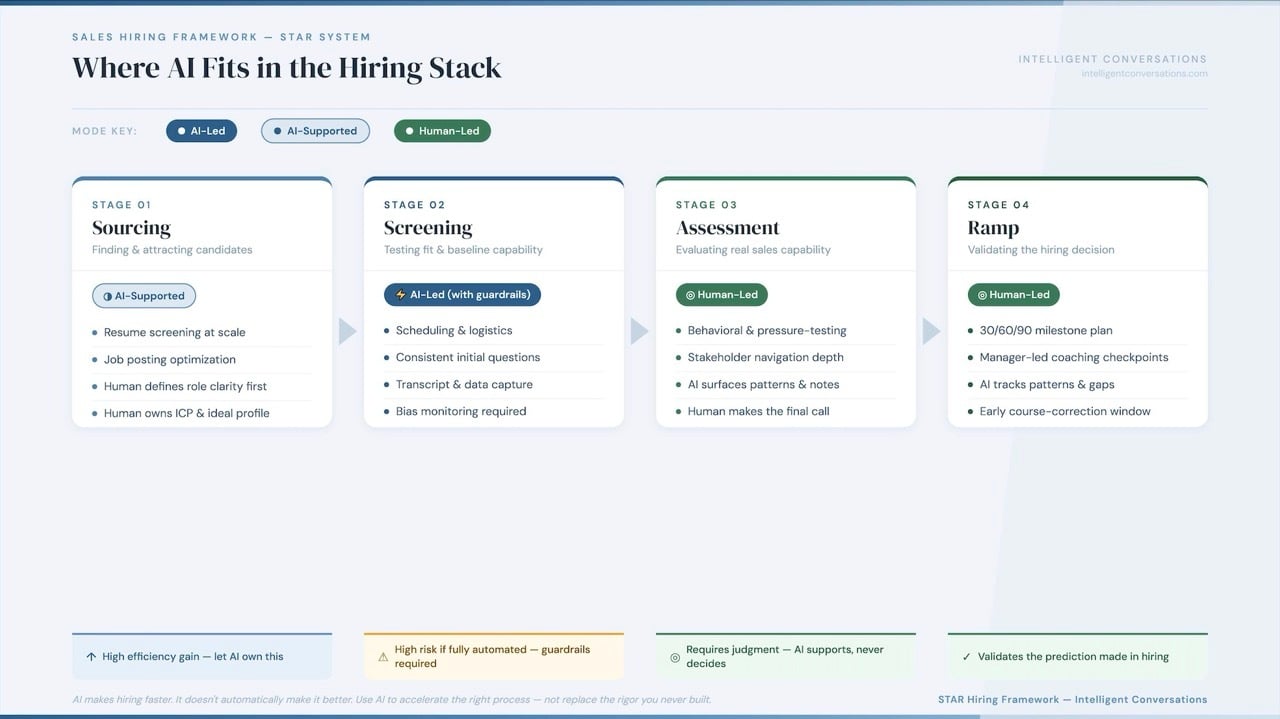
1. Initial screening and logistics
Let AI handle resume screening, schedule coordination, and basic qualification checks. This frees recruiters to focus on relationship-building with qualified candidates.
2. Interview intelligence and pattern detection
Interview intelligence platforms transcribe conversations, surface key moments, and help hiring teams spot patterns they'd otherwise miss. These tools don't make the hiring decision. They make bias visible, ensure consistency in evaluation, and capture data that improves the process over time.
3. Decision support, not decision-making
AI should recommend, score, and prioritize candidates. Humans must make the final call. This keeps accountability where it belongs and allows for context AI can't process.
The companies getting AI right treat it as decision support, not autopilot.
What Sales Hiring Actually Requires
Sales hiring isn't a sorting problem. It's a capability detection problem.
You need to know: Can this person handle objections without getting defensive? Do they understand buyer psychology or just pitch decks? Will they recover after three consecutive losses, or will they spiral?
AI can't answer those questions. Those questions require pressure-testing, behavioral depth, and pattern recognition that only structured human evaluation can provide.
The methodology that works:
Clarity first.
Define the role with specificity. Who do they call on? What's the average deal size? What's the sales cycle length? If you don't have role clarity, AI will optimize for speed while screening the wrong profile.
Structured screening.
Phone screens should test for commitment, baseline fit, communication under pressure, and authenticity. AI can handle logistics. Humans should evaluate responses.
Behavioral interviewing with pressure-testing.
Ask behavioral questions that surface real past performance, then follow up with pressure-testing questions that expose whether the candidate is repeating frameworks or demonstrating real capability.
Consistency measurement.
If two interviewers evaluate the same candidate and reach opposite conclusions, your process is broken. AI can surface that inconsistency. Humans need to fix it through better structure and calibration.
Onboarding as the validation layer.
Hiring decisions are predictions. Onboarding is where you find out if the prediction was accurate. Companies with structured 30/60/90 ramp plans can identify capability gaps early and course-correct.
This is the STAR framework: Sourcing, Testing/Screening, Assessment/Interview, Ramp. It's human-led, AI-supported, and designed to detect capability, not just credentials.
The Real Question: What Are You Optimizing For?
AI makes hiring faster. It doesn't automatically make it better.
If your current process is unstructured and unmeasured, adding AI just accelerates bad decisions. You'll hire the wrong people faster.
But if you have clarity on what the role requires, a structured screening process, and behavioral interviews designed to pressure-test capability, AI becomes a force multiplier. It handles logistics. It surfaces patterns. It enforces consistency. And it frees your team to focus on the judgment calls that actually determine whether someone can sell.
The companies struggling with AI hiring right now aren't struggling because AI is flawed. They're struggling because they're trying to use AI to replace the hiring rigor they never built in the first place.

Where to Start
Before you add another AI tool to your hiring stack, answer this: Can your current process reliably detect sales capability?
If you're not sure, run the Sales Hiring Diagnostic. It's a 15-question assessment that evaluates your hiring process across three critical areas: Clarity (do you know what you're hiring for?), Screening & Interviewing (can you detect capability?), and Onboarding & Ramp (can you validate your hiring decisions?).
You'll get a personalized video from Mike Carroll breaking down where your process is strong and where the gaps are. No sales pitch. No lengthy forms. Just a clear diagnosis of whether your hiring system is built to detect talent or just built to move fast.
Because if AI is making your hiring faster but not better, you're not solving the problem. You're just spending more money to hire the wrong people more efficiently.
FAQ
Q: Should we stop using AI in our sales hiring process?
No. AI brings real value to scheduling, initial screening, and interview intelligence. The issue isn't AI use. It's AI reliance without human judgment in the final decision. Use AI to handle logistics and surface patterns. Keep humans in the loop for capability evaluation and final hiring calls.
Q: What's the difference between AI-assisted interviews and AI-conducted interviews?
AI-assisted interviews use tools like transcription and pattern detection to support human interviewers. The human still conducts the conversation and makes the evaluation. AI-conducted interviews use AI to ask questions, analyze responses, and score candidates without human involvement. The latter increases speed but reduces the depth of evaluation, especially for roles like sales that require nuanced judgment.
Q: How do we know if our AI tools are introducing bias?
Run bias audits. Test selection rates across protected groups. Monitor whether AI recommendations disproportionately screen out candidates based on factors like employment gaps or non-traditional backgrounds. If you're using third-party AI tools, require vendors to share their bias audit results. You're legally liable for their algorithm's outcomes.
Q: What's the predictive validity of AI interviews compared to human interviews?
Unstructured interviews (AI or human) have a predictive validity of 0.2-0.3, barely better than random. Structured interviews improve that to around 0.5-0.6. AI doesn't automatically increase predictive validity. It increases consistency. If your interview structure is weak, AI will consistently apply a weak process.
Q: What should we tell candidates about our use of AI in hiring?
Be transparent. Tell them when AI is being used, what it's evaluating, and how humans are involved in the decision. Laws in NYC, California, and Colorado are starting to require it. Even if you're not in those jurisdictions, transparency builds trust and improves candidate experience.
Q: Can AI replace human interviewers for sales roles?
No. AI can't evaluate pressure resilience, stakeholder navigation, deal momentum, or team chemistry. These capabilities require judgment and pattern recognition that only structured human evaluation can provide. AI should support decision-making, not replace it.





Beyond the AI Resume: How to Verify Sales Grit in a More Automated Hiring World
You're reviewing a resume that looks perfect. Clean formatting. Strong metrics. All the right keywords. Then you bring ...
Ready to Build a High-Performing Sales Team?
Let's create your custom Sales Transformation Program.