
How to Define a Sales Role in 2026: The Job Scorecard
Written by: Mike Carroll

Most sales hiring failures start at the beginning, with unclear role definitions.
You think you're clear about what you need. HR believes the job description covers it. Your sales manager assumes expectations are understood. But six months later, you're having the conversation: "This isn't what we thought we hired."
A new sales rep starts with energy and good intentions. Three months in, you realize they're struggling with stakeholder complexity you never mentioned. Or they're uncomfortable with your technical product depth. Or they expected transactional deals but you need consultative selling.
This mismatch started from the very beginning, hiding in the ambiguity of a vague role definition.
In 2026, with longer sales cycles, more buying committee stakeholders, and increased market complexity, unclear role definitions create expensive mismatches. In our Sales Hiring as a Growth Strategy framework, we've argued that hiring is a strategic lever, not a staffing function. But you need an actual strategy with clear definitions about what each part means.
The STAR Hiring methodology only works when the role is defined with precision. A strong framework cannot compensate for a vague scorecard. This post shows you what role clarity actually means and how to build a sales job scorecard that prevents costly hiring mistakes.
What You Need to Know: The Quick Answer
What does role clarity actually mean in sales hiring?
Role clarity means defining what success looks like, in measurable, behavioral, and environmental terms, before you hire. A strong sales job scorecard defines:
- Who the rep calls on (title, industry, buying committee structure)
- Average deal size and order value
- Sales cycle length and complexity
- Stakeholder and buying committee dynamics
- Required technical or industry depth
- Pipeline expectations and ramp timeline
Without this clarity, sourcing becomes broad, screening becomes subjective, interviews drift, and onboarding expectations shift.
In our STAR Hiring framework, clarity is the foundation that every stage depends on. If you can't articulate what "good" looks like in your specific sales environment, you're guessing. And guessing is expensive.
The diagnostic insight: Most hiring breakdowns trace back to unclear role definition. The symptoms appear in interviews and onboarding, but the cause is earlier, in the scorecard you never built.

Why Role Clarity Is the Real Beginning of the Sales Hiring Process
Clarity Comes Before Sourcing
Most leaders think hiring begins with posting the job. It doesn't. It begins with defining what the job actually is.
In our STAR Hiring framework, sourcing is the first visible stage. But in practice, clarity actually comes way before this part. Without role clarity, sourcing criteria are vague, recruiters default to generic filters like "5+ years of sales experience," and "find someone like Jerry" becomes your strategy.
The cascading failure pattern looks like this:
- Unclear role definition leads to vague sourcing criteria
- Vague sourcing produces the wrong candidate pool
- Wrong pool leads to subjective screening
- Subjective screening creates inconsistent interviews
- Inconsistent interviews produce bad hiring decisions
- Bad decisions result in expensive turnover
According to Gartner research, B2B buying committees now average 6-10 decision-makers. Sales cycles have lengthened across most industries. Technical product complexity requires deeper specialization. Remote and hybrid environments demand different self-management capabilities. These factors make precision in role definition more critical than ever.
The clarity principle is simple: if you can't define the role with precision, you can't evaluate candidates with accuracy.
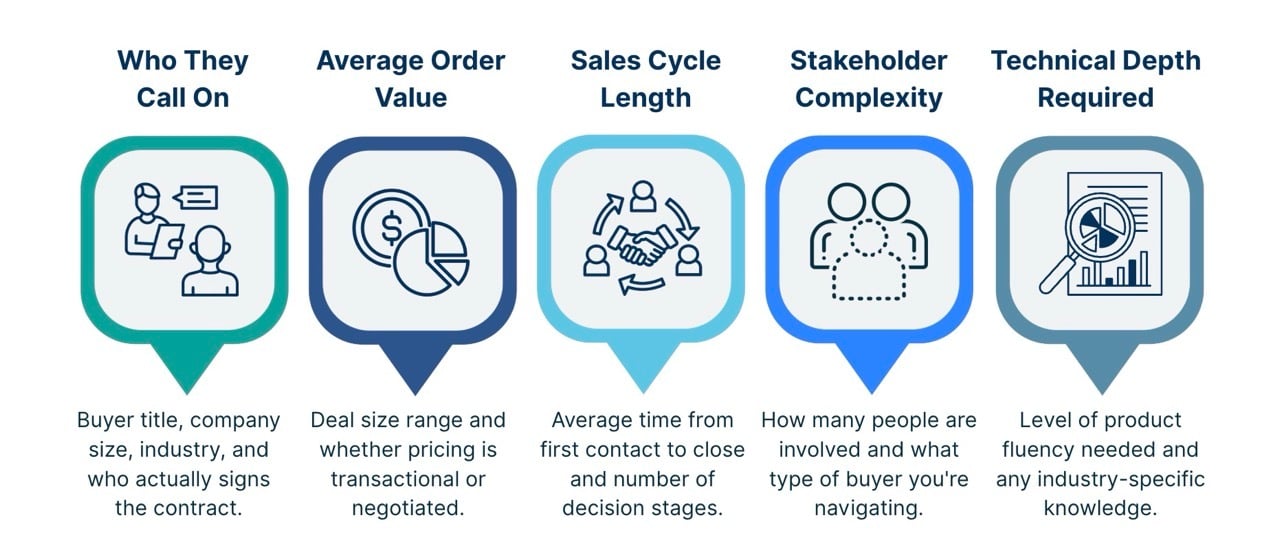
The 5 Dimensions of a Sales Job Scorecard
Here's what actually goes into a scorecard that drives hiring clarity.
Dimension 1: Who They Call On
Define: Buyer persona (title, seniority, function), industry or vertical focus, company size (employee count, revenue range), geographic territory, and buying committee structure.
Why it matters: A rep who sold to procurement at Fortune 500 companies won't automatically succeed selling to founders at Series B startups. The skills, approach, and credibility required are fundamentally different.
Sourcing criteria are built around defined buyer profiles. But those profiles must be articulated before sourcing begins. Create a "Buyer Profile Section" in your scorecard that answers:
- Who signs the contract?
- Who influences the decision?
- Who uses the product?
Dimension 2: Average Order Value (AOV)
Define: Deal size range (e.g., $50K-$150K), one-time versus recurring revenue, transactional versus consultative approach, and whether pricing is standardized or negotiated.
Why it matters: A rep accustomed to $20K transactional deals will struggle in $500K+ enterprise environments. The complexity, stakeholder involvement, and sales skills required scale directly with deal size. Interview rigor depends on knowing what experience range matters. If you don't define the AOV band, interview questions become generic.
Dimension 3: Sales Cycle Length
Define: Average time from first contact to close, number of meetings typically required, typical deal stages, and speed of decision-making in your market.
Why it matters: A rep who closed 2-week deals won't naturally understand 9-month enterprise cycles. Pipeline management skills, forecast accuracy, and patience under pressure differ dramatically across cycle lengths. In interviews, we pressure-test pipeline management and deal pacing. But we can't pressure-test what hasn't been defined.
Dimension 4: Stakeholder & Buying Complexity
Define: How many people are typically involved in decisions, whether you sell to technical buyers or economic buyers, whether you navigate procurement and legal reviews, and whether implementation affects the sales process.
Why it matters: B2B buying groups now involve more stakeholders than ever. Clarity here determines what experience qualifies and what scenarios to test in interviews. Challenge-based interview questions require understanding the actual stakeholder complexity your reps face.
Dimension 5: Technical & Product Depth Required
Define: Level of technical fluency needed (surface versus deep), whether reps conduct demos, whether they need to understand integrations or APIs, and industry-specific knowledge requirements.
Why it matters: If technical fluency matters, it must be written into the scorecard before screening begins. Otherwise, HR screens incorrectly, and interviewers test the wrong competencies. SaaS sales to marketing teams versus infrastructure sales to DevOps teams require fundamentally different technical capabilities.

The Risk of Reusing Last Year's Sales Role
Most organizations default to "post the same job description we used last time." But markets shift, products evolve, competition changes, and buyer expectations increase. What worked in 2024 may not work in 2026.
Specific risks of reusing old role definitions:
- Your ICP may have changed (company size, industry, buyer persona)
- Your product may have added complexity (new integrations, security requirements, scalability demands)
- Your competition may have forced you upmarket or downmarket
- Your go-to-market motion may have shifted (product-led growth versus enterprise sales)
A reused job description is often a recycled hiring mistake. In our Sales Hiring as a Growth Strategy pillar, we emphasize proactive hiring. Reusing an outdated job description is reactive by definition.
Early Warning Signs You Lack Role Clarity
Here's how to diagnose whether your role definition is actually clear.
During Sourcing:
- Recruiters ask you the same clarifying questions multiple times
- Your candidate pool feels either too broad or too narrow
- You keep adjusting criteria after seeing candidates
During Interviews:
- Interviewers debate personality instead of performance fit
- Different interviewers ask wildly different questions
- You rely heavily on phrases like "culture fit" or "gut feel"
- Team members disagree on whether candidates are qualified
After Hiring:
- The new hire says "I didn't realize this role involved X"
- Ramp expectations feel "fluid" or keep changing
- Managers disagree about what the person should prioritize
- The first 90 days reveal mismatched expectations
If interview questions vary widely from candidate to candidate, the problem may not be interviewer inconsistency—it may be unclear criteria.
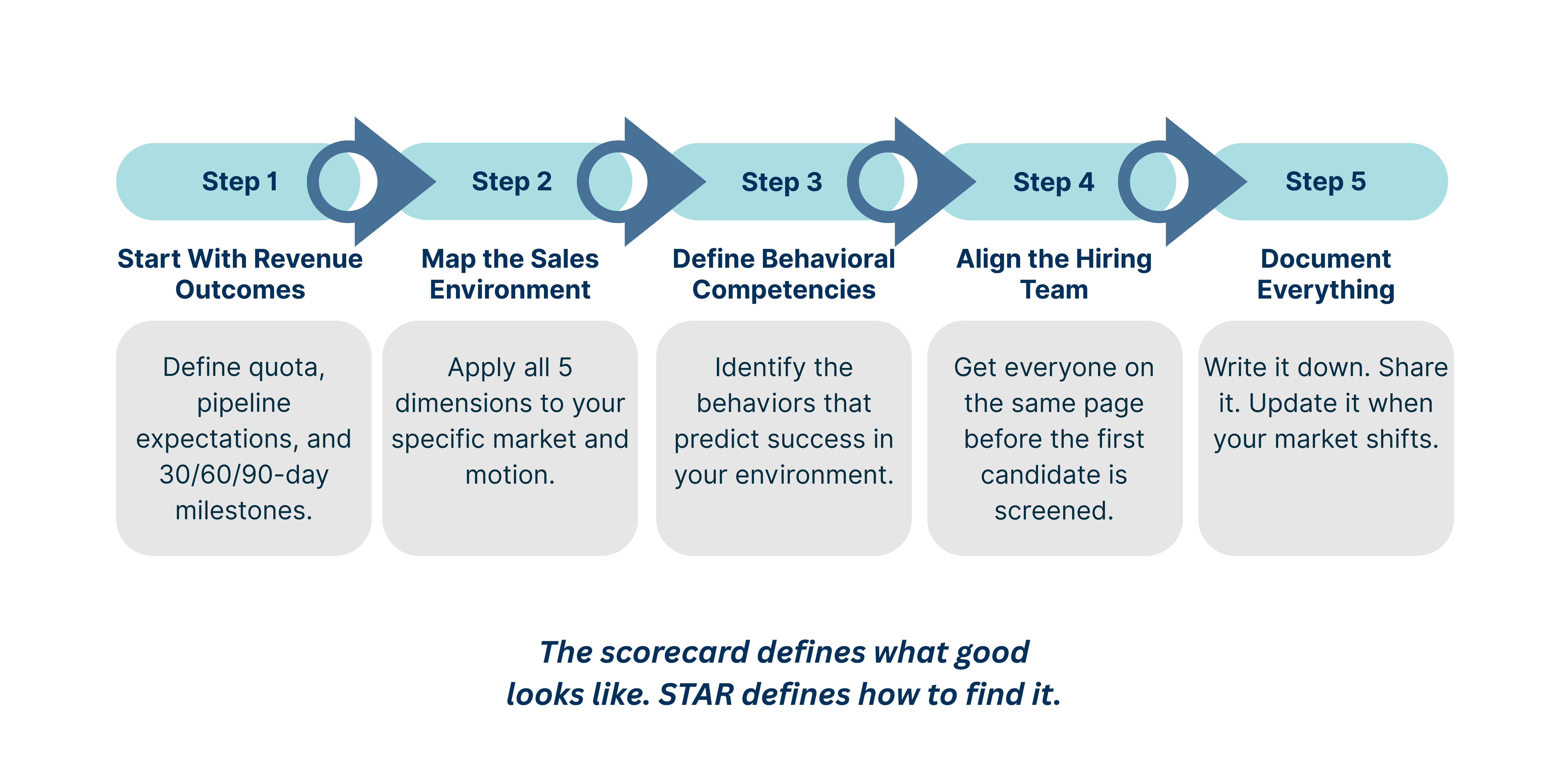
How to Build a Sales Job Scorecard: Step-by-Step
Step 1: Define Revenue Outcomes First
What is the quota for this role? What pipeline coverage do they need to maintain? What does "on track" look like at 30, 60, and 90 days? This is where hiring becomes strategic, when you define the revenue impact you need.
Step 2: Map the Sales Environment
Use the 5 dimensions:
- Who they call on
- AOV range
- Sales cycle length
- Stakeholder complexity
- Technical depth required
Step 3: Define Behavioral Competencies
What behaviors predict success in your specific environment? Resilience under quota pressure, ability to navigate complex stakeholder environments, self-directed pipeline management, and coachability. These competencies inform challenge-based interview questions in STAR.
Step 4: Align the Hiring Team
Before posting the role, walk through the scorecard with everyone involved in hiring. Ensure shared understanding of "what good looks like." Define what each interviewer will evaluate. Build consistency across the STAR stages.
The STAR framework provides structure. The scorecard provides direction. You need both.
Step 5: Document Everything
Put it in writing, not just in your head. Share it with recruiters, interviewers, and the hiring manager. Update it when you learn something new.

Why Role Clarity Reduces Hiring Cost and Improves Ramp
Creating clear scorecards improves your sourcing precision, which means you find better candidates faster. They improve screening accuracy so you filter more effectively. They improve interview consistency so you evaluate fairly. And they improve onboarding alignment where expectations are clear from day one.
When everyone knows what "good" looks like, you reduce time-to-hire. When expectations are clear, you reduce early turnover. When ramp is defined, new hires reach productivity faster.
Frequently Asked Questions
What is a sales job scorecard?
A sales job scorecard is a document that defines what success looks like in a specific sales role before you start hiring. Unlike a job description that lists responsibilities, a scorecard defines measurable criteria: who the rep calls on, average deal size, sales cycle length, stakeholder complexity, technical depth required, and clear success metrics for the first 30, 60, and 90 days. It's the foundation for consistent, effective hiring decisions.
How is a job scorecard different from a job description?
A job description lists tasks and responsibilities. A job scorecard defines success criteria and environmental context. Job descriptions tend to be generic and recycled. Scorecards are specific to your market, product, and sales motion. A job description says "manage a sales pipeline." A scorecard says "maintain 3x pipeline coverage on deals averaging $75K with 90-day sales cycles involving 4-6 stakeholders." Scorecards drive better sourcing, screening, and interviewing.
Why do most sales hiring failures start with unclear role definition?
When role definition is vague, every downstream hiring decision becomes subjective. Sourcing criteria are broad, screening is inconsistent, interviewers test different things, and onboarding expectations shift. The new hire thinks they were hired for one role while the manager expected something different. This mismatch creates the "strong resume, weak performance" pattern that costs organizations 3-5x the person's salary. Clarity eliminates this mismatch before it becomes expensive.
How does a sales job scorecard connect to the STAR Hiring methodology?
The scorecard defines the criteria. STAR defines how to apply them across sourcing, screening, interviewing, and onboarding. STAR provides the process structure—how to evaluate. The scorecard provides the evaluation criteria—what to look for. Without a scorecard, STAR interviews become inconsistent because each interviewer applies different standards. With a scorecard, STAR becomes a precision instrument for revealing whether candidates match your specific requirements.
How often should I update my sales job scorecard?
Review your scorecard whenever your market, product, or go-to-market motion changes. At minimum, review it every 6-12 months. If your ICP shifts, your average deal size changes, or your sales cycle lengthens, update the scorecard immediately. Don't reuse last year's definition by default. Markets evolve. Your hiring criteria should evolve with them. An outdated scorecard leads to hiring for yesterday's role, not today's reality.
What are the biggest mistakes companies make when defining sales roles?
The three biggest mistakes: being too vague ("we need a hunter"), copying last year's job description without updates, and failing to align the hiring team on what "good" looks like. These create mismatched expectations, inconsistent interviews, and expensive mis-hires. The fix: build a detailed scorecard before posting the role, get explicit agreement from everyone involved in hiring, and document everything so criteria don't drift during the process.

Strategy Without Clarity Is Just Intent Without Definition
In 2025, we framed sales hiring as a growth strategy. In 2026, the conversation evolves; if hiring is strategic, clarity must come first.
Hiring failures that appear in interviews and onboarding actually start much earlier, in the role definition phase. You cannot evaluate what you have not defined. The best framework, the best interviews, the best onboarding; none of it compensates for an unclear scorecard.
These are the signals measured in the Clarity section of the Sales Hiring Diagnostic. Before you post another sales role, score your clarity. Most leaders assume their role definitions are clear. The diagnostic usually reveals something different.





The True Cost of a Bad Sales Hire in 2026 (and How to Stop Repeating It)
You've done this before. You've invested months recruiting, weeks interviewing, and six figures onboarding a sales rep ...
Ready to Build a High-Performing Sales Team?
Let's create your custom Sales Transformation Program.